


In early 2025, AI visibility was an experimental add-on that a handful of forward-thinking agencies offered to clients who asked about it. By mid-2026, it has become one of the most consistently requested new services in the digital marketing agency space - and one of the most defensible recurring revenue streams available to agencies that move quickly.
$10K per month in AI visibility retainer revenue requires 5-10 clients at the right price points. That is an achievable goal for a typical agency within 6-12 months of launching the service line. Here is the framework for getting there: the service structure, the pricing, the client acquisition approach, and the operational setup that makes it sustainable.
Why AI Visibility Retainers Are a Particularly Good Revenue Stream
Before the framework, the strategic case. AI visibility retainers have structural advantages over other agency service lines:
Measurement-based value: Citation rate tracking gives you objective data showing whether your work is producing results. Clients who see their citation rates rising on a monthly dashboard have a concrete reason to continue the engagement - the evidence is not anecdotal.
Recurring measurement requirement: AI citation rates change continuously. There is no point at which a client has "finished" improving their AI visibility - the competitive landscape shifts, AI engine algorithms update, and new competitors enter the picture. This creates natural long-term retention.
Limited internal capability at clients: Most marketing teams do not have AEO expertise in-house, and building it is slow. This keeps the agency relationship valuable even as clients become more knowledgeable about the space.
High urgency for early movers: Clients who understand AI search know that being visible now, while competitors are still ignoring it, creates compounding advantage. This shortens the sales cycle relative to other agency services.
Relatively low tooling cost: The incremental cost of adding an AI visibility client (primarily AI Rank Lab's per-domain tracking cost) is low relative to the retainer value, making the service margin-positive from client one.
The Service Structure
AI visibility retainers work best when the service is defined around three pillars: measurement, optimisation, and reporting. Clients need to understand what they are paying for each month.
Pillar 1: Measurement
Weekly automated citation rate tracking across ChatGPT, Gemini, Perplexity, and Claude for the client's target keyword set. Competitive benchmarking against 3-5 identified competitors. Monthly trend analysis showing citation rate movement against baseline. This is the evidence layer - the data that proves visibility is changing.
Pillar 2: Optimisation
Monthly optimisation work based on audit findings and citation rate data. This includes schema markup implementation and maintenance, content structure improvements for AEO-targeted queries, technical access review (robots.txt, crawlability), and new content creation for query gaps. The optimisation scope defines the retainer tier.
Pillar 3: Reporting
Monthly client report covering: citation rate by engine versus baseline, competitive position, optimisation actions taken and their effects, and next-month priorities. Quarterly strategic review sessions to assess overall AI visibility trajectory and adjust strategy.
Retainer Pricing Structure
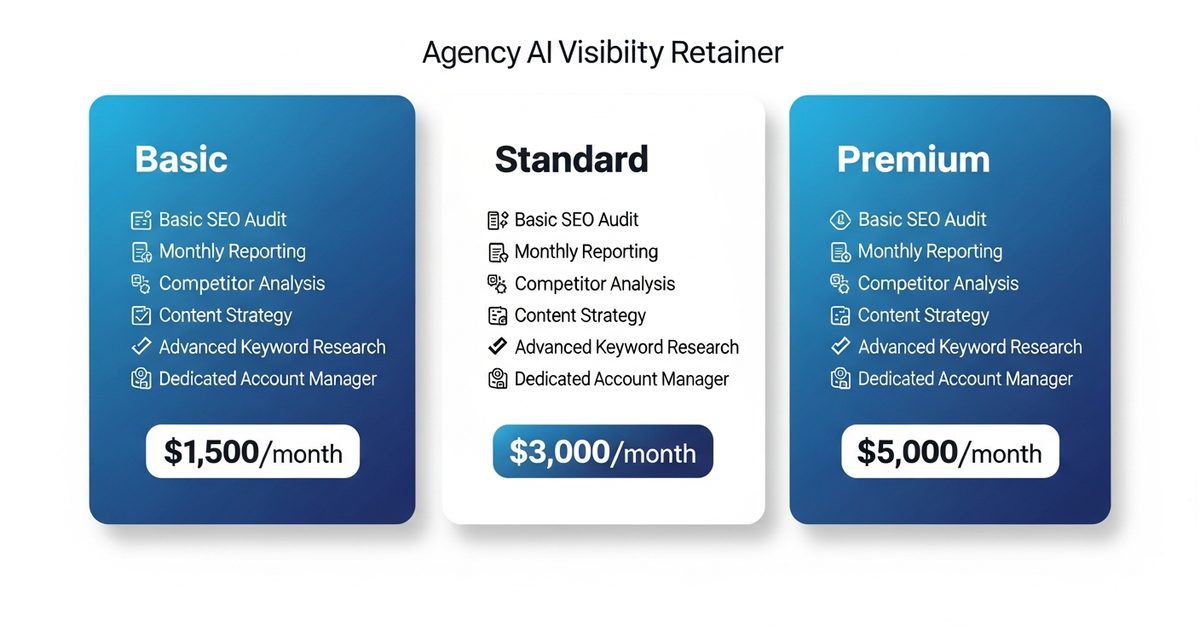
Three tiers covers most of the market. The specific prices below are starting points - adjust for your market, client size, and competitive environment.
Starter - $1,500/month
Designed for small businesses and single-brand clients with limited existing digital presence.
Citation tracking for 10-15 keywords across all four AI engines
3 competitors benchmarked
Schema markup implementation (FAQPage, Article, Organization)
Monthly report with citation rate trends
1 hour strategy call per month
No content creation included (client creates, agency optimises structure)
Growth - $3,000/month
Designed for established businesses with existing content infrastructure and competitive categories.
Citation tracking for 25-40 keywords across all four AI engines
5 competitors benchmarked
Full schema audit and implementation
2 AEO-optimised content pieces per month
Monthly report with citation rate trends and competitive analysis
2 hours strategy call per month
Quarterly full AI search audit
Agency/Enterprise - $5,000+/month
Designed for competitive categories, multi-brand clients, or businesses where AI visibility is a primary growth lever.
Citation tracking for 50+ keywords across all four AI engines
8-10 competitors benchmarked
Comprehensive schema implementation and maintenance
4+ AEO-optimised content pieces per month
White-label monthly reports
Monthly strategy session plus on-demand consultation
Annual AI search audit with competitor deep-dive
The path to $10K/month: 7 Starter clients, or 3-4 Growth clients, or 2 Enterprise clients, or any combination. Most agencies building toward $10K will have a mixed portfolio.
How to Acquire the First Five Clients
The first five clients are the hardest and the most important. They provide the case study data that makes every subsequent pitch easier.
Start with your existing client roster
Run baseline AI visibility checks for 3-5 existing clients before pitching them anything. Show up to a quarterly review with a slide showing their current ChatGPT, Gemini, Perplexity, and Claude citation rates for their top category queries - and the citation rates of their main competitors. For most clients, this data will show a gap that creates immediate urgency. You are not pitching a theoretical service; you are showing them a real problem that you can solve.
Use the baseline as the cold outreach hook
For prospect outreach, run a baseline check on the prospect's AI visibility before making contact. Lead with the data: "I checked how often [Prospect Company] appears when potential customers ask ChatGPT about [their category]. The citation rate was X%. Their main competitor [name] is at Y%. I would like to show you what we can do about that." This approach has a significantly higher response rate than service description outreach because it is specific and immediately relevant.
Build in public
Publish case studies as you produce results. Even small citation rate improvements are publishable: "We increased a client's Perplexity citation rate from 12% to 47% in 60 days - here is what we changed." These posts attract inbound interest from agencies who want the service and from prospective clients who see themselves in the case study. LinkedIn is the most effective distribution channel for this content in 2026.
Partner with complementary agencies
SEO agencies, content agencies, and PR agencies all have clients who need AI visibility services and none of them offer it. White-label your AI visibility service to these agencies or establish referral partnerships. A referral fee of 15-20% of retainer value is standard. A single partnership with a mid-size SEO agency can generate 2-3 referrals per quarter.
The Operational Setup for a $10K/Month Practice
At $10K per month in retainer revenue, the operational requirements are:
One AI visibility tool account: AI Rank Lab's agency tier handles multi-client citation tracking and reporting at a fixed monthly cost, regardless of how many clients are on the roster. This is the core tooling cost.
One designated AEO specialist: At 7-10 clients, you need one team member spending 60-70% of their time on AI visibility work. This person owns the methodology, monitors citation data weekly, and drives optimisation implementation.
Standard reporting template: A monthly report template that can be populated from dashboard data in 1-2 hours per client. Reports longer than this are not providing proportionate value for the time invested.
Client onboarding playbook: A repeatable 30-day onboarding process: week 1 (keyword mapping and baseline measurement), week 2 (technical audit and schema inventory), week 3 (priority implementation), week 4 (first monthly report setup). Consistent onboarding quality is what makes scaling possible without declining service quality.
Retention: Why Clients Stay and Why They Leave
Retention in AI visibility retainers follows a clear pattern. Clients stay when they see measurable citation rate improvement and understand the connection between that improvement and business outcomes. Clients leave when citation rates are not improving or when they cannot see the link between the work being done and the metrics moving.
The risk of losing clients is highest at months 3-4, before enough optimisation work has been implemented to show meaningful citation rate movement. Manage this risk by:
Setting explicit expectations at onboarding: citation rate improvements typically become measurable at 60-90 days, not 30
Delivering early wins where possible - schema markup implementation is fast and can show measurable improvement within the first reporting cycle
Keeping clients informed of implementation progress even when citation rates have not yet moved - the work being done is visible even before results appear in the data
Using competitive benchmarking proactively - if the client's citation rate has not improved but a competitor's has increased, that is context for the data that motivates continued investment
The $10K/Month Timeline
A realistic timeline for an agency starting from zero:
Month 1: Tool setup, methodology development, run baseline checks for 5 existing clients, first 1-2 client conversations
Month 2-3: First 2-3 paying clients onboarded, first results data being collected, case study material in progress
Month 4-6: First case study published, active outreach to prospects using baseline data hook, referral partnerships established
Month 6-9: 5-7 clients on retainer, first case study generating inbound, team specialist capacity at 50-60% utilisation
Month 9-12: 7-10 clients on retainer, $10K/month run rate achieved, service line systematised enough to train additional team members
The Window Is Open - For Now
The competitive advantage of launching an AI visibility service in 2026 rather than 2027 is real. Most agencies are still watching the space rather than building in it. The clients who are most urgently looking for AI visibility help - those who have already heard about citation rates and know they are behind - are currently finding the agencies that have already built the capability. Every month of delay is a month of case studies, client relationships, and referral momentum not being built.
The tooling is available. The client demand is growing. The methodology is documented. The path from zero to $10K/month in AI visibility retainers is clearly mapped. Start with the baseline check. Run a free AI visibility baseline on your best-fit prospect, show them what you find, and the conversation starts itself.
Frequently Asked Questions
How much should agencies charge for AI visibility retainers?▾
How long does it take to see results from AI visibility retainers?▾
What tools does an agency need to run AI visibility retainers?▾
How do you prove ROI on AI visibility retainers to clients?▾
Can agencies white-label AI visibility services?▾
Get a Free AI Ranking Consultation
Want to improve your brand's visibility in AI search engines like ChatGPT, Gemini, and Perplexity? Fill out the form and our experts will create a personalized strategy for you.

Written by
Devanshu
Chief Marketing Officer & AI Search Optimization Architect
Digital Marketing Strategist & Pioneer in SEO, Answer Engine Optimization (AEO), and Generative Engine Optimization (GEO).


