


Why Schema Markup Is the Bridge Between Your Content and AI Citations
Structured data - specifically JSON-LD schema markup - is one of the clearest signals AI engines use to extract precise answers from your content. When ChatGPT, Perplexity, or Google's AI Overviews look for a direct answer to a user question, they prefer content that tells them explicitly: here is a question, here is the answer, here is who answered it, and here is when. That is exactly what well-structured JSON-LD schema communicates.
Without schema, AI engines have to guess. They scrape your page, interpret your content structure, and make probabilistic decisions about what constitutes a direct answer. With schema, you eliminate that guesswork and make your content the path of least resistance for AI citation. The difference in citation rate between schemaed and non-schemaed content in the same topic category is measurable and significant.
This guide explains which schema types matter most for AI search in 2026, how to implement them correctly, and how to use AI Rank Lab's free schema generator to build valid JSON-LD for your pages in minutes without writing code.
The 5 Schema Types That Drive AI Citations
1. FAQPage Schema
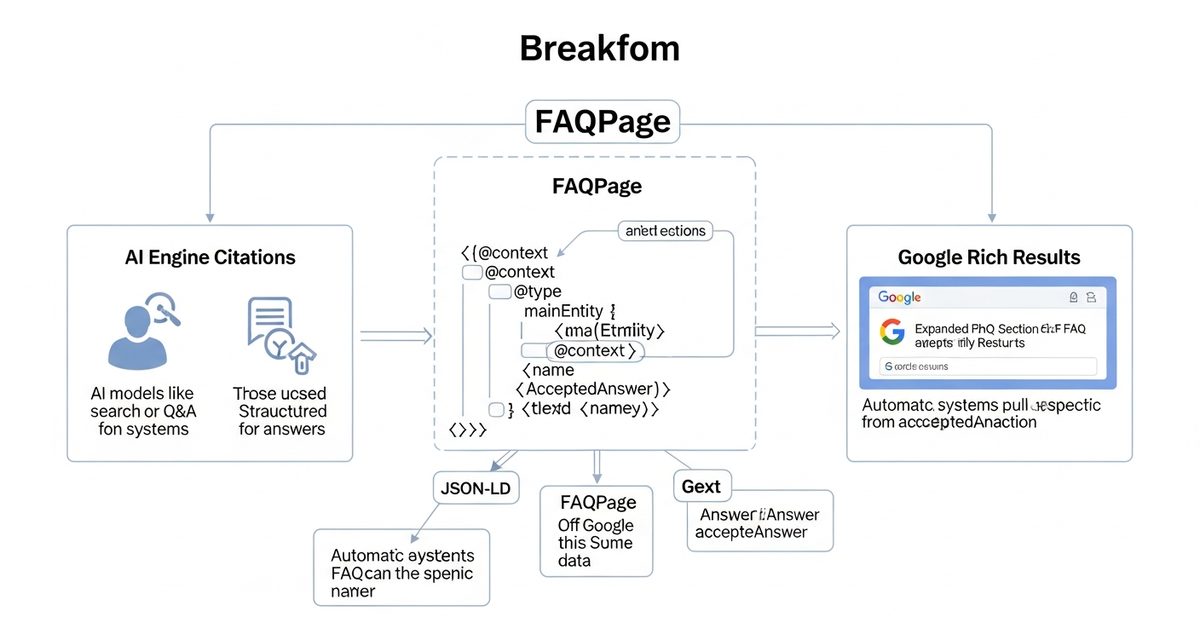
FAQPage is the highest-impact schema type for AEO. It maps directly to the conversational, question-answer format that AI engines use for response generation. When your page has FAQPage schema, AI engines can confidently extract your Q&A pairs as direct answers to user queries - with your domain as the cited source.
FAQPage schema is appropriate for: blog posts with FAQ sections, product pages with common questions, help documentation, landing pages with objection-handling Q&A, and any content that directly answers user questions. The threshold is low - if your page answers two or more questions, FAQPage schema is worth implementing.
Example structure (abbreviated):
{
  "@context": "https://schema.org",
  "@type": "FAQPage",
  "mainEntity": [
    {
      "@type": "Question",
      "name": "What is answer engine optimization?",
      "acceptedAnswer": {
        "@type": "Answer",
        "text": "Answer engine optimization (AEO) is the practice of..."
      }
    }
  ]
}
2. HowTo Schema
HowTo schema is FAQPage's counterpart for instructional content. It structures step-by-step guides in a way that AI engines can extract as direct procedural answers. When a user asks ChatGPT "how do I set up Google Search Console," a page with properly structured HowTo schema has a clear advantage over a page with the same information in unstructured prose.
HowTo schema is appropriate for: tutorials, setup guides, recipes (use Recipe schema instead), processes, and any instructional content with discrete steps. The key requirement is that the steps must be meaningfully distinct - do not use HowTo schema for a single paragraph split into artificial steps.
3. Article Schema
Article schema adds crucial citation signals to blog posts and editorial content: author name, author credentials, publication date, and modification date. These E-E-A-T signals (Experience, Expertise, Authoritativeness, Trustworthiness) are increasingly important to AI engines when selecting which sources to cite. A page with Article schema that includes a credentialed author is more citable than an identical page with no attribution.
Key fields for AI citation: author.name, author.url (linking to an author bio page), datePublished, dateModified, and publisher.name. The dateModified field is particularly important - AI engines prefer recently updated content for time-sensitive topics.
4. Product Schema
For e-commerce and SaaS product pages, Product schema enables AI engines to accurately describe your offerings in their responses. A well-structured Product schema includes name, description, price, availability, and review aggregate - giving AI engines the data they need to mention your product accurately when users ask for recommendations.
Product schema is also the foundation for AI shopping features. As ChatGPT and Perplexity expand into purchase-intent queries, Product schema positions your items to appear in AI-assisted shopping responses.
5. BreadcrumbList Schema
BreadcrumbList schema helps AI engines understand your site's content hierarchy and topic authority. A page with breadcrumb schema signals: this page belongs to this category, which belongs to this parent topic. AI engines use topical hierarchy as a trust signal when selecting citable sources - pages that are clearly part of a coherent topical cluster on an authoritative domain are more likely to be cited.
How to Use the Free AI Schema Generator
AI Rank Lab's schema generator tool builds any of these schema types through a guided form interface - no JSON knowledge required. Here is the workflow:
Step 1: Select your schema type
Choose from FAQPage, HowTo, Article, Product, BreadcrumbList, LocalBusiness, Event, or Recipe. The form fields update to match the selected type.
Step 2: Fill in the form fields
For FAQPage: enter each question and answer pair. For HowTo: enter the title, total time estimate, and each step. For Article: enter the headline, author details, dates, and publisher information. The generator validates as you type and flags required fields.
Step 3: Copy the JSON-LD output
The generator produces a valid JSON-LD block. Copy it and paste it into the section of your page HTML, or add it through your CMS's custom code field, tag manager, or SEO plugin. Most WordPress and Webflow sites have a designated schema field in their SEO plugins (Yoast, RankMath).
Step 4: Validate and verify
After publishing, run your page through Google's Rich Results Test to confirm the schema is valid and readable. Then use AI Rank Lab's full audit tool to check whether the schema is correctly detected and whether it aligns with your page's content (schema that does not match visible page content is flagged as misleading and can hurt rather than help).
Schema Implementation: Common Errors to Avoid
Error 1: Schema does not match visible content
The most penalized schema mistake. If your FAQPage schema includes a Q&A pair that does not appear visibly on the page, Google and AI engines treat it as deceptive markup. Every question-answer pair in your schema must be readable on the page without clicking, expanding, or being a member. Hidden content behind "show more" accordions is acceptable as long as the content is in the DOM.
Error 2: Generic answers that do not answer the question
AI engines evaluate answer quality, not just schema validity. A FAQPage schema with vague answers like "It depends on your situation" or "Please contact us for more information" will not drive citations because the answer is not extractable as a direct response. Write answers that directly address the question in 40-200 words.
Error 3: Missing author data in Article schema
Article schema without author information is a wasted opportunity. The author fields are how you build E-E-A-T signals into your structured data. At minimum, include the author's name and a link to their profile page. Ideally, include a Person sub-schema with credentials, social profiles, and notable works.
Error 4: Stale dateModified values
If you update article content but forget to update the dateModified field in your Article schema, AI engines will treat the content as old even if it is current. Keep dateModified synchronized with actual content updates. Many CMS integrations handle this automatically.
Error 5: Implementing schema on non-matching pages
Product schema on a blog post, or HowTo schema on a brand story page, is schema that does not match content. This creates confusion for AI engines and can trigger quality penalties. Use schema types that accurately describe the page content type.
Prioritizing Which Pages Get Schema First
If you have a large site and cannot implement schema everywhere at once, prioritize in this order:
- High-traffic informational pages that answer specific questions - these have the highest citation potential
- Product/service pages that are the primary landing pages for commercial queries
- How-to guides and tutorials that walk through processes step by step
- Category and pillar pages with BreadcrumbList schema for topical hierarchy signals
- All blog posts with Article schema for E-E-A-T attribution
AI Rank Lab's audit identifies which of your pages are missing schema and prioritizes them by traffic and topic relevance - so you can focus implementation effort where it will have the most impact on AI citations. Run an audit first at the SEO + AEO + GEO Audit Tool, then use the schema generator for the prioritized list.
Schema and the Broader AEO Picture
Schema is one of the most powerful AEO signals, but it works best as part of a complete strategy. Schema tells AI engines what kind of content you have and gives them structured data to extract. But they also need:
- Bot access - the AI crawler needs to be allowed in your robots.txt to read the schema
- Content quality - schema on thin or low-quality content does not drive citations
- Domain authority - AI engines favor citable sources that other credible sites link to
- llms.txt - the schema generator on AI Rank Lab works alongside the broader tools suite including llms.txt generation
The AI Rank Lab audit checks all of these signals together and shows you the combined picture of your AI citation readiness - schema coverage is just one dimension of the full AEO audit.
Conclusion
JSON-LD schema markup is the most direct technical action you can take to improve AI engine citation rates. It converts your content from something AI engines have to interpret into something they can extract with confidence. FAQPage schema alone, implemented on your best informational pages, can meaningfully improve how often AI engines cite your domain for relevant queries.
Use AI Rank Lab's free schema generator to build valid JSON-LD for any page in minutes. Then run the full audit to see which pages have schema gaps and where the highest-impact implementation opportunities are. The combination of the generator and the audit gives you a complete schema implementation workflow without needing a developer for the basic cases.
Frequently Asked Questions
What is the best schema type for AI engine citations?▾
How do I generate JSON-LD schema markup without coding?▾
Does schema markup directly improve Google rankings?▾
What is the difference between schema for SEO and schema for AEO?▾
How do I check if my schema is working correctly?▾
Get a Free AI Ranking Consultation
Want to improve your brand's visibility in AI search engines like ChatGPT, Gemini, and Perplexity? Fill out the form and our experts will create a personalized strategy for you.

Written by
Devanshu
Chief Marketing Officer & AI Search Optimization Architect
Digital Marketing Strategist & Pioneer in SEO, Answer Engine Optimization (AEO), and Generative Engine Optimization (GEO).


