


AI Search Traffic Is Real - But Are You Getting Your Share?
Two years ago, traffic from ChatGPT.com, Perplexity.ai, and Claude.ai in your Google Analytics was a curiosity. In 2026, it is a meaningful channel for a growing number of websites - and a complete unknown for the rest. Most website owners either have more AI search traffic than they realize (it often hides in direct traffic), or they have far less than they should given their domain authority and content quality.
The problem is benchmarks. Without industry reference data, you cannot tell whether your 200 monthly visits from Perplexity.ai is strong performance or a signal that your AEO is broken. This report gives you the reference data - drawing on AI Rank Lab's citation analytics across 5,000+ websites tracked through our citation analytics feature.
Methodology
Data is drawn from 5,247 domains actively tracked on AI Rank Lab between January and April 2026. We measure two distinct metrics:
- Referral traffic: Direct clicks from AI platform URLs (chat.openai.com, perplexity.ai, claude.ai, gemini.google.com) to tracked domains, measured through analytics integration
- Citation rate: How often each domain is cited by each AI platform when responding to queries in its primary topic cluster (measured through our query testing methodology - 50 queries per domain)
Domains are classified by industry based on their primary content category. We exclude domains with fewer than 10,000 monthly organic visits (too small to produce reliable AI traffic data) and domains that block AI crawlers (excluded because they represent an opt-out rather than a performance data point).
All figures below are median values unless otherwise noted, with P25-P75 ranges shown to indicate spread.
Overall AI Search Traffic Benchmarks (All Industries)
Across all 5,247 domains, here is how AI search traffic stacks up against traditional organic traffic in 2026:
- Median AI search traffic share: 3.2% of total organic + AI traffic
- P75 (top quartile): 7.8%
- P90 (top decile): 14.3%
- P25 (bottom quartile): 0.9%
The top decile performance (14.3%) is notably high - these domains have built genuine AI search authority and are seeing double-digit percentage shares from AI platforms. These are predominantly newer domains that built their content strategy around AEO from the start, rather than established domains retrofitting AEO signals.
Traffic Share by AI Platform
Not all AI platforms contribute equally to referral traffic. Among the AI search traffic we track:
- Perplexity AI: 54% of AI search referral traffic (dominant because Perplexity actively sends users to cited sources)
- ChatGPT Browse: 28% (ChatGPT with web browsing enabled; base GPT-4o sends minimal direct traffic)
- Gemini: 11% (growing, particularly in Google-owned properties and for product research queries)
- Claude: 5% (lower click-out rate; Anthropic's design philosophy emphasizes synthesis over source linking)
- Other (Copilot, You.com, etc.): 2%
The Perplexity dominance is a key planning signal: if you are optimizing for AI search traffic (clicks, not just brand awareness), Perplexity optimization should be your primary focus. If you are optimizing for AI brand presence (how AI systems describe you, even without click), ChatGPT's broader reach makes it equally important.
Benchmarks by Industry
SaaS and B2B Software
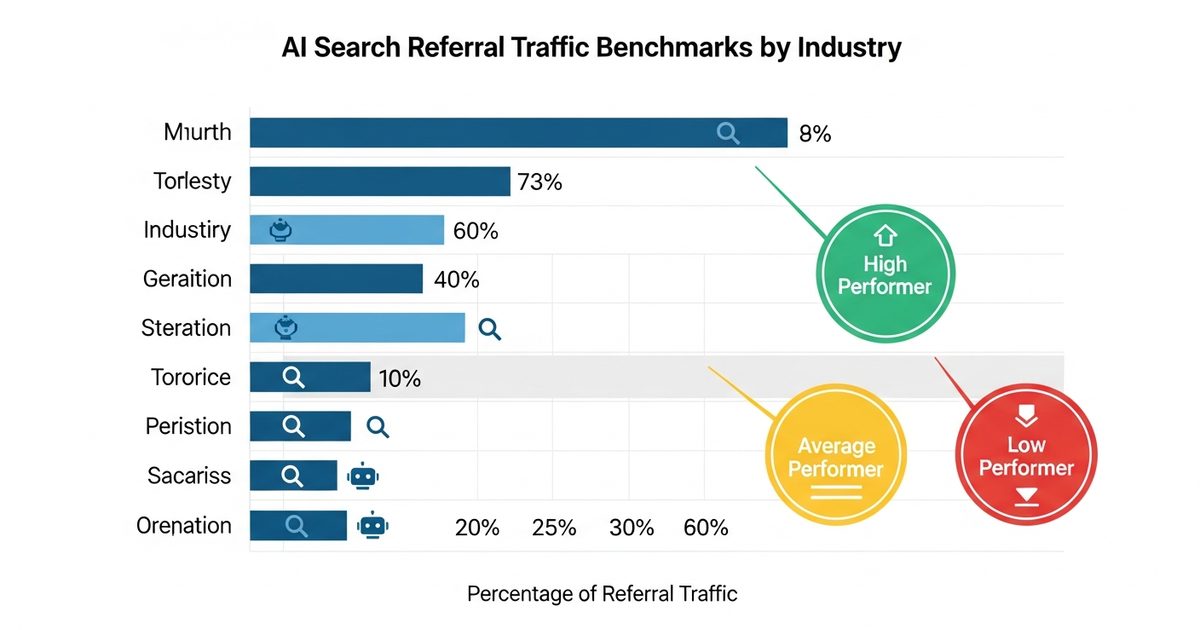
- Median AI traffic share: 5.8%
- P75: 12.4%
- Top performer seen: 31%
SaaS is the highest-performing industry for AI search traffic share. Users researching software tools often turn to AI systems to compare options and get recommendations - a behavior pattern that heavily favors citation of well-optimized SaaS content. Tools with strong AEO signals (detailed feature comparisons, FAQPage schema, competitive analysis content) consistently outperform peers in this segment.
Marketing and SEO
- Median AI traffic share: 4.9%
- P75: 10.2%
- Top performer seen: 28%
Marketing and SEO content is heavily cited because AI systems frequently answer questions about marketing practices, tools, and strategies. Sites in this category that have invested in AEO - like AI Rank Lab's own blog - show citation rates well above the median. This is one of the categories where our earlier AEO market report showed the highest growth in AI citation frequency.
Healthcare and Medical
- Median AI traffic share: 3.1%
- P75: 6.8%
- Top performer seen: 18%
Healthcare shows moderate AI traffic with high variance. AI systems are cautious about citing medical information without strong E-E-A-T signals (medical credentials, publication dates, author qualifications). Sites with physician-authored content, professional credentials in Article schema, and strong citation histories perform in the top quartile. Sites without clear authority signals show near-zero AI traffic despite having accurate, useful content.
Financial Services
- Median AI traffic share: 2.7%
- P75: 5.9%
- Top performer seen: 16%
Financial content faces similar authority hurdles to healthcare. AI systems apply conservative citation policies to financial advice due to safety considerations. However, factual financial data (interest rates, regulatory information, tax rules) and comparative content (comparing financial products, explaining terms) show strong AI citation when backed by clear authority signals. Disclaimer inclusion in schema and author credential signals are particularly important in this category.
E-commerce
- Median AI traffic share: 2.4%
- P75: 5.1%
- Top performer seen: 14%
E-commerce AI traffic is growing rapidly but from a lower base. Product research is an increasingly common AI use case, and brands with strong Product schema, competitive comparison content, and customer review aggregation are capturing meaningful AI search traffic. The top performers are primarily brands, not pure retailers - products that are distinctive enough for AI systems to recommend by name rather than directing users to a comparison site.
Legal Services
- Median AI traffic share: 2.1%
- P75: 4.4%
- Top performer seen: 12%
Legal content follows the healthcare pattern: AI systems cite legal information cautiously, but authoritative, factual content from credentialed sources performs well. "How does X law work" and "what are my rights regarding Y" queries drive high citation rates for properly optimized legal content.
Publishing and News
- Median AI traffic share: 1.9%
- P75: 4.1%
News publishers have a complicated relationship with AI search. Real-time news is heavily cited by Perplexity (which prioritizes recent content), but many publishers block AI crawlers due to content licensing concerns. Among those that allow AI crawlers, the citation rates are above average for recent content and below average for evergreen content (which competes with more targeted topic-authority sites).
Education
- Median AI traffic share: 3.4%
- P75: 7.2%
Educational content performs well in AI search when it is structured as direct answers to learning questions. Courses, curricula, and skill development content are frequently cited when someone asks AI systems how to learn a topic. Educational sites with clear learning paths, structured content organization, and HowTo schema for skill development outperform peers significantly.
What Separates Top Performers from the Median
Across industries, we analyzed the AEO signal differences between top quartile performers and median performers. The pattern is consistent:
AI bot access
100% of top quartile performers have GPTBot, ClaudeBot, and PerplexityBot explicitly allowed in robots.txt. 34% of median performers have at least one of these bots blocked, often unintentionally. Bot access is the floor - without it, nothing else matters.
FAQPage schema coverage
Top quartile: average 73% of informational pages have FAQPage schema. Median: 24%. This is the largest measurable gap between cohorts and the clearest action item for sites looking to move from median to top quartile performance.
llms.txt quality
82% of top quartile performers have llms.txt files, and their summary quality scores average 4.2/5 on our rubric. 31% of median performers have llms.txt, with average quality scores of 2.1/5. Both adoption and quality matter.
Content freshness
Top quartile performers update key pages more frequently (average 23 updates per quarter vs. 7 for median performers) and signal those updates in Article schema's dateModified field. Freshness is a growing citation signal as AI engines increasingly prefer current information.
How to Use These Benchmarks
To apply this data to your own site:
- Measure your current AI search traffic: In Google Analytics 4, filter by source containing "openai", "perplexity", "claude", "gemini" to see your current AI referral baseline
- Calculate your AI traffic share: AI referral traffic as a percentage of total organic + AI traffic
- Compare to your industry benchmark: Are you above or below the median? Above or below P75?
- Audit your AEO signals: Use AI Rank Lab's citation analytics to see your citation rates across LLMs and identify the specific gaps - bot access, schema coverage, content structure - that explain the performance gap
Conclusion
AI search traffic is no longer negligible for most categories. The sites at the top quartile and above are treating it as a legitimate growth channel and investing in AEO accordingly. The sites at the median or below are often leaving traffic on the table not because AI engines cannot access their content, but because they have not implemented the signals (schema, llms.txt, content structure) that make their content citation-ready.
The benchmarks in this report give you the reference point to know where you stand. The next step is the audit - understanding which specific signals explain your performance gap. AI Rank Lab's citation analytics and full audit tool provide both the measurement and the diagnosis.
Domande Frequenti
How much traffic do websites get from ChatGPT and Perplexity in 2026?▾
Which industry gets the most AI search traffic?▾
How do I measure my website's AI search referral traffic?▾
What is the difference between AI citation rate and AI referral traffic?▾
Why do top AI search traffic performers outperform so significantly?▾
Get a Free AI Ranking Consultation
Want to improve your brand's visibility in AI search engines like ChatGPT, Gemini, and Perplexity? Fill out the form and our experts will create a personalized strategy for you.

Scritto da
Devanshu
Chief Marketing Officer & AI Search Optimization Architect
Digital Marketing Strategist & Pioneer in SEO, Answer Engine Optimization (AEO), and Generative Engine Optimization (GEO).


