


In 2026, patients routinely ask ChatGPT what a drug does, whether it interacts with other medications, what side effects to expect, and which treatment option is recommended for a specific condition. The answers ChatGPT generates draw from its training data and, in browsing-enabled versions, from current web content - not from official prescribing information, regulatory filings, or your brand's approved communications.
This creates a monitoring and risk management challenge that most pharmaceutical marketing and regulatory teams have not yet addressed systematically: AI engines are citing your drugs and your brand in responses that millions of patients read before conversations with their physicians, and most pharma companies have no process for tracking what those responses say.
This guide covers what pharmaceutical teams need to monitor in AI search, the risk categories to track, and how to build a systematic AI citation monitoring workflow. Note that any decisions about regulatory compliance responses should involve your legal and regulatory affairs teams - this guide focuses on the monitoring and visibility layer, not on legal strategy.
Why AI Drug Citations Are a New Category of Risk
Pharmaceutical brands have long monitored what gets said about their drugs online - adverse event reports from social media, off-label promotion risks, competitive intelligence. AI citations introduce a new category that differs from traditional digital monitoring in several important ways:
AI answers are presented as definitive. When a patient reads a Google result, they can see it is one source among many and assess the credibility of the URL. When ChatGPT generates an answer, it is presented as a synthesised, confident response - making inaccurate information harder for patients to identify as potentially incomplete.
Citations happen at scale. A misstated drug interaction or incorrectly described contraindication does not appear once - it appears in every ChatGPT response generated by the same underlying model for the same category of query, to every user who asks.
The source of misinformation is hard to trace and fix. If ChatGPT gives incorrect information about a drug, the source is typically training data from multiple web sources - not a single article you can request a correction on. Addressing the underlying information quality requires a different approach than traditional media correction workflows.
Competitor drugs can be cited instead of yours. When a patient asks ChatGPT about treatment options for a condition your drug treats, your brand may be absent while competitor brands are prominently cited - regardless of your relative market position or the clinical evidence base.
The Three AI Citation Scenarios That Require Monitoring
Scenario 1: Your Drug Is Cited with Incomplete or Incorrect Information
ChatGPT may cite your brand name while describing it in ways that are incomplete, outdated, or inconsistent with current prescribing information. Common examples include: citing an older indication that has since been expanded, omitting important contraindications, stating incorrect dosing ranges, or describing a mechanism of action inaccurately. From a patient experience standpoint, incomplete information can be as problematic as incorrect information.
Scenario 2: Your Drug Is Absent When It Should Be Cited
When a patient asks about treatment options for a condition your drug is approved for, competitor drugs may be cited while yours is not mentioned - despite your brand having equivalent or superior clinical evidence. This is not primarily a compliance issue but a significant commercial and patient access concern. Patients who never encounter your drug name in their AI-assisted research may not raise it with their physician, and physicians may not volunteer it if the patient has not asked.
Scenario 3: Your Drug Is Cited in an Inappropriate Context
This is the highest regulatory-risk scenario: your drug being cited in a context that suggests an off-label use, that implies efficacy claims not supported by approval status, or that positions it for a patient population outside the approved indication. Even if your company did not create the content that led to this citation, the brand association creates a monitoring obligation.
Building Your Pharma AI Citation Monitoring Query List
Effective monitoring requires a structured query list that covers the full range of patient-facing questions about your drug category. For each drug or brand you are monitoring, build queries in these categories:
Disease-state queries
"What medications are used to treat [condition]?"
"What is the first-line treatment for [condition]?"
"What are the options for [condition] that does not respond to [existing treatment]?"
Brand-specific queries
"What is [brand name] used for?"
"What are the side effects of [brand name]?"
"How does [brand name] work?"
"Can I take [brand name] with [common co-medication]?"
Comparative queries
"[Brand name] vs [competitor brand] - what is the difference?"
"Is [brand name] better than [competitor]?"
"What alternatives are there to [brand name]?"
Start with 15-20 queries covering the most important disease-state and brand-specific questions. Expand coverage quarterly as you identify new query patterns that generate citations about your brands.
How to Monitor ChatGPT and Other AI Engines for Drug Citations
Monitoring should cover all major AI engines, as citation patterns differ significantly between platforms. A drug accurately represented in ChatGPT may be described differently in Perplexity, which draws from different web sources in real time.
Manual spot-checking (baseline assessment)
For an initial baseline assessment, run your query list manually in ChatGPT, Perplexity, Google Gemini, and Microsoft Copilot. For each response, record: is your brand cited? What specific claims are made about it? Are the claims consistent with current prescribing information? Are competitors cited instead? Document responses with screenshots and date-stamps for your records.
This manual process is sufficient for an initial assessment but is not scalable for ongoing monitoring across multiple drugs, multiple AI engines, and hundreds of queries.
Systematic monitoring with AI Rank Lab
AI Rank Lab's AI Visibility Tracker runs your query list across ChatGPT, Gemini, Claude, and Perplexity (plus Google AI Overviews and AI Mode) whenever you run it. For pharmaceutical monitoring use cases, this means: every run is stored, so citation rates are tracked over time (showing when your brand appears, in what context, and whether that changes after model updates), and you can compare runs to spot when citation patterns shift. Prompts you add to the Action Plan citation tracker are also re-checked automatically each week.
For pharmaceutical teams managing multiple brands, the ability to re-run the same systematic query set every week rather than querying each engine by hand is the difference between a one-time audit and a continuous monitoring program.
What to Do When AI Gets It Wrong
When monitoring reveals that an AI engine is citing your drug with incomplete or inaccurate information, the response options are limited but meaningful. This is not a situation where you can submit a correction request to ChatGPT and expect immediate change. The approaches that do have impact are:
Improve the quality and accessibility of authoritative source content
AI engines with browsing capability retrieve content from web sources. If the most accessible, well-structured, and comprehensive content about your drug's approved indications, mechanism of action, and safety profile is your own website - properly structured with schema markup, direct-answer formatting, and current information - it has a higher probability of being retrieved and cited correctly. Thin, hard-to-read, or outdated product information pages are less competitive than well-structured, comprehensive pages.
Ensure patient-facing content is structured for AI extraction
Patient-facing drug information pages - including official drug websites, patient support resources, and condition-specific content - should be optimised for AI crawlability: structured headings, FAQPage schema for common drug questions, and comprehensive coverage of the questions your query monitoring reveals patients are asking AI engines. For high-priority brands, this is a meaningful investment in citation quality.
Engage regulatory and legal counsel on escalation criteria
Define in advance which citation scenarios require escalation to regulatory affairs, legal, or medical affairs - and what the response workflow looks like for each. Scenarios that typically warrant escalation include: citations that imply off-label use, comparative efficacy claims not supported by approved labelling, or drug interaction information that could mislead patients about safety. Establishing these criteria before you need them prevents delay when a high-risk citation is identified.
Building a Pharma AI Monitoring Workflow
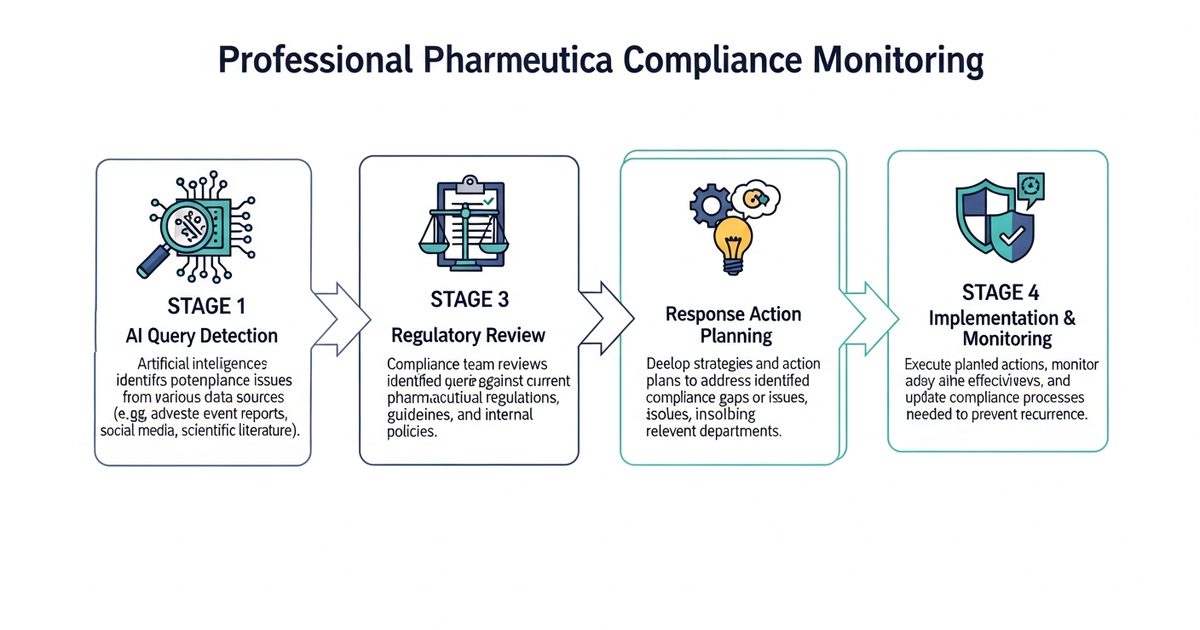
A sustainable pharmaceutical AI monitoring program has four components:
Query library - a maintained list of monitoring queries per brand, reviewed quarterly and updated as new patient query patterns emerge
Monitoring cadence - weekly tracking runs in AI Rank Lab for routine monitoring; manual deep-dives monthly or after major AI model updates (which often change citation patterns)
Documentation protocol - a standardised format for documenting AI citations: date, engine, query, full response screenshot, assessment of accuracy against approved labelling
Escalation criteria and response workflow - pre-defined thresholds for which citation types trigger which response actions, with clear ownership across regulatory, medical, legal, and digital teams
The goal is not to control what AI says - that is not achievable through direct intervention. The goal is to know what AI says about your brands, identify the highest-risk citations, and take the structural content and technical actions that improve citation quality over time.
For pharmaceutical teams building this capability from scratch, AI Rank Lab provides the monitoring infrastructure that makes ongoing tracking systematic rather than ad hoc. Run your first AI citation audit on your priority brand and see exactly what ChatGPT, Gemini, Claude, and Perplexity are saying about it today.
Frequently Asked Questions
Why do pharmaceutical companies need to monitor ChatGPT?▾
Can pharma companies control what ChatGPT says about their drugs?▾
Which AI engines should pharma teams monitor?▾
How often should pharmaceutical teams monitor AI citations?▾
What should pharma companies do if ChatGPT cites their drug incorrectly?▾
Get a Free AI Ranking Consultation
Want to improve your brand's visibility in AI search engines like ChatGPT, Gemini, and Perplexity? Fill out the form and our experts will create a personalized strategy for you.

Written by
Devanshu
Chief Marketing Officer & AI Search Optimization Architect
Digital Marketing Strategist & Pioneer in SEO, Answer Engine Optimization (AEO), and Generative Engine Optimization (GEO).


