


Here is a test that takes less than 60 seconds and tells you something your Google Analytics dashboard cannot.
Open ChatGPT. Type: "What is the best [your product or service category] for [your primary use case]?"
Read the response. Is your brand mentioned? Is your competitor mentioned instead? Is a competitor cited in the first sentence while your brand does not appear at all?
If your competitor is being recommended by ChatGPT for the queries your potential customers are asking - and your brand is not - you are losing consideration at the very top of the purchase funnel, before users ever open Google, visit your website, or see any of your paid advertising.
This is the competitive intelligence question that most marketing teams have not yet built into their workflows. This guide shows you how to answer it - in 60 seconds manually, and continuously through automated tracking.
Why Competitor ChatGPT Rankings Matter
Traditional competitive SEO analysis focuses on Google: which competitor ranks above you for which keywords, what their backlink profile looks like, and where their content outperforms yours. This analysis remains essential - but it is increasingly incomplete.
ChatGPT handles 2.8 billion monthly active users. Perplexity processes 780 million monthly queries. Google AI Overviews now appear on more than 25% of all Google searches. Across these channels, the competitive dynamic is different from Google in one critical way: instead of ten competitors visible on a results page, one to three competitors are cited in a single AI response. The brands in those citations win the recommendation. The brands outside those citations are invisible.
A competitor that appears consistently in ChatGPT responses for your market's highest-intent queries is building brand familiarity with every potential customer who uses AI search to research your category - regardless of what your Google rankings look like. That familiarity compounds into consideration, trust, and eventually revenue advantages that take months to reverse.
The 60-Second Competitor Check
You do not need any tools for the initial check. You need 60 seconds and the three query types most likely to reveal competitive AI citation advantages.
Step 1: Run a category recommendation query (20 seconds)
Open ChatGPT (free tier works) and type the highest-intent category query for your market. Use this structure: "What is the best [your exact product/service type] for [your primary customer type or use case]?"
Examples:
"What is the best project management tool for remote software teams?"
"What is the best accountant for small business owners in [city]?"
"What is the best running shoe for marathon training?"
Read the response. Note: which brand is cited first? Is your brand cited at all? How many brands are cited in total?
Step 2: Run a comparison query (20 seconds)
Type: "Compare the top [your product/service category] options" or "[Your brand name] vs alternatives". This query type directly shows you how ChatGPT frames competitive positioning in your market.
In the response, note: where does your brand appear in the comparison? Are competitors described with more specific positive attributes than your brand? Does ChatGPT recommend competitors for specific use cases that should be your territory?
Step 3: Run a direct competitor probe (20 seconds)
Type: "Is [competitor brand name] good?" and then separately "Is [your brand name] good?". Compare the responses. ChatGPT's descriptions of each brand reveal what it "knows" about them - the depth of information, the specific strengths cited, and the confidence of the recommendation signal differences in training data representation and content authority that directly affect citation frequency.
What the Results Tell You
If a competitor appears first and you appear later
Citation order matters. The brand cited first in an AI response receives higher consideration than brands cited second or third - users often read AI responses as ranked recommendations even when they are not explicitly ordered. A consistent first-citation position for your competitor on high-intent queries is a commercial disadvantage worth addressing systematically.
The gap between first and second citation typically comes from one of: stronger topical authority (more comprehensive content coverage on that topic), better content structure (more direct-answer formatting that AI engines extract more easily), or stronger third-party mention presence. The AEO audit in AI Rank Lab identifies which of these factors is driving the gap for specific queries.
If a competitor appears but you do not
Complete absence is more common than teams expect, and it is fixable. Competitors that appear for a query you are absent from typically have one or more of: a dedicated page targeting that specific use case, FAQPage schema markup on their key pages, stronger review presence on the platforms AI engines draw from for that query type, or more recently updated content on the topic.
If you both appear
Good news - you are in the citation set. The question now is how you are described relative to your competitor and whether you are cited first or third. If your competitor is described as "the leading choice for enterprise teams" while you are described as "also an option", the citation itself may be less commercially valuable than your competitor's even if you are both present.
Going Beyond the 60-Second Check
The manual check gives you a snapshot. But AI engine responses change - as models update, as competitors publish new content, and as your own optimisation efforts take effect. A snapshot from one manual check may not reflect what users see two weeks later.
Systematic competitive AI citation tracking requires:
A query list. Not one query but your full set of 15-20 highest-priority market queries across category, comparison, and problem-solution formats.
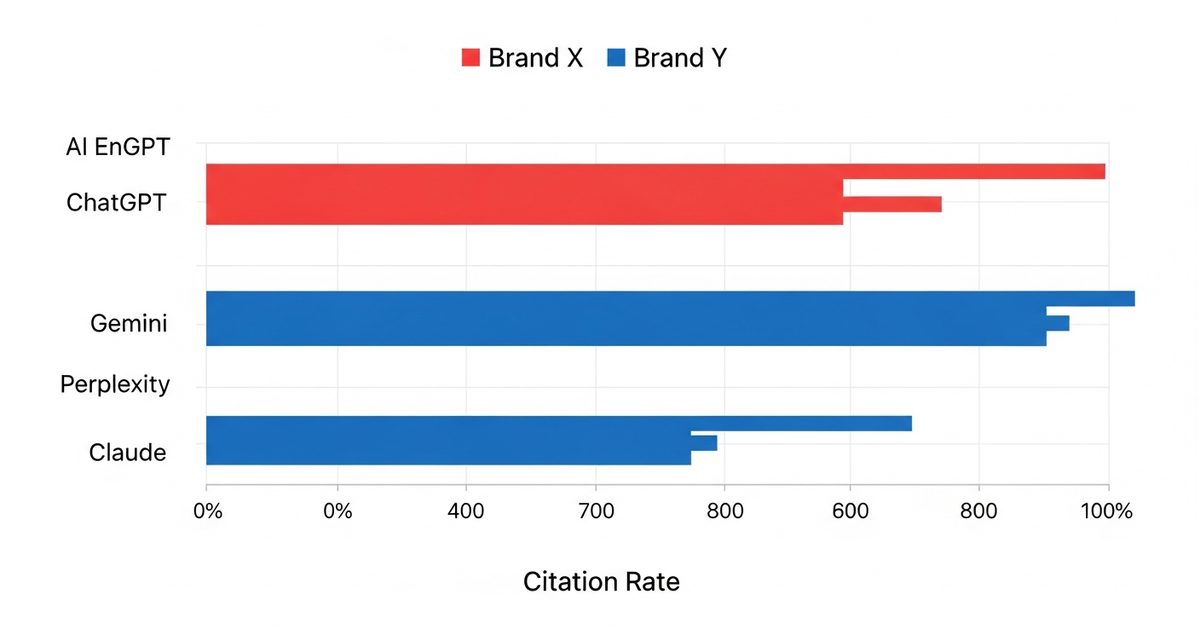
Multi-engine coverage. ChatGPT, Perplexity, Gemini, and Claude each produce different citation results for the same query. A competitor may dominate on Perplexity while you lead on Gemini - these differences reveal where to focus optimisation effort.
Regular cadence. Monthly snapshots miss changes. Weekly tracking catches citation rate shifts within the window where action is still timely.
Competitive benchmarking. Your citation rate in isolation tells you how often you appear. Your citation rate relative to your top three competitors tells you whether you are winning or losing the AI search competitive battle.
AI Rank Lab's AI Visibility Tracker provides all four components automatically. Add your domain and your top competitors, enter your query list, and the platform monitors citation rates across all four major AI engines on a weekly basis - reporting your position relative to competitors without any manual effort per monitoring cycle.
How to Use Competitive AI Citation Data to Improve Your Own Citations
Competitive monitoring is not just about knowing where you stand - it is about understanding what your competitors are doing that you are not.
Analyse the content on the pages your competitors cite from
When Perplexity cites your competitor for a query you are absent from, the source URL is visible. Visit that page. What does it do differently from your equivalent page? Common patterns: the competitor's page leads with a direct, complete answer in the first paragraph; uses question-formatted section headers; has comprehensive FAQPage schema; covers the topic with more depth or more current information. These observations translate directly into content improvement actions for your own pages.
Identify the query types where your competitors consistently win
Pattern analysis across your query list reveals whether competitors are stronger on specific query types - for example, dominating comparison queries while you lead on direct brand queries. This tells you where content investment will have the most competitive impact: building stronger comparison-focused content for query types where competitors currently out-cite you.
Track the impact of your optimisation efforts on competitive positioning
As you implement AEO optimisations - new content, schema markup, content restructuring - monitor whether your citation rate is improving relative to competitors on the specific queries targeted. This closes the feedback loop between optimisation actions and competitive outcomes.
The Competitive Advantage Window
Most of your competitors have not run the 60-second check you just ran. They have not built competitive AI citation tracking into their marketing workflow. They are optimising for Google while AI search quietly handles a growing share of the queries that matter most to their business.
The brands that build systematic AI search monitoring and optimisation in 2026 are building a competitive moat that will be significantly harder to breach in 2027 and 2028 as AI search becomes the default for more query types and more user segments.
Start with the 60-second check. Then set up AI Rank Lab's free competitive AI visibility tracking to move from a one-time snapshot to a continuous competitive intelligence program. See exactly where your brand stands against your top three competitors across ChatGPT, Gemini, Claude, and Perplexity - and what to do about the gaps you find.
Frequently Asked Questions
How do I check if my competitor appears in ChatGPT?▾
What does it mean if my competitor appears on ChatGPT but I do not?▾
Do ChatGPT competitor rankings change over time?▾
Should I check competitor rankings on Perplexity and Gemini too?▾
How do I use competitor AI citation data to improve my own rankings?▾
Get a Free AI Ranking Consultation
Want to improve your brand's visibility in AI search engines like ChatGPT, Gemini, and Perplexity? Fill out the form and our experts will create a personalized strategy for you.

Written by
Devanshu
Chief Marketing Officer & AI Search Optimization Architect
Digital Marketing Strategist & Pioneer in SEO, Answer Engine Optimization (AEO), and Generative Engine Optimization (GEO).


