


ChatGPT is no longer just a chatbot. With 2.8 billion monthly active users, it is one of the most widely used information retrieval tools in the world - and for a growing percentage of those users, it is their first stop when researching products, services, companies, and topics that would previously have been a Google search.
This creates a new search visibility challenge that traditional SEO does not address: how do you ensure that when someone asks ChatGPT a question in your market, your brand is the one it cites?
ChatGPT SEO - or more precisely, optimising for AI search citation - is different from traditional SEO in important ways, overlaps with it in others, and requires its own measurement framework. This guide covers everything you need to know to build and execute a ChatGPT SEO strategy in 2026.
What Is ChatGPT SEO?
ChatGPT SEO is the practice of structuring, formatting, and positioning your web content so that ChatGPT - and other AI search engines - select it as a cited source when generating responses to user queries. It is also called Answer Engine Optimisation (AEO) or Generative Engine Optimisation (GEO).
The goal is not to rank a URL in a list of search results. It is to get your brand's name, your content, and your expertise cited inside the AI-generated answer that users read. In ChatGPT's case, this means your brand is mentioned as a recommendation, your content is drawn on to formulate the answer, or your website URL is cited as a source in ChatGPT's browsing-enabled responses.
How ChatGPT Works as a Search Engine
To optimise for ChatGPT, you need to understand how it retrieves and uses information. ChatGPT operates differently depending on the version:
ChatGPT without browsing (knowledge cutoff)
The base ChatGPT model generates responses from its training data - a large corpus of text crawled from the web up to a specific training cutoff date. When asked about your brand, it draws on whatever web content about your brand existed in that training data: your own website pages, third-party mentions, reviews, press coverage, social media, forums, and any other indexed content that made it into the training corpus.
For ChatGPT to mention your brand without browsing, your brand needs to have had meaningful representation in publicly indexed web content before the training cutoff. Brands with thin web footprints - few pages, few external mentions, limited review presence - are underrepresented in training data and cited less frequently.
ChatGPT with browsing (Retrieval-Augmented Generation)
When browsing is enabled, ChatGPT uses Retrieval-Augmented Generation (RAG): it actively retrieves current web content to supplement its response. This makes current website content, recently published articles, and up-to-date information directly relevant to citation outcomes. A page published this month can appear in a browsing-enabled ChatGPT response tomorrow - unlike traditional SEO, where a new page might take weeks to index and months to rank.
For ChatGPT SEO, this means that well-structured, recently published or updated content has a much faster path to citation in browsing-enabled ChatGPT than the equivalent content would have to a Google top-10 ranking.
ChatGPT SEO vs Traditional SEO: The Key Differences
Factor | Traditional SEO | ChatGPT SEO |
|---|---|---|
Goal | Rank URL in top 10 results | Get cited in AI-generated response |
Competition | 10 results per SERP | 1-3 citations per response |
Primary ranking signal | Backlinks + keyword relevance | Content structure + answer completeness |
Schema markup | Helpful for rich snippets | Critical for structured data extraction |
Content freshness | Important for time-sensitive topics | Critical - 3.2x citation advantage for recent content |
Query format | Short keywords ("running shoes flat feet") | Full questions ("What running shoes are best for flat feet?") |
Measurement | Rankings, organic traffic | Citation rate, AI visibility score |
Time to results | Weeks to months | Days to weeks (browsing mode) |
The most consequential difference is the competition model. Ten brands can rank on page one of Google. One to three brands get cited in a ChatGPT response. This makes ChatGPT SEO both higher-stakes per query and faster to show measurable results when you move from uncited to cited.
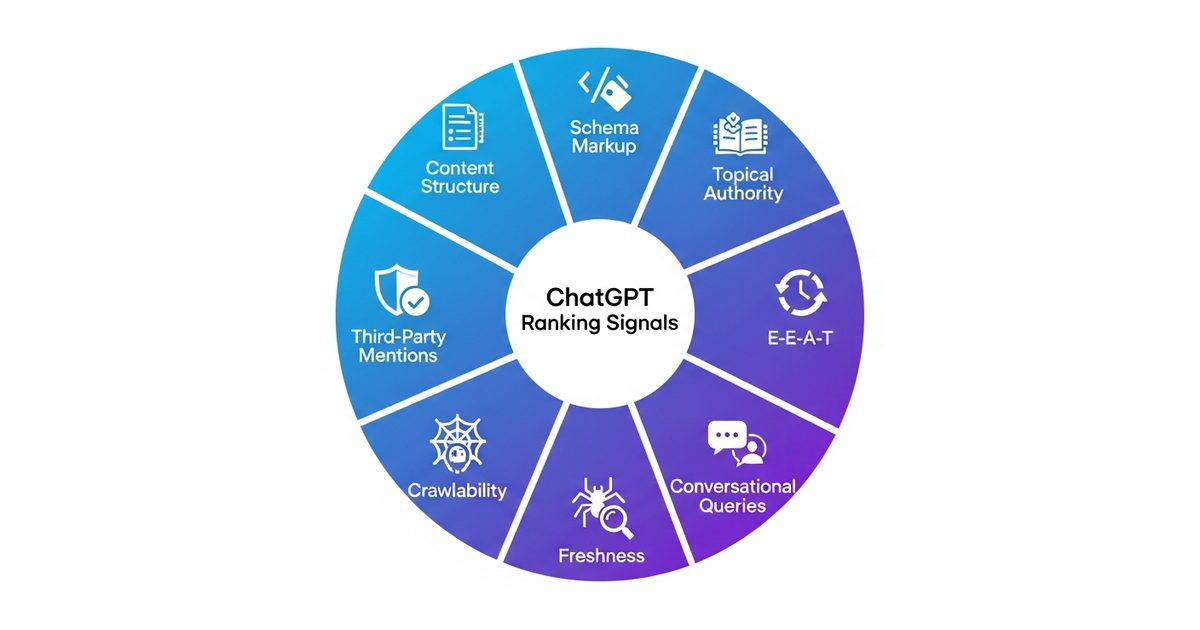
The 8 Key Factors for ChatGPT SEO
Factor 1: Answer Completeness
ChatGPT cites sources that fully resolve a query in one place. Content that answers a question in the first paragraph and then supports it with data, examples, and context performs far better than content that builds slowly to the answer or that requires the reader to click through to learn more. Apply the inverted pyramid: answer first, support second, expand third.
Test this against your own pages: ask ChatGPT the question your page is meant to answer. If it does not cite your page, read your page and ask honestly: does it answer the question directly in the first 100 words, or does it take two or three sections to get there? Most pages that lose the citation comparison do so because of answer delay, not answer quality.
Factor 2: Conversational Query Coverage
ChatGPT users type full questions and natural language requests, not keyword fragments. "What is the best project management software for a remote team of 10?" is a ChatGPT query. "project management software remote team" is a Google query. Your content needs to be structured around the full conversational question, not just its keyword core.
Map your content to question-formatted queries. Use question-formatted H2 and H3 headings. Research your topic through Perplexity's "Related Questions" panel and Google's People Also Ask to identify the exact phrasing real users employ. Content structured around those questions rather than keyword variations earns significantly more ChatGPT citations.
Factor 3: Comprehensive Schema Markup
Schema markup is the most direct technical signal available for ChatGPT SEO. When your content has FAQPage, Article, or HowTo schema, you are explicitly telling AI retrieval systems what the content contains and how to extract it. BrightEdge research shows pages with comprehensive schema earn a 36% advantage in AI-generated citations.
Priority schema types for ChatGPT SEO:
FAQPage - for any page that answers multiple questions; the single highest-impact schema type for AI citation
Article / BlogPosting - with author, datePublished, and dateModified fields; signals freshness and credibility to AI systems
HowTo - for step-by-step instructional content; enables structured extraction of procedural information
Organization - on your homepage and about page; establishes brand entity recognition in AI knowledge graphs
Product - for e-commerce and SaaS product pages; machine-readable specifications and pricing
Factor 4: Topical Authority
ChatGPT's citation preferences reflect something close to topical authority: sites that have published comprehensive, consistent coverage of a subject area are cited more reliably for queries in that area than sites with sparse or incidental coverage. A company with 30 high-quality articles on project management earns more ChatGPT citations for project management queries than a company with one landing page - even if that landing page is technically the better individual piece of content.
Build content clusters: a comprehensive pillar article on each core topic, supported by detailed articles on every relevant subtopic. Internal links between cluster articles reinforce topical authority signals. Aim for the kind of depth that makes your domain the obvious source on your subject - not just a credible source.
Factor 5: E-E-A-T Signals
Experience, Expertise, Authoritativeness, and Trustworthiness - the framework Google uses to assess content quality - also shapes what ChatGPT cites. AI systems trained on human-evaluated quality data have learned to prefer content that demonstrates genuine expertise: author credentials clearly stated, first-hand experience referenced in the content, original research cited, and consistent authoritative coverage across the domain.
Practical E-E-A-T actions for ChatGPT SEO: add author bios with credentials to every article, reference original data or case studies rather than restating generic information, maintain a consistent byline and publishing identity, and ensure your About page clearly establishes your organisation's expertise and track record in your subject area.
Factor 6: Content Freshness
ChatGPT - particularly in browsing mode - applies a significant recency bias when selecting sources. Content updated within the last 30 days receives 3.2 times more AI citations than equivalent content last updated over a year ago, according to BrightEdge research. A comprehensive article on a topic that has not been touched in 18 months is at a structural disadvantage against a competitor's slightly less comprehensive article that was updated last month.
Build a content refresh calendar. Identify your 20 highest-value pages and audit them quarterly: update statistics to the most recent available figures, replace outdated examples with current ones, add coverage of recent developments in the topic, and update the dateModified field in your schema. Freshness signals help even when the core substance of the content has not fundamentally changed.
Factor 7: Third-Party Mentions and Review Signals
ChatGPT's training data includes enormous quantities of review platform content, editorial coverage, social media discussions, and forum posts. Brands with strong third-party mention profiles - positive reviews on G2 or Trustpilot, coverage in industry publications, mentions in relevant Reddit threads, inclusion in editorial "best of" roundups - are more consistently cited than brands whose web presence consists primarily of their own website.
Third-party mentions function as a form of authority signal that is independent of your own content quality. Actively building review presence, pursuing editorial coverage, and participating visibly in the communities where your audience gathers all contribute to the training-data presence that improves ChatGPT citation frequency.
Factor 8: Technical Crawlability
ChatGPT's browsing mode cannot retrieve content that is blocked, slow to load, or inaccessible to web crawlers. Technical barriers - robots.txt blocks, JavaScript-dependent content that does not render without a browser, slow Core Web Vitals scores, broken page structures - prevent your content from being indexed for AI retrieval regardless of how good the content is.
Audit your highest-value pages for technical crawlability issues: verify they are not blocked by robots.txt or canonical tags that exclude them from indexing, check that core content loads without JavaScript execution, and address any Core Web Vitals failures that might indicate poor rendering performance. AI Rank Lab's Core Web Vitals Automator identifies and fixes the performance issues most likely to affect AI crawler accessibility.
Step-by-Step ChatGPT SEO Implementation Plan
Week 1-2: Audit and baseline
Run an AEO/GEO audit on your domain via AI Rank Lab to identify your top-priority gaps across all 8 factors
Establish your current citation rate baseline: manually test your top 10-20 target queries in ChatGPT and Perplexity and record results
Set up AI Rank Lab's AI Visibility Tracker for ongoing automated monitoring
Run a schema markup audit via Google's Rich Results Test on your 10 highest-traffic pages
Week 3-4: Quick technical wins
Add FAQPage schema to every page that addresses multiple questions (highest citation impact per hour of effort)
Add Article schema with author, datePublished, and dateModified to all content pages
Add Organization schema to your homepage and About page
Fix any robots.txt or crawlability issues identified in the audit
Month 2: Content restructuring
Rewrite your top 5 highest-traffic pages to lead with direct answers in the first 100 words
Convert page section headings to question format where relevant
Add author bios with credentials to all content pages that lack them
Update statistics and examples on pages not touched in the last 6 months
Month 3 onwards: Content cluster development
Map your core topics and identify the top 5-10 subtopic gaps in your coverage
Publish one AEO-optimised content piece per week targeting identified citation gaps
Build internal linking structure between cluster articles
Monitor citation rate weekly via AI Rank Lab and adjust content priorities based on results
Measuring ChatGPT SEO Performance
Traditional SEO metrics - Google rankings, organic traffic, domain authority - do not measure ChatGPT SEO performance. You need dedicated measurement:
AI Citation Rate - what percentage of your target queries produce a ChatGPT response that cites your brand. This is the primary KPI for ChatGPT SEO. Track it weekly using AI Rank Lab's tracker.
Citation Position - when your brand is cited, is it cited first, second, or third? First citations drive significantly higher brand consideration than third citations.
Multi-Engine Citation Rate - your citation rate in ChatGPT vs Gemini vs Perplexity vs Claude. Each engine has different citation patterns; optimising for one does not guarantee optimisation for others.
Share of AI Voice - your citation rate relative to competitors for the same query set. The competitive context often matters more than the absolute number.
Common ChatGPT SEO Mistakes
Optimising only for Google and hoping ChatGPT follows. Google rankings and ChatGPT citations have a moderate positive correlation but are not the same thing. A page ranking #1 on Google may not be cited by ChatGPT at all; the citation factors require independent optimisation.
Publishing thin AI-generated content at scale. ChatGPT is increasingly capable of identifying AI-generated content that lacks genuine expertise and deprioritising it as a source. Content that demonstrates real knowledge, original perspective, and subject-matter depth performs better than high-volume, low-depth AI output.
Measuring only Google analytics and missing AI-referred traffic. Set up AI engine referral source tracking in GA4 to measure the traffic contribution from ChatGPT, Perplexity, and Gemini separately from your Google organic channel.
Not refreshing successful pages. A page that earns a ChatGPT citation today loses that advantage if it is not updated as competing content is published and as AI models are updated. Treat citation maintenance as ongoing work, not a one-time achievement.
Ignoring third-party channels. ChatGPT SEO is not only about your own website. Your brand's representation in training data, review platforms, editorial coverage, and community discussions all contribute to citation frequency. A strong own-site AEO strategy combined with a weak external presence will underperform against competitors who have invested in both.
ChatGPT SEO Tools
AI Rank Lab - the primary tool for ChatGPT SEO: AI Visibility Tracker, AEO/GEO audit, AI Content Writer, Keyword Planner, and Core Web Vitals Automator. Free tier available.
Google Search Console - essential for Google AI Overviews data and schema validation
Perplexity AI - manual citation testing and competitive research
Schema markup validators - Google Rich Results Test, Schema.org validator
For a comparison of all available AI SEO tools, see the guide to the best AI SEO tools for 2026.
The ChatGPT SEO Opportunity in 2026
Most brands have not yet invested in ChatGPT SEO. The majority are still applying traditional SEO logic to a channel that operates on different principles - and wondering why their Google rankings do not translate into AI citations.
The brands that build their ChatGPT SEO foundation now are accumulating a compounding advantage. AI models are updated continuously, and brands with better content structure, stronger topical authority, and higher third-party mention density are systematically more likely to appear in future model outputs. The investment you make in ChatGPT SEO today compounds into a more durable citation position over the next two to three years.
Run a free AEO audit on AI Rank Lab and see exactly where your brand stands in ChatGPT search today - which queries are producing citations, which are not, and what to fix first.
Frequently Asked Questions
What is ChatGPT SEO?▾
How is ChatGPT SEO different from traditional SEO?▾
How long does ChatGPT SEO take to show results?▾
Can I rank on ChatGPT without ranking on Google?▾
What is the most important factor for ChatGPT SEO?▾
How do I measure my ChatGPT SEO performance?▾
Get a Free AI Ranking Consultation
Want to improve your brand's visibility in AI search engines like ChatGPT, Gemini, and Perplexity? Fill out the form and our experts will create a personalized strategy for you.

Written by
Devanshu
Chief Marketing Officer & AI Search Optimization Architect
Digital Marketing Strategist & Pioneer in SEO, Answer Engine Optimization (AEO), and Generative Engine Optimization (GEO).


