


Most websites have three to five GEO issues that are meaningfully reducing their citation rates in ChatGPT, Claude, and Perplexity. The majority of these issues take less than an hour to fix. The problem is not the fixes - it is finding them.
AI Rank Lab's free GEO audit tool runs a complete generative engine optimization check on your domain in under 60 seconds and returns a prioritized report showing exactly which signals are reducing your AI search visibility - with specific fix instructions for each finding. No signup required for the one-time free audit. No credit card.
What the Free GEO Audit Checks
The audit covers five signal categories that together determine how well generative AI systems can access, parse, trust, and cite your content:
1. AI Crawler Access
The audit checks your robots.txt and, where detectable, CDN-level configurations for rules that block AI crawlers. Specifically: GPTBot (ChatGPT), ClaudeBot (Claude), PerplexityBot (Perplexity), and Google-Extended (Gemini). A blocked crawler means zero citation rate from that LLM in browsing mode regardless of content quality.
If any AI crawler is blocked, the audit flags it as a critical finding with the exact robots.txt edit needed to fix it. This is one of the most common and fastest-to-fix GEO issues - a single-line edit with citation rate impact visible within 3-4 weeks.
2. Schema Markup Completeness
The audit crawls your homepage, product pages, and top content pages checking for the schema types with the highest GEO impact: Organization (entity identity), FAQPage (direct Q&A extraction), Article or BlogPosting (content structure), and Product or SoftwareApplication (offering definition).
For each schema type found, the audit checks field completeness - not just whether the type exists but whether the fields LLMs use most are populated. Missing sameAs on Organization schema, absent author on Article schema, or FAQPage entries with questions that do not match real user query phrasing are all reported with specific fix guidance.
3. Content Citability
The audit evaluates your key pages against the content signals that predict citation confidence: heading hierarchy (H1-H2-H3 logical structure), content depth (word count relative to query complexity), direct answer placement (is the answer clearly stated in the first 200 words?), and presence of citable statistics with source attribution.
Pages that score below citability thresholds are flagged with the specific issues - thin content, broken heading structure, no FAQ entries, no data points - rather than a generic "improve content quality" recommendation.
4. E-E-A-T Signals
The audit checks the organizational and author authority signals that LLMs - particularly Claude - use to assess citation confidence: named authors with linked credentials on content, complete About page with organizational identity, Contact and legal page presence, and detectable external reference presence (Crunchbase, LinkedIn, G2).
E-E-A-T gaps are common on sites that have optimized their content but not their organizational identity signals. A site with excellent content but no named authors and a minimal About page will consistently under-perform on Claude citation rates relative to its content quality.
5. llms.txt and AI Directives
The audit checks for a valid llms.txt file at your domain root and assesses whether any Terms of Service or robots.txt language unintentionally restricts citation use alongside training data use. Early llms.txt implementation gives you a structural advantage as LLM crawler adoption of the standard grows - the audit flags both the absence of llms.txt and any existing AI-use language that may be inadvertently reducing citation permissions.
How to Run Your Free GEO Audit
The process takes under 60 seconds from start to report:
Navigate to AI Rank Lab's free GEO audit tool.
Enter your domain name in the audit field.
Click "Run Free Audit" - no account creation or email required for the initial audit.
Wait 30-60 seconds while the crawler checks your domain across all five signal categories.
Review your GEO score (0-100) and the prioritized findings list.
Your report is available immediately in the browser. To save or share the report, or to run audits on additional pages beyond the homepage and top indexed pages, a free account (email only, no payment) provides report history and expanded crawl depth.
How to Read Your GEO Audit Report
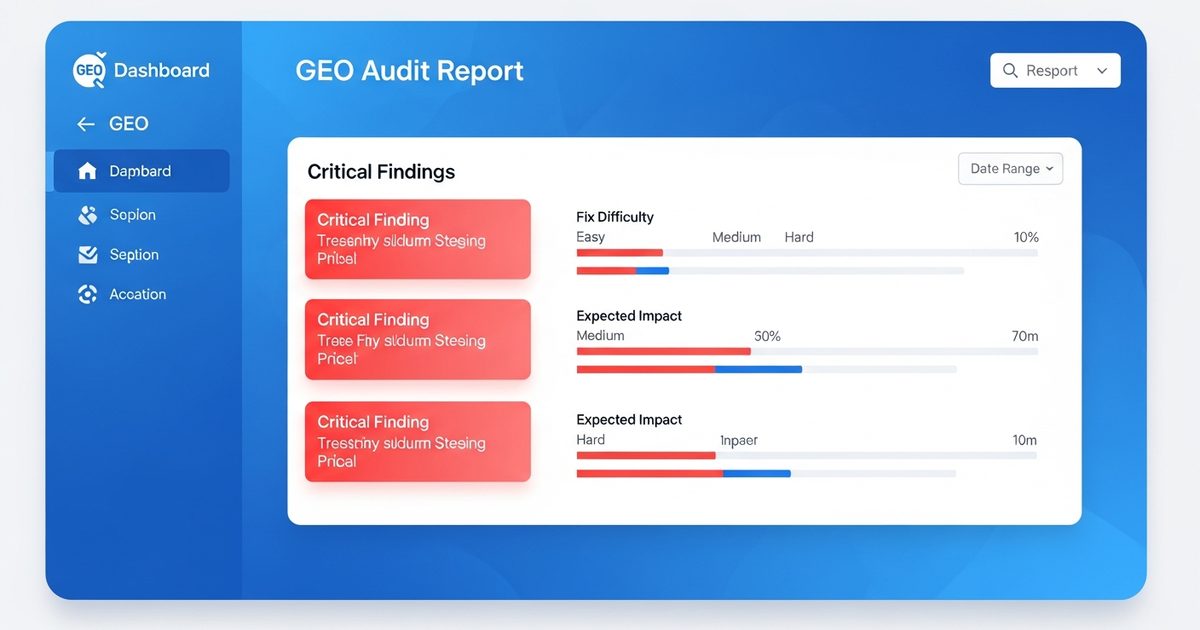
Your report opens with your overall GEO score and a per-category breakdown showing how you score across the five signal categories. The most important section is the prioritized findings list below the score.
Each finding includes four pieces of information:
The issue: Exactly what is wrong (e.g., "GPTBot blocked in robots.txt", "FAQPage schema missing from /features page", "No author schema on blog content").
Expected impact: How much fixing this finding is projected to improve your citation rate - shown as High, Medium, or Low with an estimated score-point change.
Fix difficulty: Easy (under 30 minutes, no developer required), Medium (requires content or schema changes, 1-4 hours), or Hard (requires strategic content development, days to weeks).
Fix instructions: Specific, actionable steps to resolve the finding - not generic advice but the exact edit, schema code snippet, or content change needed.
Start with every Easy/High finding in your report. These are the fixes with the best impact-to-effort ratio and will deliver the fastest visible citation rate improvement.
What a Typical Free GEO Audit Finds
Across sites that run the free GEO audit, the five most common critical findings are:
1. FAQPage schema absent from key pages (found on ~71% of audited sites). The highest-impact missing schema type. Sites without FAQPage schema on their product, features, and top content pages are leaving significant citation rate potential unrealized. Fix time: 1-2 hours per page.
2. Bot access blocks for one or more AI crawlers (~43% of sites). Frequently a wildcard Disallow: / in robots.txt that was set for security reasons and inadvertently blocks GPTBot or ClaudeBot. Fix time: under 5 minutes.
3. Missing sameAs on Organization schema (~58% of sites). Organization schema exists but the sameAs array linking to LinkedIn, Crunchbase, and other entity references is absent. Fix time: 15-20 minutes.
4. Blog content without author or dateModified schema (~64% of sites). Article schema is present but missing the author Person schema and dateModified fields that LLMs use to assess authority and freshness. Fix time: automated with most CMS plugins once configured correctly.
5. No llms.txt file (~87% of sites). The standard is new and adoption is low. Early implementation provides a differentiation advantage and takes 30-45 minutes to implement for most sites. Fix time: 30-45 minutes.
How the Free Audit Compares to Paid GEO Audit Tools
The free AI Rank Lab GEO audit covers your homepage and the top indexed pages of your domain - typically 10-20 pages depending on site structure. It provides a complete diagnostic picture for most SMB and early-stage growth company use cases.
Paid audit features extend the crawl to your full domain (all indexed pages, not just top pages), add keyword-specific citation rate testing (how often are you cited for your specific target queries across ChatGPT, Claude, Perplexity, and Gemini?), and enable ongoing monitoring so you can track whether fixes are improving citation rates over time.
For teams at the beginning of their GEO program, the free audit provides everything needed to identify and prioritize the fixes that will have the highest citation rate impact. Once those fixes are implemented, ongoing citation rate monitoring via a paid plan is the logical next step - you need to measure whether the fixes worked and catch new issues before they compound. Paid plans start at $69/month.
Who the Free GEO Audit Is For
The free GEO audit is designed for three situations:
First GEO baseline: You have never checked your AI search visibility and want to understand where you currently stand before investing in an optimization program. The free audit gives you a complete picture in 60 seconds.
Technical verification after site changes: After a CMS migration, robots.txt update, CDN configuration change, or major content restructure, a free audit re-run confirms no GEO signals were inadvertently broken. Infrastructure changes are the most common cause of sudden citation rate drops.
Client prospecting for agencies: Running a free GEO audit on a prospect's domain is a fast way to identify specific, high-impact improvements you can demonstrate during a pitch. Concrete findings with quantified expected impact are more persuasive than generic GEO capability claims.
Run your free GEO audit now - enter your domain and get your report in under 60 seconds. No signup, no credit card required.
Frequently Asked Questions
Is AI Rank Lab's GEO audit really free?▾
What does a GEO audit check?▾
How long does a GEO audit take?▾
What are the most impactful GEO audit findings to fix first?▾
How is a GEO audit different from an SEO audit?▾
How often should I run a GEO audit?▾
Get a Free AI Ranking Consultation
Want to improve your brand's visibility in AI search engines like ChatGPT, Gemini, and Perplexity? Fill out the form and our experts will create a personalized strategy for you.

Written by
Devanshu
Chief Marketing Officer & AI Search Optimization Architect
Digital Marketing Strategist & Pioneer in SEO, Answer Engine Optimization (AEO), and Generative Engine Optimization (GEO).


