


"Ranking on ChatGPT" is not quite the right frame. ChatGPT does not have a ranked results page the way Google does. What it does have is a retrieval and selection process that determines which sources it cites when generating answers - and that process is something you can directly influence.
When a ChatGPT user asks "what is the best project management software for remote teams" and ChatGPT responds by citing specific tools, those citations are not random. They reflect the sources ChatGPT has retrieved from its knowledge base and web browsing, assessed for authority, and determined to be confidently citable for that specific query. The goal of ChatGPT optimization is to be in that set of cited sources as often as possible for your target queries.
Here is the complete process for getting there in 2026, step by step.
Step 1: Measure Your Current ChatGPT Citation Rate
Before optimizing anything, establish your baseline. You need to know where you currently stand on ChatGPT for your most important queries.
Manual baseline check: Select 15-20 queries that your target customers are likely to ask ChatGPT. These should be a mix of: category queries ("best [your product category] software"), comparison queries ("[your brand] vs [competitor]"), problem queries ("how to solve [problem your product addresses]"), and direct brand queries ([your brand name]).
Enter each query into ChatGPT and note: Is your brand mentioned? Is your website linked? How is your brand described when mentioned? Which competitors are mentioned instead of or alongside you?
Automated tracking: For ongoing measurement, use AI Rank Lab to automate this process. The platform queries ChatGPT on your behalf for your full keyword set on a regular schedule, tracks citation rates, and alerts you to significant changes. Manual checks work for establishing a one-time baseline; you need automation for tracking trends over time.
What baseline tells you: If your brand queries return 90%+ citation rates but your category queries return under 15%, your problem is topical authority, not entity recognition. If your brand queries also return low citation rates (under 70%), you have a fundamental entity clarity issue to address first. The baseline diagnosis determines where the optimization work starts.
Step 2: Fix Technical Access Issues First
No optimization work matters if ChatGPT cannot access your content. GPTBot is OpenAI's web crawler, and if it is blocked from your site, ChatGPT cannot retrieve or cite your content in its browsing mode.
Check your robots.txt file: Open yourdomain.com/robots.txt and look for any rules that block GPTBot. A rule like User-agent: GPTBot / Disallow: / completely blocks OpenAI's crawler. More common is a wildcard block (User-agent: * / Disallow: /blog/) that inadvertently blocks GPTBot alongside other crawlers.
The correct robots.txt configuration for ChatGPT visibility:
User-agent: GPTBot
Allow: /

User-agent: ChatGPT-User
Allow: /
This explicitly allows GPTBot and ChatGPT-User to access all content. You can add Disallow rules for specific sections you do not want indexed (admin pages, user data), but core content pages, blog posts, and product pages should be fully accessible.
Check server and CDN-level blocking: Some security configurations block crawlers at the server level or CDN (Cloudflare, etc.) rather than in robots.txt. Check your Cloudflare WAF rules, server firewall configurations, and any rate-limiting rules that might be blocking GPTBot's IP ranges. AI Rank Lab's bot tracking feature shows whether GPTBot is actually accessing your site - if bot visits are zero despite an open robots.txt, the block is at the server or CDN level.
Submit to OpenAI's crawler: OpenAI does not have a public recrawl request tool equivalent to Google Search Console, but ensuring your sitemap is up to date and submitted to major search engines (which GPTBot uses as a crawl signal) helps ensure your content is in GPTBot's crawl queue.
Step 3: Establish Clear Entity Recognition
ChatGPT needs to have a clear, consistent understanding of what your brand is, what it does, and who it serves. Entity ambiguity - inconsistent brand names, conflicting descriptions of your product category, unclear target audience - directly reduces citation confidence.
Organization schema: Implement Organization schema on your homepage and About page with consistent values for: name (exact brand name as you want it cited), description (concise, accurate description of what you do), url (canonical homepage URL), sameAs (links to your profiles on LinkedIn, Crunchbase, Wikipedia if applicable, and other authoritative entity references).
Consistent brand name across the web: Check that your brand name is spelled and formatted consistently in: your website title tag, your Organization schema, your Google Business Profile, your LinkedIn company page, your Crunchbase profile, any press coverage that ChatGPT might retrieve. Inconsistencies ("AI Rank Lab" vs "AIRankLab" vs "AI Rank Labs") create entity ambiguity that reduces citation confidence.
Clear product category definition: ChatGPT retrieves sources based on relevance to the query. If your content does not clearly signal which product category you belong to, ChatGPT may not retrieve you for category queries even when you are relevant. Use precise category language consistently: "AEO platform," "AI citation tracking tool," "answer engine optimization software" - not generic terms that do not differentiate your category.
Step 4: Implement AEO Schema Markup
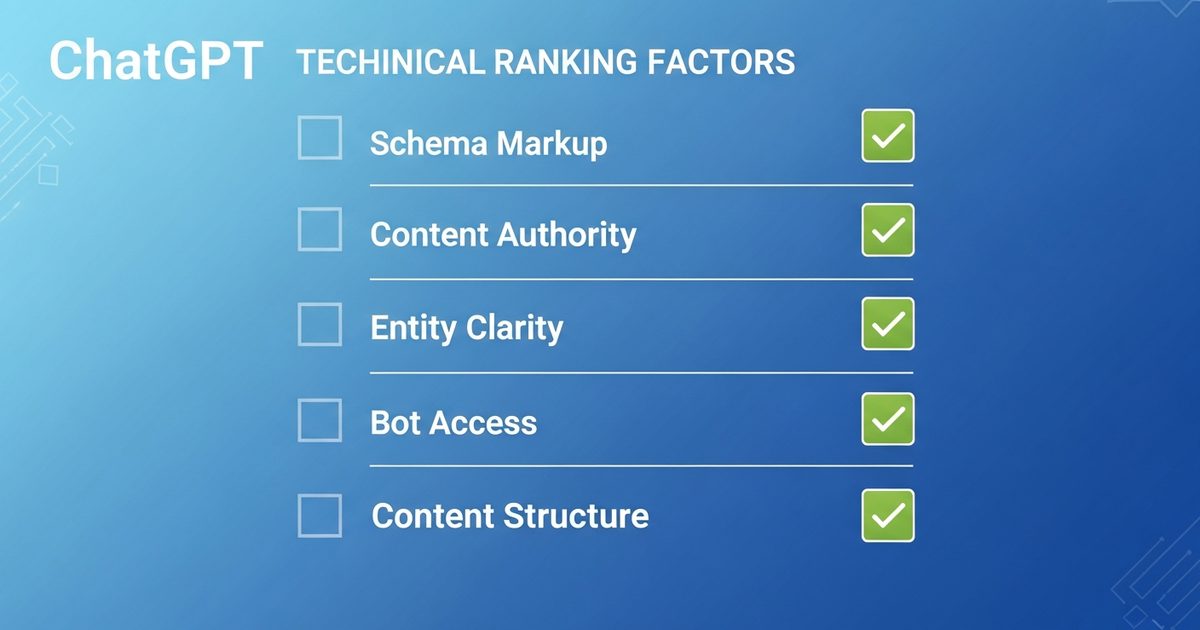
Structured data helps ChatGPT extract structured information from your content and cite it with confidence. The most important schema types for ChatGPT citation optimization:
FAQPage Schema
FAQPage schema is the highest-impact schema type for ChatGPT citations. When your page includes FAQPage schema with questions that match the phrasing of queries ChatGPT users ask, the platform can extract those Q&A pairs directly and cite your content as the source of a structured answer.
Implementation rules: Write 5-8 FAQ entries per page. Questions should match actual query phrasing your target audience uses (research these using Semrush's People Also Ask data, AnswerThePublic, or your own search console query data). Answers should be 40-120 words - comprehensive enough to be authoritative but concise enough to be directly quotable.
Article and BlogPosting Schema
For blog content and educational articles, Article or BlogPosting schema signals to ChatGPT that the content is a structured editorial piece with a defined author, publication date, and subject matter. Include: headline, description, author (with Person schema), datePublished, dateModified, publisher (with Organization schema), and about (the topic entity the article covers).
Product and SoftwareApplication Schema
For product or software pages, Product or SoftwareApplication schema defines your offering clearly. Include: name, description, applicationCategory, offers (pricing), and aggregateRating (if you have legitimate review data). This structured product data helps ChatGPT cite you accurately in comparison and feature queries.
Step 5: Build Content That ChatGPT Wants to Cite
ChatGPT's citation preference follows a clear pattern: it cites comprehensive, structured, authoritative content over thin summaries and shallow overviews. Understanding what "authoritative" means to a language model is the key to content optimization for ChatGPT.
Content depth requirements
For queries where ChatGPT is generating a detailed answer, it prefers to cite pages that comprehensively cover the topic. A 600-word page that touches on a topic will lose citation share to a 2,000-word page that covers it thoroughly, all other things being equal. Target 1,800-2,500 words for any page you want to be cited in substantive ChatGPT responses. Do not pad - every additional section should add genuine informational value.
Structural clarity
ChatGPT processes content hierarchically, using heading structure to understand the relationships between topics. A well-structured page with clear H1, H2, and H3 headings is far more parseable than a wall of text. Structure your key pages as: H1 (primary topic with target keyword), H2 sections for each major subtopic, H3 subsections for specific points within each topic. This heading hierarchy maps directly to how ChatGPT structures comprehensive answers.
Include citable statistics and data
ChatGPT is most confident citing specific, verifiable claims with source attribution. Including statistics with year and source - "According to Gartner (2025), 47% of enterprise search queries will be handled by AI by 2027" - gives ChatGPT extractable, citable data points that it can use as evidence in generated answers. Pages that consist only of opinions and generic claims provide less for ChatGPT to work with.
Match query intent precisely
ChatGPT retrieves content based on semantic relevance to the query. If you want to be cited for "best project management software for remote teams," you need a page that specifically and substantively addresses project management software for remote teams - not a generic software overview page that mentions remote work in passing. Topic specificity in your content is directly correlated with citation rate for specific queries.
Step 6: Build Topical Authority Through Content Coverage
ChatGPT's confidence in citing a source is partly a function of how thoroughly that source covers its topic area. A website that has 20 comprehensive articles covering every angle of a specific topic is cited more confidently than a website that has one article on the topic, even if that single article is high quality.
This is the topical authority principle applied to ChatGPT optimization. For your primary category, map the full topic cluster: every question your target audience asks about the category, every comparison they make, every problem they are trying to solve. Create comprehensive content for each major node in that topic cluster. As your coverage deepens, ChatGPT's confidence in your domain as an authoritative source for that category increases.
Practically, this means identifying content gaps using tools like MarketMuse or Semrush's topic research features, and systematically filling those gaps with quality content. A content calendar built around topical authority mapping is more effective for ChatGPT citation rates than a content calendar built around individual keyword targets.
Step 7: Earn Authority Signals That ChatGPT Uses
ChatGPT's knowledge base is informed by the broader web authority signals that search engines use. Earning genuine authority signals improves both traditional search rankings and ChatGPT citation rates simultaneously:
Backlinks from authoritative publications: When respected publications in your category cite your research, link to your content, or quote your leadership team, those links are authority signals that ChatGPT's training data incorporates. PR coverage, guest articles on industry publications, and research that gets cited by others are the highest-value authority building activities.
Wikipedia and authoritative entity references: Being mentioned in Wikipedia (where legitimately warranted) and on reference sites like Crunchbase, G2, Capterra, and industry directories establishes entity recognition that ChatGPT can confidently reference.
Customer reviews on major platforms: G2, Trustpilot, and Capterra reviews contribute to ChatGPT's confidence in citing your brand in recommendation queries. A brand with 500 reviews on G2 is more citable for "best [category] software" queries than a brand with 5 reviews.
Step 8: Track, Measure, and Iterate
ChatGPT's retrieval behavior is not static. OpenAI updates its models, training data, and browsing behavior regularly. Citation rates that are strong today can weaken as the model updates - and citation rates that are low today can improve as your content authority builds.
Track your ChatGPT citation rates weekly using AI Rank Lab's automated monitoring. Set up alerts for citation rate drops of more than 5 percentage points on your highest-priority queries. Review your full citation rate data monthly and identify which queries are improving, which are stagnant, and which have dropped.
For stagnant queries, run the AI Rank Lab AEO audit to check for new technical issues or gaps that have appeared since your last audit. For dropping queries, check whether a competitor has recently published more comprehensive content on the topic - and whether matching or exceeding that content depth is the right response.
The ChatGPT Ranking Timeline
Setting realistic expectations for how long each optimization step takes to show citation rate improvement:
Technical fixes (robots.txt, schema): 2-4 weeks for GPTBot to recrawl and update citations
Entity clarity improvements: 4-8 weeks for brand query citation rates to improve
FAQ schema implementation: 3-6 weeks for citation rate improvement on specific FAQ-matched queries
Content depth expansion: 6-10 weeks for meaningful citation rate improvement as ChatGPT's retrieval incorporates expanded content
Topical authority building (content cluster): 3-6 months for category-level citation rate improvements as the full topic cluster is built out
Authority signal building (backlinks, reviews): 3-9 months for cumulative impact on citation confidence
The teams that see the fastest initial results focus on technical access and schema in the first month, building toward content depth and authority in months 2-6. This sequencing - technical foundation first, content and authority second - is the most efficient path to meaningful citation rate improvement.
Getting Started: The 48-Hour ChatGPT Audit
If you want to start today, this 48-hour audit sequence gives you the most important diagnostic data quickly:
Hour 1: Run manual citation checks on your 10 most important queries. Note current rates.
Hour 2: Check robots.txt for GPTBot blocking. Fix any blocks found.
Hour 3: Run AI Rank Lab AEO audit to identify all technical gaps in priority order.
Day 2: Implement schema fixes identified in the audit (FAQPage on your top 3 priority pages).
Week 2-4: Begin content expansion on the 3 highest-value low-citation queries.
Month 2+: Build out the full topic cluster and authority program.
The 48-hour audit defines the work. The weeks and months after are execution. Start your AI Rank Lab AEO audit free to get your ChatGPT citation rate baseline and prioritized optimization roadmap today.
Frequently Asked Questions
How do you rank on ChatGPT?▾
Does ChatGPT rank websites like Google?▾
How long does it take to rank on ChatGPT?▾
What is GPTBot and how does it affect ChatGPT rankings?▾
Does FAQ schema help ChatGPT cite your content?▾
How do I know if ChatGPT is citing my website?▾
Get a Free AI Ranking Consultation
Want to improve your brand's visibility in AI search engines like ChatGPT, Gemini, and Perplexity? Fill out the form and our experts will create a personalized strategy for you.

Written by
Devanshu
Chief Marketing Officer & AI Search Optimization Architect
Digital Marketing Strategist & Pioneer in SEO, Answer Engine Optimization (AEO), and Generative Engine Optimization (GEO).


