


What Is a White Label SEO Report?
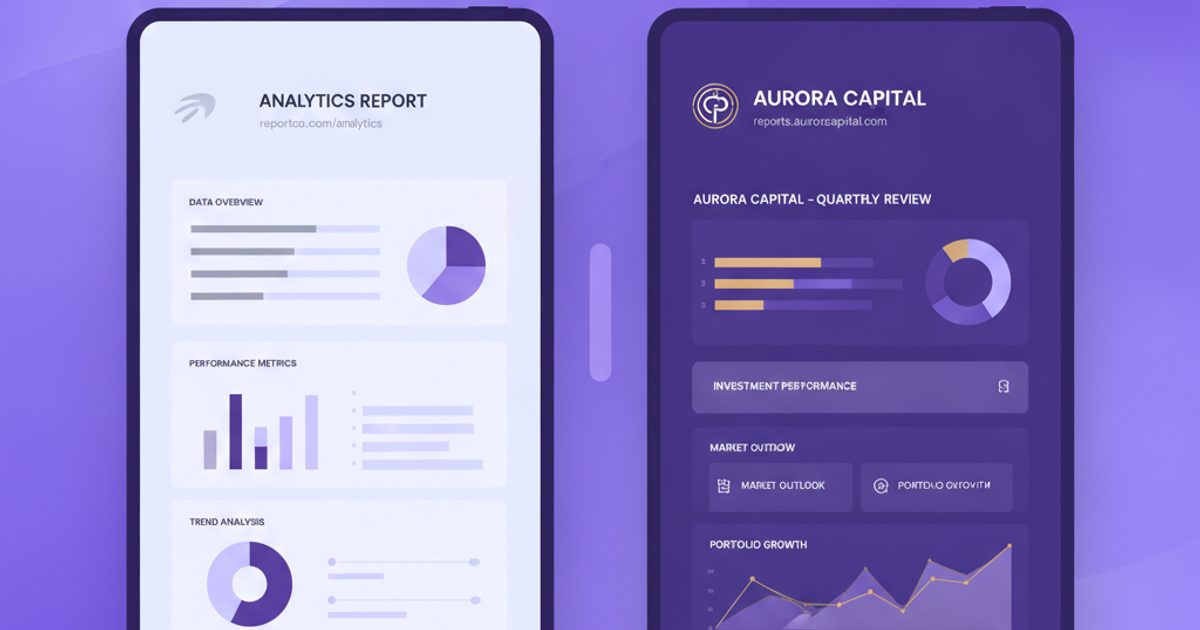
A white label SEO report is a performance report - rankings, traffic, technical audit results, or AI visibility data - that carries an agency's own branding instead of the underlying software vendor's. The client sees the agency's logo, colors, and often a custom domain; the platform doing the actual data collection stays invisible. According to Sitechecker's 2026 white label SEO software review, the baseline feature set includes branded dashboards, automated scheduled report delivery in PDF or CSV, and role-based multi-user access so the agency - not the tool vendor - owns the client relationship end to end.
The term gets used loosely, though, and that looseness costs agencies money. A cosmetic branded PDF export, a live client-facing dashboard hosted on the agency's own subdomain, and a fully resellable white-label platform are three different products that get marketed under the same phrase.
Why Agencies Need White Label Reporting
Unbranded, vendor-visible reports create an obvious problem: they show the client exactly which tool is doing the work, which invites them to go buy that tool directly and cut the agency out. White label reporting removes that exposure and reinforces that the agency itself is the source of the insight and the fix.
The retention argument is usually stated as an assumption. The 2026 AgencyAnalytics Marketing Agency Benchmarks Report, based on a survey run February-April 2026, puts real numbers behind it: 97% of agencies rate accurate reporting as important or extremely important for client retention, and 76% call it "extremely important," up from 70% the year before. That said, the same report is precise about mechanism - reporting clarity is not the top churn driver on its own. Budget cuts (42%), client-side internal changes (37%), and lack of perceived value (32%) outrank reporting issues (10%). The honest read: white label reporting supports retention indirectly, by making the agency's value visible and reinforcing the relationship, rather than preventing churn by itself.
What a Real White Label Report Should Include
Based on the feature sets reviewed across current platforms, a white label report that actually holds up under client scrutiny includes:
Full custom branding - agency logo, brand colors, and no mention of the underlying platform anywhere in the export or dashboard.
A custom domain or portal - reports served from something like reports.youragency.com rather than a vendor's own domain, with SSL included.
Automated, scheduled delivery - PDF, CSV, or a live dashboard link sent on a fixed cadence (monthly is the de facto standard per the Arvow 2025 white label tools comparison) rather than manually assembled each cycle.
Multi-client management - one agency dashboard covering every client account, with per-client and per-team-member access controls.
API access - the ability to pull the underlying data into the agency's own systems rather than being locked into the vendor's report layout.
White Label SEO vs. White Label GEO Reports
Traditional white label SEO reports cover rankings, backlinks, technical audit issues, and organic traffic. White label GEO (Generative Engine Optimization) reports cover a different question entirely: is the brand being cited or recommended when someone asks ChatGPT, Claude, Gemini, or Perplexity a relevant question. That means tracking citation frequency, brand sentiment inside AI-generated answers, and competitive share of voice across AI engines - data that a traditional rank tracker does not collect.
Most agencies are now being asked for both in the same client conversation, but as the LLM Pulse review of white-label AI visibility tools points out, white labeling for GEO tools "exists on a spectrum" the same way SEO tools do: most platforms only offer a static branded PDF export of AI visibility data, while a smaller set provide a live, interactive dashboard hosted on the agency's own domain with complete brand control down to the notification emails.
What White Label SEO and GEO Reporting Costs
Pricing varies by which tier of "white label" is actually being sold. For SEO-only reporting tools, the Arvow comparison of 11 platforms found a range from $19/month (SEOptimer's entry tier) up to $249/month for a fully-featured professional plan, with most agencies settling in the $50-200/month band for a dedicated reporting tool.
GEO reporting is typically priced as a service layered on top of an existing SEO retainer rather than sold as a standalone SaaS seat. The Visiblie breakdown of GEO-as-a-service pricing outlines three common tiers agencies charge clients directly: basic AI visibility monitoring at $500-1,500/month (roughly 75%+ margin once white-label automation removes manual report assembly), monitoring plus optimization work at $1,500-5,000/month (around 70%+ margin), and full-service GEO management at $5,000-10,000/month (around 65%+ margin as more hands-on work is involved).
A Worked Example: What a Combined SEO + GEO White Label Report Looks Like
AI Rank Lab's own white-label offering illustrates what a combined report structure looks like in practice, since it ships both report types under one agency brand rather than as separate add-ons. The platform generates two distinct branded report types: a White-Label AEO Report covering AI snippet visibility scoring, featured-answer and People Also Ask analysis, structured data and schema auditing, and competitor AEO benchmarking; and a White-Label GEO Report covering AI citation and coverage tracking, brand mention analysis inside LLM outputs, content authority signals, and a generative-engine ranking roadmap. Both are delivered through a custom agency subdomain with SSL, branded PDF exports carrying the agency's own header and footer, a multi-client dashboard for managing every account from one place, and a REST API with webhook support for agencies that want to pull the raw data into their own systems instead of using the built-in report layout. That structure maps directly onto the checklist above - branding, custom domain, scheduled delivery, multi-client management, and API access - applied to both the SEO and GEO side of the report in one place instead of stitching two vendors together.
How Agencies Deliver White Label Reports to Clients
Delivery generally falls into three patterns, in increasing order of sophistication: a manually or automatically generated branded PDF sent on a fixed schedule; a live client-facing dashboard hosted on the agency's own subdomain that the client can log into anytime; or, for agencies operating at larger scale, a fully white-labeled instance of the platform itself that the agency effectively resells as its own product. Most agencies start with scheduled PDF delivery and move to a live dashboard once client volume makes manual report assembly too time-consuming to sustain.
Frequently Asked Questions
What is a white label SEO report?▾
Why do agencies need white label SEO reporting?▾
What should a white label SEO report include?▾
How much does white label SEO reporting software cost?▾
What is the difference between a white label SEO report and a white label GEO report?▾
Does white label reporting actually improve client retention?▾
Can you white label AI visibility (GEO) reports, not just traditional SEO reports?▾
What should agencies charge for GEO monitoring on top of an existing SEO retainer?▾
Get a Free AI Ranking Consultation
Want to improve your brand's visibility in AI search engines like ChatGPT, Gemini, and Perplexity? Fill out the form and our experts will create a personalized strategy for you.

Written by
Devanshu
Chief Marketing Officer & AI Search Optimization Architect
Digital Marketing Strategist & Pioneer in SEO, Answer Engine Optimization (AEO), and Generative Engine Optimization (GEO).


