


Your brand exists in the minds of AI systems whether you have optimized for it or not. When someone asks ChatGPT to recommend a project management tool, or asks Claude which cybersecurity vendors are worth evaluating, or asks Gemini for the best accounting software for small businesses - these systems form a response based on everything they have retrieved and learned about your category. The question is not whether your brand appears in these conversations. The question is whether you know your current standing and whether you are managing it intentionally.
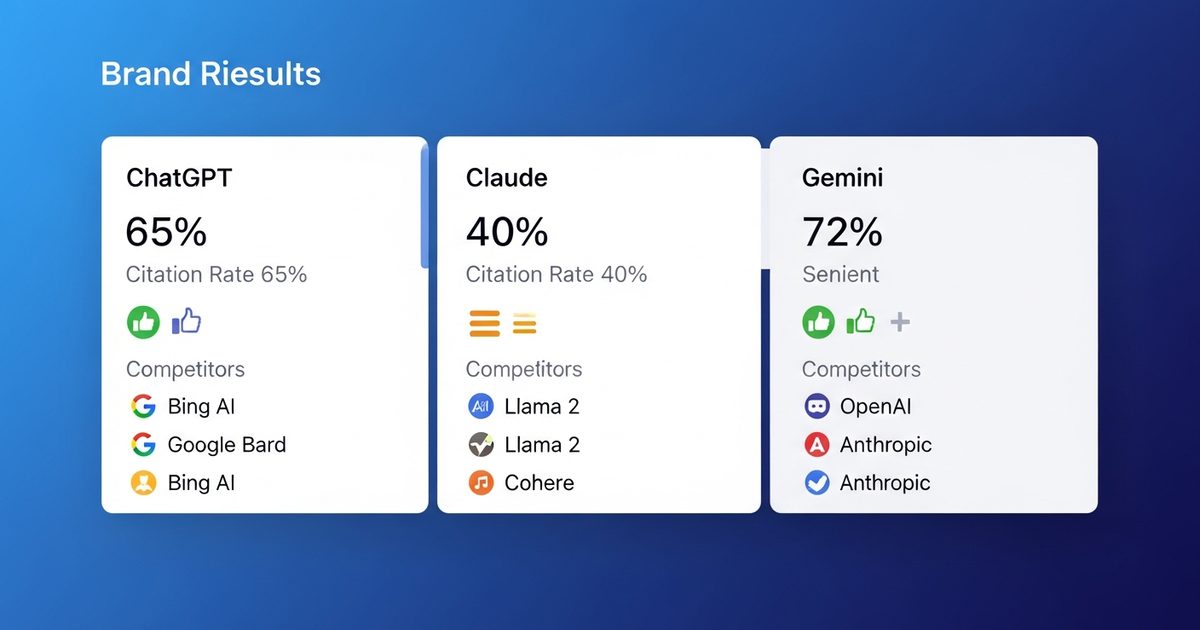
AI Rank Lab's free brand visibility checker gives you that picture in under 60 seconds. Enter your domain, run 25 prompts across ChatGPT, Claude, and Gemini, and get a complete report showing your citation rate per platform, how your brand is described when cited, which competitors appear alongside you, and where your visibility gaps are largest.
Run your free brand visibility check here. No credit card. No signup required for the initial check.
What the Free AI Brand Visibility Checker Reports
The free check runs your brand against 25 prompts across ChatGPT (GPT-4o), Claude (3.5 Sonnet), and Gemini Advanced and returns five data points that together give you a complete picture of your current AI brand visibility:
Citation Rate Per Platform
The core metric: what percentage of the 25 prompts returned your brand as a cited source on each LLM. Results are shown separately per platform because citation rates vary independently - your brand may be cited in 65% of ChatGPT responses but only 30% of Claude responses for the same prompt set, which points to a specific diagnostic finding rather than a general quality issue.
Industry context is provided alongside your score - you see not just your citation rate but how it compares to the typical range for your category and company stage. A citation rate of 40% looks very different for a 6-month-old startup versus a 5-year-old category leader.
Brand Description Accuracy
When LLMs cite your brand, what do they say? The checker captures the descriptive language each LLM uses when your brand appears in responses and assesses whether it accurately reflects your product category, key differentiators, and target use case. Misrepresentation patterns - LLMs describing you as a category you do not occupy, attributing features you do not have, or omitting your primary value proposition - are flagged as brand narrative findings.
Brand description accuracy matters beyond citation rate. A brand cited 60% of the time but described inaccurately in half of those citations delivers less value than a brand cited 50% of the time and described correctly. Both metrics together tell the full story.
Competitor Share-of-Voice
For each prompt where your brand was not cited, the checker identifies which competitors were cited instead. This competitive displacement data shows which specific brands are winning the citations you are missing - and across which query types. If Competitor A appears in 70% of category queries where you are absent, while Competitor B appears in 80% of comparison queries where you are absent, your optimization priorities for each competitor gap are different.
Share-of-voice is shown as a percentage: out of all citations across the 25 prompts on each LLM, what percentage cited your brand versus each named competitor. This metric is more strategically actionable than raw citation rate because it frames your visibility in the competitive context your buyers experience.
Sentiment Indicators
The checker identifies the sentiment language LLMs use in responses where your brand appears - whether your brand is described positively, neutrally, or with caveats. Caveat patterns ("[Brand] is a good option but...", "[Brand] works well for X but not for Y") that appear consistently across LLMs often reflect gaps in your FAQ coverage or content that has not addressed the objection being surfaced.
Top Visibility Gaps
The three to five findings with the highest expected impact on your citation rate - drawn from the combined citation data and diagnostic signals. These are the specific technical or content issues most likely responsible for your current visibility gaps, ranked by expected improvement if addressed.
How the Free Check Works
Enter your domain in the AI brand visibility checker and the platform automatically:
Identifies your brand entity from your domain (name, product category, primary use case) using your homepage content and schema markup.
Generates 25 prompts across your brand's keyword territory: direct brand queries, category queries, comparison queries, and problem queries relevant to your product space.
Submits each prompt to ChatGPT, Claude, and Gemini and captures the full responses.
Applies NLP-based brand detection to identify citations, descriptions, sentiment language, and competitor mentions in each response.
Calculates citation rates, share-of-voice, and brand description accuracy per LLM.
Generates the visibility gap findings prioritized by expected impact.
Total time from domain entry to full report: 45-90 seconds depending on LLM response latency.
Who the Free Brand Visibility Checker Is For
The checker is useful at three distinct stages of AI visibility program maturity:
Starting from zero: If you have never checked your AI brand visibility and want to understand your baseline before investing in an optimization program, the free check gives you a complete cross-platform picture in 90 seconds. The top visibility gap findings tell you exactly where to focus first without having to interpret raw citation data yourself.
After implementing AEO fixes: After making technical changes - schema updates, robots.txt edits, content additions - the free check verifies whether citation rates changed. Note that AEO changes typically take 3-8 weeks to show in LLM responses due to recrawl cycles. Running the checker 4-6 weeks after a significant fix batch gives you meaningful before/after comparison data.
Competitive intelligence: The competitor share-of-voice data shows which brands are winning citations in your category across ChatGPT, Claude, and Gemini. Checking your citation rate alongside checking your top two or three competitors reveals whether you are losing citations to a specific competitor consistently - which tells you which competitor's content and AEO signals to study.
From Free Check to Ongoing Monitoring
The free check is a point-in-time assessment. AI brand visibility is not static - LLM models update, new content enters AI training data, and competitor optimization activities shift citation rates continuously. A citation rate that is strong today can decline as competitors publish stronger content or as model updates change retrieval preferences.
Ongoing monitoring via AI Rank Lab's citation analytics tracks your brand visibility across ChatGPT, Claude, Perplexity, and Gemini on a weekly automated basis, alerts you to significant citation rate drops before they compound, and provides trend data showing whether your optimization work is having the intended effect over time.
The difference between a free one-time check and ongoing monitoring is the difference between knowing your weight today and tracking your health over months. Both are useful; they answer different questions. The free check tells you where you stand and what to fix. Ongoing monitoring tells you whether your fixes worked and whether your competitive position is improving or being eroded.
Paid monitoring plans that include full keyword set tracking, weekly automated refresh, and competitive share-of-voice dashboards start at $69/month. See full pricing details.
What Drives AI Brand Visibility
Understanding the signals behind your visibility score helps you interpret the findings and prioritize fixes correctly. The five factors with the most direct impact on your citation rates across ChatGPT, Claude, and Gemini:
Bot crawl access: GPTBot, ClaudeBot, and Bard-Google (the crawlers for each platform) must be allowed in your robots.txt to access your content for browsing-mode citations. Blocked crawlers produce zero citations from that platform in browsing mode regardless of content quality. Check your robots.txt first if citation rates are dramatically lower on one platform than another.
Entity clarity: LLMs need a clear, consistent understanding of what your brand is and what it does before they confidently cite it. Organization schema on your homepage with complete fields (name, description, url, sameAs) plus consistent brand name usage across all web properties are the primary entity clarity signals.
FAQPage schema: The single highest-impact per-page AEO optimization. FAQ entries that match actual user query phrasing give LLMs directly extractable Q&A pairs to cite precisely. Implementing 5-8 targeted FAQs per key page is the fastest route to measurable citation rate improvement after any bot access issues are resolved.
Content depth: LLMs prefer comprehensive sources. Pages that cover their topic with 1,800+ words, clear H2-H3 structure, and supporting statistics are cited more confidently than thin pages on the same topic. Content depth improvements take longer to show in citation rates (6-10 weeks) but drive durable improvements.
Topical authority: A site with comprehensive coverage across its category is cited more confidently than a site with isolated strong content. Building out your topic cluster - covering all major subtopics with quality content and connecting them with internal links - is the long-term citation rate multiplier that individual page optimizations cannot replace.
Run your free AI brand visibility check now to see your current citation rates across ChatGPT, Claude, and Gemini - and the specific fixes that would have the highest impact on your scores.
Frequently Asked Questions
What is an AI brand visibility checker?▾
Is the AI brand visibility checker really free?▾
How is AI brand visibility different from SEO rankings?▾
Why do I show up in ChatGPT but not in Claude?▾
How do I improve my AI brand visibility score?▾
What AI platforms does the brand visibility checker cover?▾
Get a Free AI Ranking Consultation
Want to improve your brand's visibility in AI search engines like ChatGPT, Gemini, and Perplexity? Fill out the form and our experts will create a personalized strategy for you.

Written by
Devanshu
Chief Marketing Officer & AI Search Optimization Architect
Digital Marketing Strategist & Pioneer in SEO, Answer Engine Optimization (AEO), and Generative Engine Optimization (GEO).


