


About 68% of Google searches ended without a click in early 2026. The reason is not a mystery - a growing share of those searches produced an AI-generated answer that satisfied the query before the user ever saw a link to click. ChatGPT now serves around 900 million users every week. Gemini reaches 750 million monthly. Perplexity has become the default research tool for a fast-growing segment of knowledge workers and students.
If your brand is not appearing in the responses those platforms generate, you are invisible to a large and growing piece of your potential audience - and unlike traditional search rankings, you probably have no idea it is happening.
That is what AI search visibility means: whether your brand shows up, how it is described, and how often it is cited when AI engines generate answers about your category. This guide covers what it is, why it matters, how to measure it accurately, and the specific steps that actually move the needle.
What Is AI Search Visibility?
AI search visibility is your brand's presence inside AI-generated responses across the major language model platforms. When someone asks ChatGPT "what are the best project management tools," or asks Perplexity "which CRM is best for small agencies," or asks Gemini "who are the leading AI SEO platforms" - your AI search visibility determines whether your brand is in that answer, how prominently it appears, and how accurately it is described.
It is distinct from traditional search visibility in a few important ways:
- No ranking list: AI engines do not return a ranked list of ten results. They synthesize an answer, which may name one brand, three brands, or none at all depending on how they have processed the available information about your category.
- No click required: A user can get a complete recommendation for your category without ever visiting any website. Your AI visibility determines whether your brand is in that recommendation - regardless of whether you ever get a traffic signal from it.
- Context and sentiment matter: Being mentioned is not the same as being recommended. AI engines can mention your brand in a positive, neutral, or negative context. "Brand X is a popular option" and "Brand X has faced criticism for" are both mentions - but only one helps you.
- Sources are not always transparent: Unlike Google results where you can see which pages rank, AI engines often do not show users which sources informed their answer. You need dedicated tools to figure out which of your pages are being cited and which are not.
Why This Matters More Than Most Teams Realize
There is a version of this problem that feels abstract - "AI is changing search, we should probably think about it" - and then there is the version that hits when a stakeholder opens ChatGPT, asks about your product category, and your brand is not mentioned once while two competitors appear in the first paragraph of the response.
The second version is how most brands discover they have an AI visibility problem. By the time that happens, the competitors who noticed earlier have been building AI citation equity for months - producing the right content, earning the right mentions, fixing the right technical issues - while your brand was optimizing exclusively for Google.
The gap compounds quickly. AI engines learn from the web of content that references a brand. The more your brand is cited across authoritative sources, the more the models that train on that content associate your brand with your category. Brands that start building AI visibility early compound an advantage that takes real effort to close later.
The Metrics That Actually Matter
Before getting into how to improve AI visibility, it helps to be clear on what you are measuring. These are the five metrics that give you an accurate read on your AI search presence:
Mention rate
The percentage of AI responses to your target queries that include your brand name. If you run 100 relevant prompts across ChatGPT and your brand appears in 35 of the responses, your mention rate is 35%. This is your broadest awareness signal - it tells you how present you are in your category's AI conversation, but not how prominently or how accurately.
Citation rate
The percentage of responses where your site is directly cited as a source, usually with a link. Citation rate is typically lower than mention rate and is often the more strategically important metric - citations drive referral traffic, signal credibility to the AI system, and indicate that the platform has indexed and trusts your specific content.
Share of voice
Your mention and citation rates relative to specific competitors on the same queries. This is where AI visibility data becomes truly actionable. Knowing you appear in 40% of responses is hard to act on. Knowing you appear in 40% while your primary competitor appears in 71% on the same queries tells you exactly how large the gap is and creates urgency to close it.
Sentiment and context
How AI engines characterize your brand when they do mention you. Positive context (recommended, leading, trusted) is the goal. Neutral mentions (also available, another option) are better than nothing. Negative or qualified mentions (has faced criticism for, some users report issues with) can be more damaging than no mention at all. Monitoring context quality, not just mention quantity, is the difference between measuring AI visibility and managing your AI reputation.
Coverage gaps by query
The specific prompts where competitors appear and you do not. This is your prioritized action list. Not all queries matter equally - a coverage gap on a high-intent query like "best [your category] for [your target customer]" is far more consequential than a gap on a tangential informational query. Sorting coverage gaps by query importance is what separates a strategic AI visibility program from a tracking exercise.
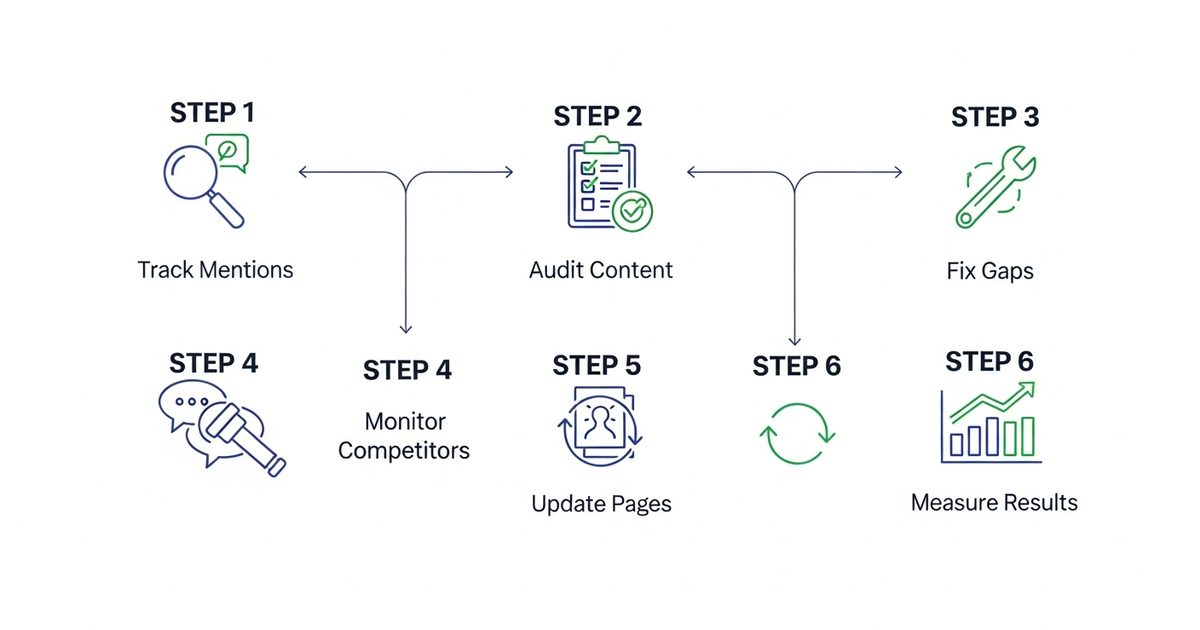
How AI Visibility Monitoring Works
To measure these metrics consistently, you need a monitoring setup that accounts for a fundamental challenge: AI responses are non-deterministic. The same prompt can produce different brand mentions, different sources cited, and different characterizations on different days - or even different runs on the same day.
A single manual check of ChatGPT tells you almost nothing useful. One negative result could be random variance. One positive result could be a one-off. Reliable AI visibility data requires running a representative set of queries repeatedly across multiple engines and aggregating the results into trend data that smooths out the noise.
Here is how a properly structured monitoring setup works:
Query set design: Start with the prompts your actual customers would use when researching your category. These fall into several types - category discovery queries ("best [category] tools"), comparison queries ("[competitor A] vs [competitor B]"), problem queries ("how do I solve [specific pain point]"), and branded queries ("is [your brand] reliable"). A representative set includes all four types across the queries that matter most to your business.
Multi-engine execution: Each query runs across ChatGPT, Perplexity, Gemini, Claude, and any other platforms where your audience is active. Results vary meaningfully by platform - a brand that dominates Perplexity responses may be invisible on Claude. Platform-level breakdowns are essential because the fix for each platform can be different.
Response analysis: Each response is analyzed for brand mentions, citations, competitor appearances, and sentiment. The better tools do this with enough statistical sample volume to produce reliable results - small sample sizes produce noisy data that is hard to trust and harder to act on.
Trend aggregation: Results are compiled over time so you can see whether your visibility is improving, declining, or holding steady - and correlate changes to the content or technical actions you took.
The Six Factors That Determine Your AI Visibility
Understanding what AI engines actually use to decide whether to include your brand in a response gives you the levers to pull when you want to improve. These are the six factors that matter most:
1. Brand mentions across authoritative sources
AI language models learned about your brand primarily from the content they were trained on. The more your brand is mentioned in credible, topically relevant sources - industry publications, review sites, reputable blogs, news coverage - the stronger the association between your brand and your category in the model's understanding. Third-party mentions are often more influential than your own website content.
2. Content structure and extractability
AI engines prefer content they can quote cleanly. A page full of dense paragraphs is harder for an LLM to extract a crisp answer from than a page with a clear opening definition, structured lists, comparison tables, and concise summaries at the top of each section. The same information, formatted differently, can produce dramatically different AI citation rates.
3. Topical authority and depth
A single page on a topic rarely generates consistent AI citations. AI systems reward brands that demonstrate genuine expertise across a topic - a cluster of interlinked, comprehensive pages covering different facets of a subject signals authority that isolated pages do not. Topical authority is built over time through consistent, high-quality content on your core subject areas.
4. Crawl accessibility for AI bots
AI engines have their own crawlers - GPTBot for OpenAI, PerplexityBot for Perplexity, Google-Extended for Google AI products. If your robots.txt file blocks these crawlers, or your CDN rules reject their user agents, those platforms cannot index your content - which means they cannot cite it. This is one of the most common causes of AI visibility gaps and one of the easiest to fix once identified.
5. Schema markup and structured data
Schema markup tells AI systems and search engines exactly what type of content a page contains and how to interpret its structure. FAQ schema makes individual question-and-answer pairs extractable. Article schema establishes authorship and publication date. Organization schema clarifies what your brand does and who it serves. Pages with proper schema are consistently easier for AI systems to parse and cite accurately.
6. Freshness on time-sensitive topics
For queries where recency matters - market statistics, product comparisons, pricing information, regulatory developments - freshness affects how prominently AI systems treat your content. Outdated pages that have not been updated in two or three years are less likely to be cited than recently refreshed equivalents, particularly on Perplexity which indexes fresh content aggressively.
The Step-by-Step Process for Improving AI Visibility
Step 1 - Establish a baseline
Before making any changes, measure where you stand. Run your target queries across the major AI engines and record your mention rate, citation rate, and share of voice against 3 to 5 competitors. This baseline is what makes all subsequent changes meaningful - without it, you cannot tell whether your actions are working or not.
Step 2 - Audit AI crawler access
Check your robots.txt for rules that block GPTBot, PerplexityBot, Google-Extended, or ClaudeBot. Check your CDN and firewall configurations for user-agent blocking that might affect AI crawlers separately from your robots.txt. This is the fastest, highest-impact fix available - if crawlers cannot reach your pages, nothing else matters. Fix this before investing in content changes.
Step 3 - Identify your coverage gap queries
From your baseline data, extract the specific queries where competitors appear and you do not. Prioritize by business importance - high-intent queries in your core category first. These gap queries are your content roadmap. Each one represents a specific page you need to create, improve, or restructure.
Step 4 - Restructure content for AI extraction
For the pages you want cited, apply AEO formatting principles. Open each section with a direct answer before elaborating. Use question-phrased subheadings. Add FAQ schema. Replace dense prose with structured lists and tables where appropriate. Ensure your pages load quickly - AI crawlers, like Google, deprioritize slow pages.
Step 5 - Build third-party brand signals
Content on your own site is necessary but not sufficient. AI engines weight third-party references heavily. Pursue coverage in industry publications, get listed on reputable review platforms (G2, Capterra, Trustpilot, Product Hunt), build authentic backlinks from topically relevant sites, and ensure your brand is accurately described on Wikipedia, Wikidata, and other reference sources that AI training datasets frequently include.
Step 6 - Monitor, iterate, and repeat
Set a weekly cadence for checking your key metrics and a monthly cadence for deeper analysis. Look for which changes moved your citation rate and which did not. AI visibility is not a one-time project - it is an ongoing program that compounds over time as your content footprint grows and your brand signals strengthen.
The Gap Most Tools Leave Open
A common frustration with AI visibility tools is that they are excellent at showing you the problem and weak on helping you fix it. A dashboard that shows your citation rate dropped 8% last month is useful. A tool that also tells you which specific pages on your site are being crawled and cited, which competitor pages are being cited instead of yours, and what structural differences exist between those pages - that is what bridges the gap between monitoring and actually improving.
When evaluating any AI visibility tool, ask this question: after I see the gap, can this platform help me understand why the gap exists and what to change? Tools that stop at the alert leave the diagnostic work entirely to you. Tools that connect citation data to AEO content scoring, AI bot crawl logs, and competitor source attribution give you a complete picture from measurement to fix.
AI Rank Lab is built around this closed loop - monitoring your citation and mention rates across ChatGPT, Perplexity, Gemini, and Claude while simultaneously tracking AI bot activity on your site and scoring your pages for AEO compliance. When your citation rate dips, you can see whether a crawler was blocked, whether a competitor published better-structured content on a key query, or whether your own pages have schema or formatting issues suppressing their extractability.
Common Mistakes That Suppress AI Visibility
Only optimizing for Google: Traditional SEO and AI visibility are related but not the same. A page can rank on page one of Google and never appear in an AI response because its structure makes it hard for LLMs to extract clean quotes from. Optimizing purely for Google rankings does not automatically produce AI citations.
Blocking AI crawlers accidentally: Many sites added aggressive bot-blocking rules during the 2023 to 2024 AI content scraping debates without realizing those rules would also block AI search indexing bots. Check your robots.txt and CDN rules specifically for GPTBot and PerplexityBot. This is worth doing even if you are confident your site is open - the implementation details vary by hosting provider and CDN configuration.
Relying on small-sample manual checks: Opening ChatGPT once a month and running three queries is not monitoring. AI responses vary too much from run to run to draw conclusions from small samples. Systematic monitoring requires consistent query sets, run regularly, with enough volume to produce statistically meaningful trend data.
Treating all AI engines as identical: ChatGPT, Perplexity, Gemini, and Claude have different architectures, different training data cutoffs, different real-time indexing behavior, and different citation tendencies. A strategy that produces strong results on Perplexity will not automatically transfer to Gemini. Platform-specific breakdowns in your monitoring data are essential for diagnosing and fixing engine-specific gaps.
Measuring mentions without measuring context: A mention in a list of "tools that have faced reliability complaints" is not the same as a recommendation. Tracking mention count without tracking sentiment and context can give you a falsely positive picture of your AI visibility while your brand is being described in ways that actively harm conversion.
Getting Started Today
If you are starting from zero on AI visibility, the most important first step is establishing a baseline. You cannot manage what you are not measuring, and every week you wait is another week competitors who started earlier are building the citation equity that takes time to close.
Start by defining your 20 to 30 most important target queries - the ones your ideal customers would ask when researching your category. Run them across ChatGPT, Perplexity, Gemini, and Claude manually and record the results. Note where competitors appear and you do not. That gap list is your starting roadmap.
Then put a monitoring system in place so those results are tracked consistently going forward rather than checked sporadically. The AI Rank Lab brand visibility tracker automates this process - running your prompt set across the major engines on a regular schedule, tracking your mention and citation rates over time, and surfacing the coverage gaps and technical issues behind them so you have both the measurement and the diagnosis in one place.
AI search visibility is not a future concern. It is a present one. The brands building an advantage in this space right now are not the ones with the biggest budgets or the most sophisticated tools - they are the ones who started measuring and improving systematically while everyone else was still treating it as something to figure out later.
Frequently Asked Questions
What is AI search visibility?▾
How do I check my brand's visibility in ChatGPT and Perplexity?▾
Why is my brand not showing up in AI search responses?▾
What is the difference between AI citation rate and AI mention rate?▾
Does traditional SEO help with AI visibility?▾
How long does it take to improve AI search visibility?▾
Get a Free AI Ranking Consultation
Want to improve your brand's visibility in AI search engines like ChatGPT, Gemini, and Perplexity? Fill out the form and our experts will create a personalized strategy for you.

Written by
Devanshu
Chief Marketing Officer & AI Search Optimization Architect
Digital Marketing Strategist & Pioneer in SEO, Answer Engine Optimization (AEO), and Generative Engine Optimization (GEO).


