


The Problem With "AI-Powered" SEO Tools
Every SEO tool in 2026 claims to be "AI-powered." Most of them mean they use machine learning to prioritize which broken links to fix first or generate automated content briefs. That is AI powering SEO work - not AI search optimization. These are completely different things.
AI search optimization means making your content visible to ChatGPT, Claude, Perplexity, and Gemini - the AI systems that now answer millions of queries directly, without sending users to your website unless they click a cited source. An AI SEO analyzer that actually addresses this challenge needs to audit entirely different signals than a traditional tool with an AI marketing badge.
We tested 7 platforms that market themselves as AI SEO analyzer tools. We evaluated each on two dimensions: (1) traditional SEO audit quality, and (2) actual AI search visibility analysis - the signals that determine whether AI engines cite your content. The gap between marketing claims and actual capabilities was striking.
What Real AI Search Visibility Analysis Requires
Before the comparisons, here is the checklist we used to evaluate genuine AI search optimization capability. A tool earns a check only if it natively reports on the signal in its audit output:
- AI crawler access: Does robots.txt allow GPTBot, ClaudeBot, PerplexityBot, Google-Extended?
- FAQPage schema: Is it present, valid, and mapped to real user questions?
- HowTo schema: Present and structured for instructional content?
- llms.txt: Does the site have one? Is it formatted correctly?
- Citation-readiness: Is content structured as direct answers AI engines can extract?
- Entity clarity: Does the site clearly define what it does, who it serves, and what it is expert in?
- AI crawler monitoring: Can you see which AI bots visited, when, and which pages they hit?
- Competitive citation tracking: Are competitors being cited in AI answers where you are not?
A genuinely useful AI SEO analyzer should cover most of these. Here is how 7 tools perform.
1. AI Rank Lab - Full AI Search Visibility Platform
True AI search optimization: Yes
Traditional SEO depth: Comprehensive
Pricing: Free for 3 domains, paid from $49/month
AI Rank Lab's SEO + AEO + GEO Audit Tool is the only tool in our test that covers the complete checklist above. It was built specifically for AI search optimization, not retrofitted with AI marketing language. The audit output includes a dedicated AEO section that reports on every signal AI engines use to select citations.
The bot access check is particularly useful: the tool reads your robots.txt and reports specifically on GPTBot, ClaudeBot, PerplexityBot, and Google-Extended status - not just "crawlability" in the abstract. This matters because many sites that correctly allow Googlebot inadvertently block AI crawlers through rules written before those bots existed.
The AEO/GEO analysis feature goes beyond a one-time audit. It tracks your AI visibility scores over time and alerts you to changes - useful for monitoring whether a robots.txt update or schema addition actually improved your AI citation rate. The competitive citation tracking shows you which domains are being cited by ChatGPT and Perplexity for your target topics, a capability no other tool in this comparison offers.
On the traditional SEO side, AI Rank Lab performs at the level of a mid-tier dedicated SEO tool - strong on technical signals (crawlability, meta tags, redirects, Core Web Vitals) and content signals (thin content, duplicate pages, missing alt text). It is not as granular as Screaming Frog on raw crawl data, but the combined SEO + AEO + GEO coverage in one report makes it the highest-value tool in this comparison for most teams.
AI search checklist coverage: 8/8
2. Semrush - Traditional Leader, AI Layer Still Thin
True AI search optimization: Partial
Traditional SEO depth: Best-in-class
Pricing: From $139.95/month
Semrush is the most complete traditional SEO platform and has begun adding AI features - notably AI-generated content briefs and some structured data checks. But its core audit tool is still oriented toward Google rankings, not AI engine citations.
In our evaluation, Semrush checked for structured data presence and flagged invalid schema, earning partial credit on the FAQPage and HowTo signals. It does not check AI crawler access in robots.txt, has no llms.txt awareness, and offers no citation-readiness or competitive AI citation tracking. The platform's AI features are about using AI to do SEO work faster, not about optimizing for AI search engines.
For teams already invested in Semrush for keyword research and backlink analysis, it makes sense to continue using it for traditional SEO. But you will need AI Rank Lab or a dedicated AEO tool to cover the AI search layer.
AI search checklist coverage: 2/8
3. Ahrefs - Best Traditional Tool, Zero AI Search Coverage
True AI search optimization: No
Traditional SEO depth: Best-in-class
Pricing: From $129/month
Ahrefs is honest about what it is: the deepest backlink and keyword research tool on the market with a solid site audit component. It does not claim AI search optimization capability, and in practice it has none. No AI crawler checks, no llms.txt detection, no AEO signals, no citation tracking.
The Ahrefs team has mentioned AI search visibility in blog content but has not shipped features for it as of our test date. If and when they do, their data infrastructure would make them a strong competitor. For now, Ahrefs is the right choice for traditional SEO depth and should be paired with a dedicated AEO tool for AI search coverage.
AI search checklist coverage: 1/8
4. Clearscope - AI Content Optimization, Not AI Search Optimization
True AI search optimization: No
Traditional SEO depth: Content-layer only
Pricing: From $199/month
Clearscope is an AI-powered content optimization tool - one of the best at helping writers produce topically comprehensive content that ranks in Google. It analyzes top-ranking pages, suggests semantic terms to include, and scores content drafts for relevance depth.
This is genuinely useful AI-assisted SEO. But it is not AI search optimization. Clearscope does not check whether your content is citation-ready for LLMs, whether your schema is formatted for AI extraction, or whether AI bots can crawl your site. It is optimizing for Google's topical relevance algorithm, which is a different signal than what drives AI engine citations.
The confusion is understandable given the marketing language in this space. "AI content optimization" (using AI to improve Google rankings) is completely different from "optimization for AI search" (making your content visible in AI engine answers). Clearscope does the former excellently.
AI search checklist coverage: 1/8
5. Surfer SEO - Similar to Clearscope, No AI Citation Features
True AI search optimization: No
Traditional SEO depth: Content-layer only
Pricing: From $99/month
Surfer SEO occupies the same space as Clearscope - AI-assisted content writing for Google rankings. Its Content Editor analyzes NLP signals in top-ranking pages and helps writers produce content that matches what Google's algorithm rewards. It has added AI writing features that generate outlines and drafts based on SERP analysis.
Like Clearscope, Surfer does excellent work at its intended job. And like Clearscope, it has no features for AI search visibility: no bot access checks, no FAQPage schema recommendations, no llms.txt guidance, no citation-readiness scoring. For AI search optimization, you need a different tool entirely.
AI search checklist coverage: 1/8
6. MarketMuse - Deep Content Intelligence, No AI Search Layer
True AI search optimization: No
Traditional SEO depth: Content intelligence layer
Pricing: From $149/month
MarketMuse takes a site-wide approach to content strategy, modeling topic authority across an entire domain rather than optimizing individual pages. Its AI identifies content gaps, recommends internal linking opportunities, and forecasts the ROI of publishing new content on specific topics.
This is sophisticated content strategy work, and for large content teams it can be genuinely valuable. But MarketMuse is modeling Google's topic authority algorithm, not AI engine citation patterns. There is no overlap between the two in its current feature set. The site-wide authority modeling does not track whether AI engines are citing your domain, which topics they cite you for, or what is preventing citation on topics where you should rank.
AI search checklist coverage: 1/8
7. SE Ranking - Emerging AI Features, Limited AEO
True AI search optimization: Partial
Traditional SEO depth: Comprehensive
Pricing: From $65/month
SE Ranking is a full-featured SEO platform at a lower price point than Semrush or Ahrefs. It has been adding AI features more aggressively than most traditional platforms, including AI-generated content suggestions and some structured data checking. In our evaluation it earned partial credit for FAQPage schema detection and flagged missing structured data on key page types.
It does not check AI crawler access, has no llms.txt awareness, and offers no competitive AI citation tracking. Its AI features are primarily AI-assisted content generation rather than AI search visibility analysis. SE Ranking is a good value traditional SEO platform with slightly more AEO awareness than Semrush or Ahrefs, but it is not a substitute for a dedicated AI search visibility tool.
AI search checklist coverage: 2/8
The Feature Gap in Numbers
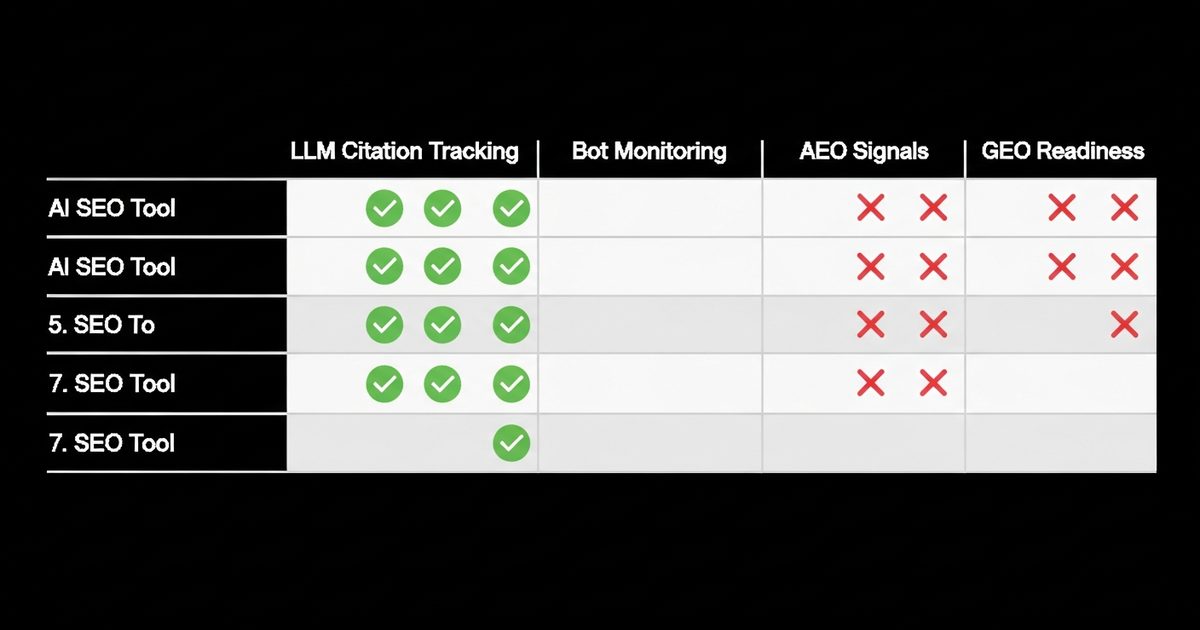
Across all 7 tools, here is how coverage of the 8 AI search visibility signals breaks down:
- AI crawler access check: 1 out of 7 tools (AI Rank Lab only)
- FAQPage schema analysis: 4 out of 7 tools (but only AI Rank Lab evaluates citation-readiness, not just validity)
- llms.txt detection: 1 out of 7 tools (AI Rank Lab only)
- Citation-readiness scoring: 1 out of 7 tools (AI Rank Lab only)
- Entity clarity analysis: 1 out of 7 tools (AI Rank Lab only)
- AI crawler monitoring: 1 out of 7 tools (AI Rank Lab only)
- Competitive citation tracking: 1 out of 7 tools (AI Rank Lab only)
The pattern is clear: the traditional SEO tool market has not yet built genuine AI search optimization capability. Most tools are using "AI" in marketing copy to describe features that use machine learning to do traditional SEO work faster - not to optimize visibility in AI search engines.
When You Need More Than Traditional SEO Tools
If your traffic analytics show clicks from ChatGPT, Perplexity, or Copilot URLs, you are already getting AI search referrals - and you need to understand and grow them. Traditional SEO tools cannot help with this because they were not designed to measure or optimize these signals.
The same is true if you are in a category where AI overviews dominate search results. When someone asks ChatGPT "what is the best accounting software for freelancers" and your competitor gets cited but you do not, no amount of Semrush audit work will close that gap. You need to understand why - and that requires an AEO-aware tool.
Signs you need a dedicated AI SEO analyzer:
- You can see AI search referral traffic in your analytics but it is not growing
- Competitors are frequently cited in AI answers for your target topics
- You have not verified whether your robots.txt allows AI crawlers
- You do not know whether you have an llms.txt file or whether you need one
- Your content answers common questions but you are not seeing AI citation growth
Conclusion: Most "AI SEO" Tools Are Not What They Claim
The majority of platforms marketed as AI SEO analyzer tools in 2026 are using AI to do traditional SEO work - generating content briefs, scoring topical relevance, predicting Google rankings. That is genuinely useful but has nothing to do with optimizing your visibility in ChatGPT, Perplexity, Claude, or Gemini.
Genuine AI search optimization requires auditing and monitoring a completely different set of signals: AI bot access, citation-ready content structure, FAQPage schema for direct answer extraction, llms.txt configuration, and competitive citation tracking. Of the 7 platforms we tested, only AI Rank Lab covers these signals comprehensively.
If you want to understand and improve your AI search visibility - not just your Google rankings - start with a full AI Rank Lab audit. The results will likely show gaps that none of your current SEO tools have flagged.
Frequently Asked Questions
What is an AI SEO analyzer tool?▾
Can Semrush or Ahrefs optimize for ChatGPT visibility?▾
What signals determine if ChatGPT or Perplexity cites my content?▾
Is llms.txt important for AI SEO?▾
How do I know if AI bots are crawling my site?▾
Get a Free AI Ranking Consultation
Want to improve your brand's visibility in AI search engines like ChatGPT, Gemini, and Perplexity? Fill out the form and our experts will create a personalized strategy for you.

Written by
Devanshu
Chief Marketing Officer & AI Search Optimization Architect
Digital Marketing Strategist & Pioneer in SEO, Answer Engine Optimization (AEO), and Generative Engine Optimization (GEO).


