


Every website has SEO problems it is not aware of. The average site has 14 critical technical SEO issues, 8 on-page gaps that limit ranking potential, and - increasingly - 5 or more AEO and GEO issues that reduce visibility in ChatGPT, Claude, and Gemini responses. Most of these issues are invisible without an audit tool and fixable without an agency.
AI Rank Lab's free SEO audit tool generates a complete website report in 90 seconds covering over 100 on-page, technical, AEO, and GEO signals - with prioritized fix recommendations for every finding. No signup required for the initial audit. No credit card.
What Makes This Different from Semrush, Ahrefs, and Neil Patel's Analyzer
Every major SEO tool offers some form of free site audit. The difference with AI Rank Lab is scope: traditional free SEO audits check traditional SEO signals. AI Rank Lab's free audit checks traditional SEO signals and AEO signals (ChatGPT, Claude, Perplexity, Gemini citation readiness) and GEO signals (generative engine optimization including llms.txt and AI crawler access) in a single report.
In 2026, a site audit that only checks Google-facing signals is incomplete. A significant and growing percentage of buyer discovery happens on AI platforms, not Google. A free audit that tells you your H1 is missing but does not tell you that GPTBot is blocked from your entire domain is giving you half the picture.
The comparison:
Audit Coverage | AI Rank Lab | Semrush | Ahrefs | Neil Patel |
|---|---|---|---|---|
Technical SEO | Yes | Yes | Yes | Yes |
On-page SEO | Yes | Yes | Yes | Yes |
Core Web Vitals | Yes | Yes | Limited | Yes |
Schema markup | Comprehensive | Basic | Basic | Basic |
AEO signals | Yes | No | No | No |
AI crawler access | Yes | No | No | No |
GEO / llms.txt | Yes | No | No | No |
ChatGPT citation rate | Yes | No | No | No |
Free with no signup | Yes | Limited | No | Yes |
What the Free SEO Audit Checks
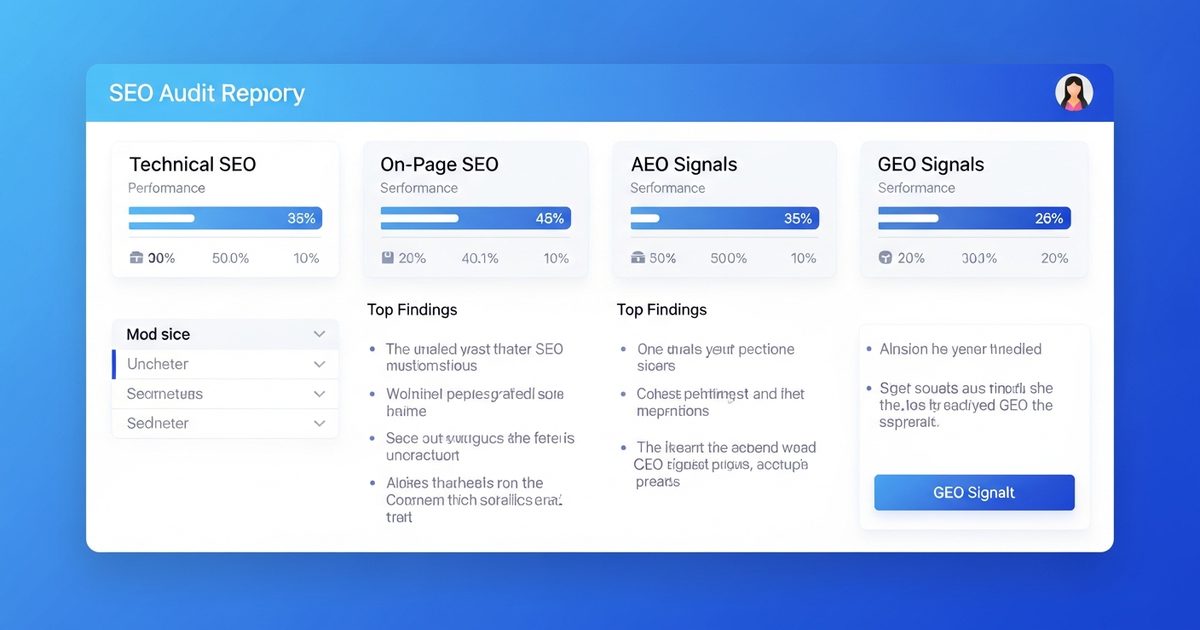
The audit covers four signal categories. Here is what each checks and why each matters:
Category 1: Technical SEO (35 signals)
Technical signals determine whether search engines - and AI crawlers - can access, crawl, and index your site correctly. Technical problems cap the performance of all other SEO work: even excellent content will not rank if crawlers cannot reach it or if page speed causes Google to deprioritize it.
The audit checks: HTTPS and SSL certificate validity, page load speed (LCP, FID, CLS - Core Web Vitals), mobile-friendliness score, robots.txt validity and AI crawler access rules, XML sitemap presence and validity, canonical tag implementation, URL structure and redirect chains, broken links on crawled pages, duplicate content indicators, and server response codes across sampled pages.
Each technical finding includes a severity rating (critical, high, medium, low) and the specific impact on your Google ranking potential and AI crawler access. Critical findings are flagged with a red badge and shown first in your prioritized fix list.
Category 2: On-Page SEO (28 signals)
On-page signals determine how well each page is optimized for its target keyword and how clearly it communicates its topic to search engines and LLMs. On-page issues are typically faster to fix than technical issues and often have the most direct impact on ranking positions for specific keywords.
The audit checks: title tag presence, length (50-60 characters), and keyword inclusion; meta description presence, length (140-160 characters), and relevance; H1 presence and uniqueness per page; heading hierarchy logic (H1-H2-H3 structure); keyword usage in headings and body content; content length relative to query complexity; internal link density and anchor text distribution; image alt text completeness; and URL readability and keyword inclusion.
Category 3: Schema Markup (22 signals)
Schema markup is critical for both traditional SEO (featured snippets, rich results) and AEO/GEO (LLM citation quality and entity recognition). The audit checks schema completeness more thoroughly than traditional SEO tools, assessing not just whether schema types are present but whether the fields that matter most for AI citation confidence are populated.
Schema types checked: Organization (with sameAs validation), FAQPage (question count and answer length quality), Article and BlogPosting (author, dateModified, publisher completeness), BreadcrumbList, Product or SoftwareApplication (for product pages), and LocalBusiness (where applicable). For each schema type found, field-level completeness is checked against recommended property sets.
Category 4: AEO and GEO Signals (20 signals)
This is the category that makes AI Rank Lab's free audit unique among SEO tools. It covers the signals that determine your visibility in AI answer engines - signals that traditional SEO audits completely miss.
AEO signals checked: GPTBot allowed in robots.txt, ClaudeBot allowed, PerplexityBot allowed, Google-Extended allowed; FAQPage schema present on product and key content pages; Organization schema entity clarity (name, description, sameAs completeness); author schema on blog content; E-E-A-T signals (About page completeness, Contact page presence, named authors with linked credentials).
GEO signals checked: llms.txt file presence and validity; absence of unintentionally broad AI-use prohibition language in Terms of Service or robots.txt; content structure signals for AI extractability (direct answer placement, data point density, heading coverage of topic).
How to Run Your Free SEO Audit
Enter your website URL (homepage or any specific page you want to audit).
Click "Run Free Audit" - no account or email required for the initial run.
Wait 60-90 seconds while the tool crawls and analyzes your site.
Review your overall SEO score and the four-category breakdown.
Work through the prioritized findings list starting with critical issues.
Creating a free account (email only) saves your report for future comparison, enables auditing additional pages beyond the homepage and top indexed pages, and unlocks the option to rerun audits after implementing fixes to measure improvement. The free account requires no payment information.
Reading Your SEO Audit Report
Your report opens with an overall SEO health score (0-100) and a traffic-light summary per category. The most actionable section is the findings list.
Priority the findings correctly: Sort by the impact-to-effort ratio, not just by severity. A Critical/Easy finding (e.g., missing H1 on homepage) should be fixed before a Critical/Hard finding (e.g., no backlinks from authoritative sources) because the easy fix delivers impact faster. The findings list is pre-sorted this way by default - work through it from top to bottom.
AEO findings are new for most sites: Most teams have never seen AEO or GEO findings in an audit report. Treat these with the same priority as technical findings - a blocked GPTBot is as impactful as a broken sitemap for your AI search visibility, and the fix is comparably simple.
Schema findings often surprise: Many sites have schema markup but fail on field completeness. A FAQPage schema with 2 FAQ entries is better than none, but 6-8 entries with questions matching actual user queries is where citation rate impact becomes measurable. The audit shows exactly which fields are missing and which are present.
Who the Free Audit Is For
Website owners and in-house marketers: Get a complete picture of your site's SEO and AI visibility health without paying for Semrush or Ahrefs. The prioritized findings list tells you exactly what to fix and in what order - you do not need an agency to interpret it.
Agencies and consultants: Use the free audit for prospect analysis and client onboarding. Running a free audit on a prospect's domain generates specific, quantified findings that make for a more compelling pitch than generic capability claims. The AEO and GEO findings in particular are often entirely new to prospects and create immediate value-demonstration moments.
Developers and technical SEO specialists: The schema completeness checking and AI crawler access audit go deeper than most tools. Use it to validate implementations after schema changes or robots.txt updates - the audit confirms that the changes are being correctly detected, not just that the edits were made.
Free Audit vs Paid Plans
The free audit covers your homepage and top indexed pages with a one-time snapshot. Paid plans extend coverage and add ongoing monitoring:
Full-site crawl: Paid plans crawl all indexed pages rather than just the top pages - important for large sites where AEO or technical issues may exist on deeper pages not included in the free audit sample.
Weekly automated re-audit: Catches regressions introduced by site changes, plugin updates, or CDN configuration changes before they compound into traffic or citation rate losses.
Citation rate tracking: Tracks your ChatGPT, Claude, Perplexity, and Gemini citation rates over time alongside the audit findings, closing the loop between what the audit identified and whether fixing it improved your AI visibility.
Competitor audit comparison: Runs the same audit on your top competitors and shows you their scores alongside yours - identifying where competitors have AEO or technical advantages worth addressing.
Paid plans start at $49/month. See full pricing here.
For teams at the start of their SEO and AEO programs, the free audit provides everything needed to identify the highest-impact fixes. Once those are implemented, ongoing automated monitoring becomes the next investment - ensuring you catch new issues before they compound rather than discovering them in the next manual audit.
Run your free website SEO audit now - complete report in 90 seconds, no signup required.
Frequently Asked Questions
Is AI Rank Lab's SEO audit really free?▾
What does a free SEO audit check?▾
How is AI Rank Lab's free SEO audit different from Semrush or Ahrefs?▾
How long does a free SEO audit take?▾
What should I fix first after an SEO audit?▾
Does a free SEO audit include AEO and GEO checks?▾
Get a Free AI Ranking Consultation
Want to improve your brand's visibility in AI search engines like ChatGPT, Gemini, and Perplexity? Fill out the form and our experts will create a personalized strategy for you.

Written by
Devanshu
Chief Marketing Officer & AI Search Optimization Architect
Digital Marketing Strategist & Pioneer in SEO, Answer Engine Optimization (AEO), and Generative Engine Optimization (GEO).


