


Search your inbox for "GEO" from the last six months and you will find it used to mean three different things: sometimes it is a synonym for AEO, sometimes it is described as a broader category that includes AEO, and sometimes it refers specifically to optimizing for generative AI training data rather than real-time citation. Add SEO into the conversation and the definitional confusion compounds.
The confusion is not just semantic. Treating GEO, AEO, and SEO as interchangeable leads to misallocated effort: optimizing for Google rankings when your buyers are starting their research on ChatGPT, or vice versa. Getting the distinctions clear is a practical prerequisite for building an optimization strategy that maps to how your buyers actually discover and evaluate you.
This guide defines each discipline precisely, compares them across goals, signals, tools, and KPIs, identifies where they overlap, and shows how to run all three as a unified workflow.
Definitions First
SEO (Search Engine Optimization) is the practice of improving a website's visibility in traditional search engine results - primarily Google and Bing. Its goal is higher organic rankings for target keywords, which drives clicks and traffic to your site. SEO has been the dominant organic acquisition channel for twenty years and has a mature set of tools, signals, and measurement approaches.
AEO (Answer Engine Optimization) is the practice of making your content citable by AI answer engines - ChatGPT, Claude, Perplexity, and Gemini - when those platforms generate answers to user queries. Its goal is appearing as a cited source in AI responses for queries your target audience is asking those platforms. AEO is a distinct channel from Google organic because being cited by ChatGPT does not require or guarantee ranking on Google.
GEO (Generative Engine Optimization) is the broadest of the three terms. It encompasses AEO's citation-focused work and extends to the full relationship between your brand and generative AI systems: how LLMs describe your brand (not just whether they cite you), how your content enters training data, how you communicate AI-specific directives via llms.txt, and how you shape your brand's narrative across the generative AI ecosystem. AEO is the measurement-and-citation subset of GEO.
Side-by-Side Comparison
Dimension | SEO | AEO | GEO |
|---|---|---|---|
Primary goal | Rank higher on Google/Bing | Get cited by ChatGPT, Claude, Perplexity, Gemini | Shape how generative AI describes and references your brand |
Channel | Google Search, Bing | ChatGPT, Claude, Perplexity, Gemini | All generative AI platforms including training data |
Primary KPI | Organic keyword rankings, traffic | Citation rate per LLM per keyword cluster | AI visibility score, brand description accuracy, share of voice in AI responses |
Top signals | Backlinks, Core Web Vitals, on-page keywords, E-E-A-T | Bot access, FAQPage schema, entity clarity, content depth, topical authority | All AEO signals plus llms.txt, brand narrative consistency, training data presence |
Key tools | Semrush, Ahrefs, Google Search Console, Screaming Frog | AI Rank Lab, Otterly.ai, Sona, GetAIRefs | AI Rank Lab, Geoptie, Profound, llms.txt generators |
Content format priority | Long-form, keyword-dense, internally linked | FAQ-structured, schema-marked, entity-clear | AI-readable summaries, structured facts, brand narrative pages |
Measurement cadence | Weekly rank tracking, monthly traffic review | Weekly citation rate tracking, monthly AEO score review | Monthly AI visibility report, quarterly brand narrative audit |
Time to impact | 3-6 months for new content, 2-6 weeks for technical fixes | 3-8 weeks for technical/schema fixes, 3-6 months for authority | 4-12 weeks for citation and description improvements |
Maturity | 20+ years, highly mature | 2-3 years, rapidly maturing | 1-2 years, early stage |
SEO: What It Is and What It Does Not Cover
SEO is the most mature of the three disciplines and the one with the most established playbook. Its core loop: identify keywords your target audience searches, create content that ranks for those keywords, build the authority signals (backlinks, brand mentions, E-E-A-T) that move those rankings up, and convert the resulting traffic.
SEO tools - Semrush, Ahrefs, Moz, Google Search Console - measure ranking positions, organic click-through rates, backlink profiles, and on-page optimization signals. The feedback cycle is relatively clear: implement a change, wait 4-8 weeks, check whether rankings moved.
What SEO does not cover: your brand's visibility in ChatGPT or Claude responses. Google's organic rankings and LLM citation decisions are driven by different signals and measured in different systems. A site that ranks number one on Google for a keyword can be entirely absent from ChatGPT responses on the same query - and frequently is. The channels are independent, though some underlying content quality signals overlap.
Google's AI Overviews (the AI-generated summaries in Google Search results) are a partial exception - they are driven in part by SEO signals and are tracked by SEO tools like Semrush and SE Ranking. But Google AI Overviews are a feature of Google Search, not a separate AI platform. Optimizing for Google AI Overviews is SEO work. Optimizing for ChatGPT citations is AEO work.
AEO: What It Is and What It Does Not Cover
AEO is the practice of making your content the preferred citation source when ChatGPT, Claude, Perplexity, and Gemini generate answers to queries in your topic area. The core goal is citation rate: what percentage of the time does each LLM cite your brand or content when answering your target queries?
AEO signals are partly technical (bot access, schema markup, entity clarity) and partly content-based (depth, structure, topical authority, FAQ quality). The complete AEO guide covers all signal categories in detail. The key point for this comparison: AEO is measurable at the query level - you can run a specific query through an AEO tracking tool and know exactly whether you are cited, which competitor is cited instead, and how often your citation rate is improving or declining.
What AEO does not fully cover: how LLMs describe your brand when they do mention you. You might be cited 60% of the time for a target query, but if Claude consistently describes your product in a way that misrepresents its category or competitive positioning, the citation is not delivering its full value. That is where GEO's brand narrative work extends beyond AEO's citation-rate focus.
GEO: What It Is and What Makes It Distinct
GEO is the broadest framing for the full scope of optimizing your brand's presence in the generative AI ecosystem. It includes everything AEO covers and adds:
Brand narrative management: How do different LLMs describe your product, your category, your competitive positioning? GEO audits track not just whether you are cited but what is said when you are cited - and whether that description matches your intended brand positioning. Gaps between your actual positioning and LLM-generated descriptions are addressable through content that explicitly states your positioning in citable, structured language.
Training data signals: LLMs cite sources based partly on what they have learned during training. The content that shapes training data - authoritative publications, reference databases, industry reports - influences citation preferences even in real-time browsing modes. GEO work includes ensuring your brand is accurately and comprehensively represented in the content that shapes LLM training.
llms.txt and AI-specific directives: The llms.txt standard allows you to communicate directly with AI crawlers about how you want your content to be used. This is a GEO-specific optimization layer with no SEO or pure AEO equivalent. Implementing llms.txt communicates your preferred citation format, content access permissions, and brand narrative guidance directly to the systems making citation decisions.
Cross-platform AI visibility: GEO thinking extends beyond the four major LLMs to AI-powered search features in other platforms - Perplexity, You.com, AI assistants embedded in productivity software, and future platforms not yet dominant. GEO is the orientation that positions your brand for AI visibility broadly, rather than optimizing for specific current platforms.
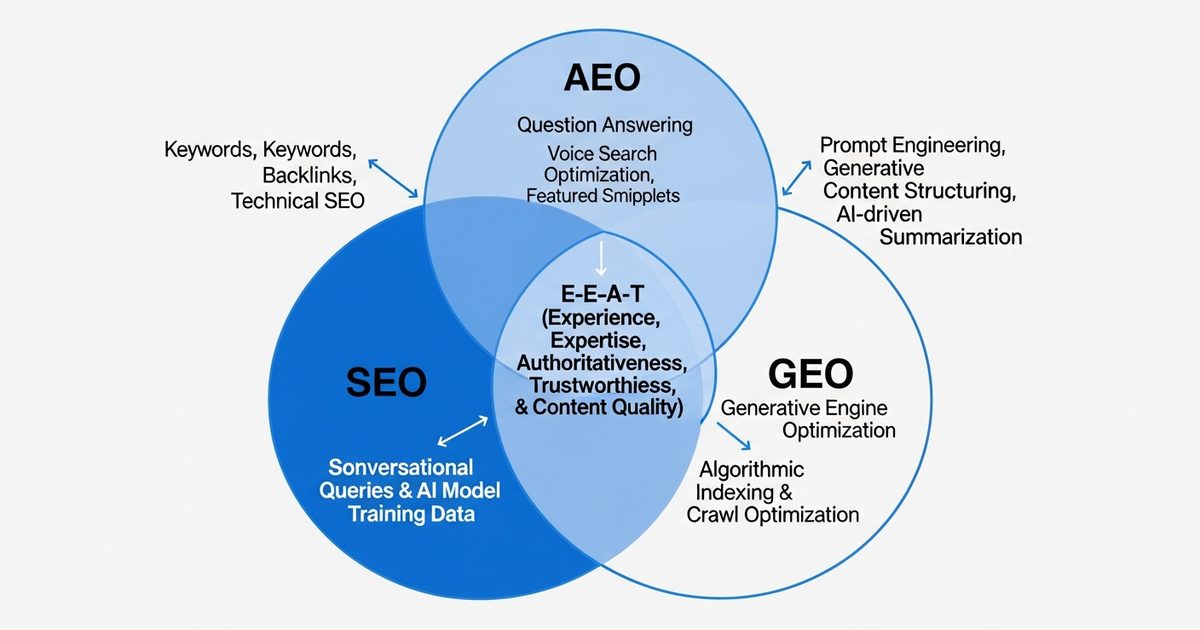
Where SEO, AEO, and GEO Overlap
The three disciplines share a significant common foundation. Work that improves performance in one area often improves performance in the others:
E-E-A-T signals: Experience, Expertise, Authoritativeness, and Trustworthiness signals - named authors, authoritative backlinks, credible organizational identity - improve Google rankings, increase Claude citation confidence, and strengthen training data presence simultaneously. E-E-A-T work has the highest cross-discipline ROI of any optimization investment.
Schema markup: Structured data improves how search engines parse your content for featured snippets and AI Overviews (SEO benefit), how LLMs extract and cite your content (AEO benefit), and how generative AI systems understand your brand entity (GEO benefit). FAQPage schema in particular has measurable positive effects across all three disciplines.
Content quality and depth: Comprehensive, well-structured content outperforms thin content for Google rankings, for LLM citation rates, and for brand narrative accuracy. The investment in high-quality topical content delivers returns across all three channels simultaneously.
Technical accessibility: Fast, crawlable, accessible pages perform better across all three disciplines. Fixing Core Web Vitals helps SEO. Fixing bot access helps AEO. Both contribute to GEO. Technical site health is a prerequisite rather than a discipline-specific optimization.
The Unified Workflow
Rather than running three separate optimization programs, the most efficient approach treats SEO, AEO, and GEO as layers of a single workflow:
Foundation layer (shared): Technical site health, E-E-A-T signals, schema markup, and content quality standards apply across all three disciplines. Build this foundation first. A technically sound site with strong content quality and complete schema markup performs better in Google rankings, LLM citation rates, and generative AI brand representation simultaneously.
SEO layer: Keyword research, on-page optimization, backlink building, and Google-specific signals. This work drives organic search traffic and contributes to the authority signals that benefit AEO and GEO as secondary effects.
AEO layer: Bot access audit, FAQPage schema on priority pages, entity clarity fixes, citation rate tracking across ChatGPT, Claude, Perplexity, and Gemini. Use an AEO tool like AI Rank Lab's AEO audit to establish your citation rate baseline and prioritize technical fixes.
GEO layer: llms.txt implementation, brand narrative audit (how do LLMs describe you?), training data presence assessment, and AI visibility score tracking. This layer extends AEO work to address how the broader generative AI ecosystem represents your brand.
Which to Prioritize
The right prioritization depends on where your buyers are in their discovery journey and which channels drive the most valuable first-touch interactions for your specific audience.
For B2B SaaS companies targeting technical buyers: ChatGPT and Perplexity are already significant discovery channels. AEO and GEO deserve parallel investment with SEO, not sequential investment after SEO is mature.
For consumer brands with existing strong Google presence: AEO gaps are likely significant and growing as consumer AI adoption accelerates. Adding AEO measurement and fixes onto an existing SEO foundation is the most efficient path to the next channel's returns.
For new brands without established Google authority: Build the shared foundation (E-E-A-T, schema, content quality) first - it benefits all three disciplines simultaneously. Then run AEO and SEO in parallel rather than sequencing SEO first, because AEO technical wins can be achieved faster than SEO authority building.
In all cases, the first step is establishing measurement baselines for all three channels: Google Search Console for SEO, and an AEO tracking tool for citation rates across LLMs. You cannot prioritize what you cannot measure.
Run your free AI Rank Lab AEO and GEO audit to establish your citation rate baseline across ChatGPT, Claude, Perplexity, and Gemini - and see the specific technical and content signals holding your scores down relative to competitors.
Frequently Asked Questions
What is the difference between GEO and AEO?▾
What is the difference between GEO and SEO?▾
Should I do SEO or GEO first?▾
What is GEO in digital marketing?▾
Does SEO help with GEO?▾
What tools are used for GEO?▾
Get a Free AI Ranking Consultation
Want to improve your brand's visibility in AI search engines like ChatGPT, Gemini, and Perplexity? Fill out the form and our experts will create a personalized strategy for you.

Written by
Devanshu
Chief Marketing Officer & AI Search Optimization Architect
Digital Marketing Strategist & Pioneer in SEO, Answer Engine Optimization (AEO), and Generative Engine Optimization (GEO).


