


Most pages that rank for this query are vendor rankings. This one is not, for a reason worth stating up front: a large share of what the link building industry sells is, in Google's own words, a policy violation, and no honest buying guide can rank those offers as though the only variable were price.
We cannot buy from these vendors, audit their inventory or verify their claims, so nothing here is a quality review. What we can do is read what each vendor publishes about itself, on a stated date, and set it against what Google's documentation actually says. That is the guide below: what the category sells, where the line sits, what the published prices are, and the questions that separate a supplier who earns coverage from one who resells placements.
What do link building services actually sell?
Five products, sold under many names. Knowing which one you are being quoted for matters more than the vendor's logo.
- Guest posts. The vendor writes an article and places it on a third-party site, with a link back to you inside it. The placement is normally paid for, whether or not you are told that.
- Niche edits, also called link insertions or curated links. Your link is added into an article that already exists and already ranks. Faster and cheaper than a guest post, and almost always a payment to the site owner.
- Digital PR. The vendor builds something worth covering, usually original data or a study, and pitches journalists. The coverage is earned and unpaid, so the links cannot be guaranteed.
- Content promotion and editorial outreach. You already have an asset; the vendor gets it in front of people who might cite it, including recovering unlinked brand mentions.
- Marketplace inventory. A catalogue of sites with authority scores and a price per placement, which you browse and buy from directly.
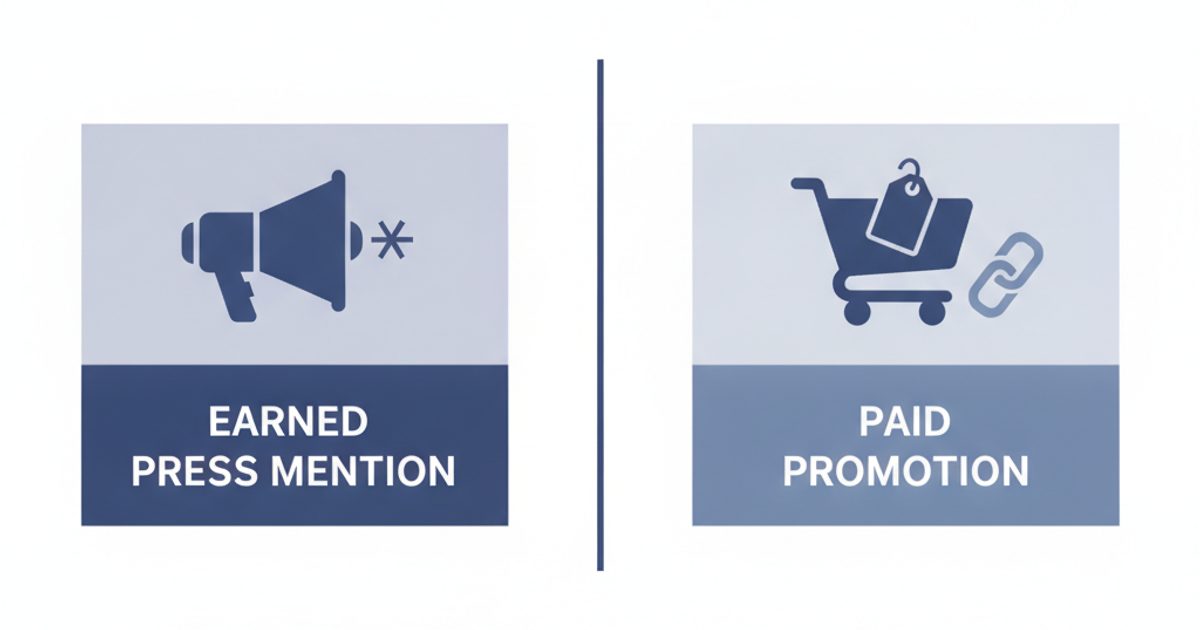
The first two and the last are purchases. The middle two are pitches. That distinction is the whole article.
What does Google's link spam policy actually say about paid links?
It says the transaction is fine and the ranking credit is not. Google's spam policies for web search, last updated 28 August 2026, define link spam as "the practice of creating links to or from a site primarily for the purpose of manipulating search rankings" and list among the examples "buying or selling links for ranking purposes", which it expands to include "exchanging money for links, or posts that contain links" and "exchanging goods or services for links".
The same list names several other things this industry sells routinely: "excessive link exchanges", "advertorials or native advertising where payment is received for articles that include links that pass ranking credit", "low-quality directory or bookmark site links" and "widely distributed links in the footers or templates of various sites".
Then comes the sentence buyers rarely get shown. Google states: "Google does understand that buying and selling links is a normal part of the economy of the web for advertising and sponsorship purposes. It's not a violation of our policies to have such links as long as they are qualified with a rel="nofollow" or rel="sponsored" attribute value." The companion page on qualifying outbound links, last updated 10 December 2025, tells publishers to mark advertisements and paid placements with rel="sponsored".
So the policy line is precise. Paying for a placement is allowed. Paying for a placement that passes ranking credit is the violation. Nearly every paid link product on the market is sold specifically on the promise that it is do-follow, which is to say sold on the part that breaks the rule.
Is buying backlinks safe, or will Google penalise my site?
The realistic answer is that the common outcome is wasted money rather than a penalty, and the uncommon outcome is severe. Both mechanisms exist.
The first is algorithmic. Google's systems attempt to detect manipulated links and discount them, which means the usual result of a purchased link is simply that it does nothing. You paid $300 for a signal that was neutralised on arrival, and because nothing visibly broke, you have no way to know.
The second is a manual action. Google's Search Console help documents an "Unnatural links to your site" action, issued when "Google has detected a pattern of unnatural, artificial, deceptive, or manipulative links pointing to your site". Recovery is not a button. The documented path is to audit your backlink profile, contact site owners to remove links or add a nofollow attribute, disavow what you cannot get removed, then file a reconsideration request documenting what you did. Months of work, and the traffic loss runs the whole time.
Judge it as an unhedged bet rather than a moral question. If your business is a brochure site for a local trade, the downside of a discounted link is small. If you are a funded company whose pipeline depends on organic search, you are risking the channel to save the harder work, and the vendor carries none of that risk.
Which link building tactics are compliant with Google's guidelines?
The compliant ones share a single property: the publisher chose to link without being paid to.
| Tactic | Position under Google's policy | Why |
|---|---|---|
| Digital PR with original data or research | Compliant | The journalist links because the story is worth covering. No payment for the link. |
| Content promotion and editorial outreach | Compliant | You pitch an asset; the publisher decides. Refusal is a real possibility, which is the point. |
| Unlinked brand mention recovery | Compliant | The coverage already exists and was already editorial. |
| Broken link and resource page outreach | Compliant when the replacement genuinely fits | Nothing changes hands; you are fixing a page. |
| Sponsorships and paid placements marked rel="sponsored" | Compliant | Google explicitly permits paid links qualified with the attribute. |
| Paid do-follow guest posts and niche edits | Link scheme | "Buying or selling links for ranking purposes", named in the policy. |
| Private blog networks | Link scheme | Sites that exist to pass links, which is the definition of link spam. |
| Link exchanges run at scale | Link scheme | "Excessive link exchanges" is on the policy's list. |
| Guaranteed-DR placement packages | Link scheme in practice | A guaranteed placement on a named authority tier implies payment; editorial decisions cannot be promised. |
Do link building agencies publish their prices or the sites they place links on?
We checked eight established vendors at source on 16 September 2026. Half publish a price. None publishes, openly and without an account, the list of sites it places on. That second number is the finding.
| Vendor | Published price (checked 16 Sep 2026) | Stated method | Placement sites disclosed publicly | Metric or volume guarantee |
|---|---|---|---|---|
| The HOTH | Yes: $175 at DA/DR 20+, $225 at 30+, $345 at 40+, $405 at 50+ per link | Link outreach priced by authority band | No, reporting after purchase | Yes, authority band plus six-month replacement |
| Editorial.Link | Yes: $375 per link; $1,750 for 5; $6,000 for 20 | Outreach placements | No | Stated as averages: DR 50-90, 5k+ traffic |
| Rhino Rank | Yes: curated links from $60, guest posts from $75, listicles from $135, press releases from $99 | Curated links, guest posts, listicles | No | No metric guarantee; refund up to $550 on a first order |
| Loganix | Partly: niche edits from $100, marketplace links from $99; premium quoted | Marketplace of 25,000 sites plus managed placements | Inventory browsable in-account, not public | Premium editorial stated as DR70+, brand mentions DR50+ |
| Page One Power | No, quote only behind a form | Manual outreach, broken link building, unlinked mentions, digital PR | No | No |
| uSERP | No, quote only | Editorial outreach, digital PR, unclaimed brand mentions | No | No count guarantee; replaces removed mentions within six months |
| Siege Media | No, quote only; cites an effective cost per link under $250 as a typical outcome | Content that earns links passively | No | No, explicitly refused |
| Sure Oak | No, quote only | Prospecting, vetting, outreach | No | No |
Read the middle two columns together and the pattern is hard to miss. Every vendor that publishes a price publishes it banded by Domain Rating or Domain Authority. You cannot band an earned mention by authority tier in advance, because you do not control whether the journalist runs it. A price list organised by DR is a price list for inventory, and inventory means the placement was bought. That is not a judgement of those companies, several of which are long-established and transparent about exactly this. It is what their own pages tell you if you read the pricing structure as evidence.
The quote-only vendors are not automatically cleaner. Quote-only is also where an outreach retainer lives, and where a resold marketplace link can hide behind the word "bespoke". Absence of a price is not a signal in either direction. The structure of the price, when there is one, is.
How much should a single backlink cost?
From the published rates above, the working range for a bought placement in 2026 is roughly $60 to $405 per link, and a managed campaign that earns coverage prices as a retainer instead. Siege Media cites an effective cost per link under $250 as a typical outcome of its content-led model rather than a rate card, which is a useful benchmark for what a link is worth when nobody paid the publisher for it.
Three things follow. First, very cheap links are cheap because the site accepting them accepts everything; under about $60 you are almost certainly buying from a network. Second, the price you pay is set by the placement site's authority score, not by whether the link will work, and authority scores are third-party estimates that vendors on both sides optimise for. Third, a $375 link that Google discounts costs the same as a $375 link that works. There is no partial refund for a neutralised signal, which is why vendors sell placements and almost never sell outcomes.
How do I spot a private blog network before I pay for placements?
Ask for three to five example live placements from recent client work, then check each site yourself. The tells are consistent and you do not need a tool subscription to see most of them.
- No real audience. Traffic that is near zero while the authority score is high means the score was manufactured, not earned.
- Topical incoherence. A site publishing on dentistry, crypto, casinos and pet insurance in the same month is not a publication. It is a placement surface.
- Every post is a guest post. No staff writers, no bylines that appear twice, no editorial voice.
- A public "write for us" page with a price. That is the business model stated out loud.
- Outbound links all point at commercial money pages with exact-match anchors, and the surrounding paragraph reads as though it was written around the link.
- Hidden ownership. No named editor, no address, privacy-shielded registration, a template shared with other sites in the same pitch.
- The vendor will not name the site before you buy. If a placement cannot be shown to you until payment clears, you are being sold inventory that would not survive inspection.
Why is a guaranteed DR or a guaranteed number of placements a red flag?
Because a guarantee is a confession about supply. An editor deciding to cite you is not something a vendor can promise, so any firm promise of twenty links next month at DR 50 or above means the vendor already controls, or can reliably buy, the placements. Guarantee and earned coverage are mutually exclusive.
This is exactly why the refusal is the more credible signal. Siege Media's own service page declines to guarantee link volume on the grounds that natural link generation is volatile month over month. uSERP frames success in revenue, profit and qualified leads rather than link counts. Page One Power describes tactics and declines to attach numbers. Read a refusal to guarantee as the vendor telling you the truth about what it controls.
Treat replacement warranties separately and more kindly. A promise to replace a link that disappears within six months, which The HOTH and uSERP both publish, is a service commitment about durability, not a promise of an editorial decision.
What is the difference between niche edits, guest posts and digital PR?
Who decided to publish, and whether money changed hands for the decision.
A niche edit inserts your link into a page that already exists and already has some standing. It is the fastest product in the category, and it is a purchase: an existing article does not get edited to add your link for free. A guest post produces a new article on someone else's site containing your link. A few publications genuinely accept contributed articles on merit, and those are worth pursuing; the volume product sold under this name is a paid placement with an article attached.
Digital PR is a different job. You create something citable, usually original data, a study or a tool, and pitch it to writers covering that beat. The hit rate is lower, the timeline is longer, nothing is guaranteed, and the links you do get come from publications that will not sell a placement at any price. It is also the only one of the three that produces coverage a competitor cannot simply buy next week at the same rate you did.
What questions should I ask a link building agency before I sign?
Nine questions. The wording of the answers tells you more than the answers themselves.
- Do you pay the publisher, in money, product or service, for any placement in this campaign? A straight answer is the whole test; hedging is the answer.
- Show me five placements from the last ninety days, on live URLs, for any client.
- Will the links be do-follow, and if you are paying for them, why are they not marked
rel="sponsored"? - Do you own, part-own or have a standing commercial relationship with any of the placement sites?
- What proportion of this retainer is outreach labour versus placement fees paid out?
- What happens if a pitch is declined? A vendor with no answer has never had one declined.
- Will you tell me the target site before placement and let me veto it?
- What do you report on besides link count and DR?
- If Google issues a manual action for unnatural links, what do you do? Get the answer in the contract, not the call.
What happens if I already bought backlinks and want to recover?
If traffic is intact and Search Console shows no manual action, the likely position is that the links were discounted and you lost the money, not the site. Stop buying, and do not panic-disavow a healthy profile; disavow is a blunt instrument and Google's guidance treats it as a remedy for manipulative links you cannot get removed, not routine hygiene.
If there is a manual action in Search Console, follow the documented path rather than improvising: pull the backlink list, prioritise recent and high-volume sources, ask site owners to remove the links or add a nofollow attribute, disavow what will not come down, then submit a reconsideration request that states plainly what you bought, from whom, what you removed and what you changed so it does not recur. Candour helps here. Reviewers see a lot of requests that pretend the links appeared spontaneously.
The buying decision, stated plainly
If you want links that cannot be neutralised and cannot be bought out from under you by a competitor, buy the work that earns them: original data, a genuinely useful asset, and someone who will pitch it and be refused sometimes. It is slower, it is priced as a retainer, and nobody will guarantee you a number.
If you buy placements instead, do it with your eyes open. You are buying a signal Google's policy names as a violation, from a supplier who will not show you the site list, priced by a third-party score, with the downside sitting entirely on your domain. Some sites make that trade and do fine. Just make it as a decision you priced, rather than one a ranking listicle made for you.
Frequently Asked Questions
What do link building services actually sell?▾
Is buying backlinks safe, or will Google penalise my site?▾
What does Google's link spam policy actually say about paid links?▾
Which link building tactics are compliant with Google's guidelines?▾
How much should a single backlink cost?▾
How do I spot a private blog network before I pay for placements?▾
Why is a guaranteed DR or a guaranteed number of placements a red flag?▾
Do link building agencies publish their prices or the sites they place links on?▾
What is the difference between niche edits, guest posts and digital PR?▾
What questions should I ask a link building agency before I sign?▾
What happens if I already bought backlinks and want to recover?▾
Get a Free AI Ranking Consultation
Want to improve your brand's visibility in AI search engines like ChatGPT, Gemini, and Perplexity? Fill out the form and our experts will create a personalized strategy for you.

Written by
Devanshu
Chief Marketing Officer & AI Search Optimization Architect
Digital Marketing Strategist & Pioneer in SEO, Answer Engine Optimization (AEO), and Generative Engine Optimization (GEO).


