


A few years ago, your content strategy came down to one question: what keywords do we want to rank for? You picked your targets, wrote thorough pages, earned some links, and watched Google send you traffic. That was the whole loop.
Now there are four acronyms on the whiteboard - SEO, AEO, GEO, AIO - and most marketing teams are not entirely sure which ones they are already doing, which ones they should be doing, or whether any of them actually differ in a way that changes their day-to-day work.
They do differ. But not in the way most comparison articles suggest. This guide cuts through the noise: clear definitions, concrete examples, a side-by-side breakdown, and a prioritization guide so you know exactly where to focus given where you stand right now.
Why Four Acronyms Exist for Essentially the Same Goal
All four strategies share the same end objective - getting your content in front of people who are looking for what you offer. The reason they splintered into separate terms is that the surfaces where people find information have multiplied dramatically.
As recently as 2022, "search" meant Google. You typed a query, you got ten links, you clicked one. That funnel was predictable enough that a single discipline - SEO - could handle the whole job.
Then a few things happened at once. AI assistants arrived and started answering questions directly, bypassing the link list entirely. Google responded by inserting AI-generated summaries at the top of its own results. Voice search kept growing. Reddit and YouTube began capturing more discovery queries. And the share of searches going to traditional blue-link results dropped.
Google's global search market share has declined from roughly 93% to somewhere in the 65 to 70% range as of 2025, as users spread queries across ChatGPT, Perplexity, Claude, Gemini, and other AI-native platforms. That shift is what produced four distinct disciplines - each targeting a different surface in the modern discovery landscape.
What Is SEO?
SEO - Search Engine Optimization - is the original discipline. It is the practice of making your web pages more likely to appear prominently when someone uses a traditional search engine like Google, Bing, or DuckDuckGo.
The four core pillars have not changed much in a decade:
- Technical health - site speed, mobile responsiveness, crawlability, Core Web Vitals, structured data
- On-page optimization - keyword targeting, title tags, meta descriptions, heading hierarchy, internal linking
- Content quality - depth, originality, accuracy, and demonstrating E-E-A-T (Experience, Expertise, Authoritativeness, Trust)
- Link authority - backlinks from credible, relevant domains that signal your site is worth ranking
SEO is still the foundation. It feeds your conversion funnel, builds domain authority, and provides the credibility signals that every other discipline builds on. Reports of SEO's death are, as usual, premature. What has changed is that SEO alone no longer reaches your whole audience - because a growing chunk of that audience is not using traditional search at all.
What Is AEO?
AEO - Answer Engine Optimization - is the practice of structuring content so that search engines and AI systems can extract a direct, authoritative answer to a specific question and display it without requiring the user to click through to your page.
The most visible AEO placements include:
- Featured snippets (position zero in Google) - the highlighted answer box above the first organic result
- People Also Ask boxes - the expandable question-and-answer accordions in search results
- Google AI Overviews - the AI-synthesized summaries that appear above organic results for many queries
- Voice search responses - what Siri, Alexa, or Google Assistant reads aloud when someone asks a question
The mental model for AEO: imagine someone asks your content a direct question out loud. Your page should be able to answer in two or three clear sentences before elaborating. If the best answer is buried 600 words deep inside dense prose, no algorithm will surface it as a snippet.
AEO tactics in practice:
- Open each section with a direct one or two sentence definition or answer before elaborating
- Use question-phrased subheadings ("What is AEO?" / "How does featured snippet selection work?")
- Add FAQ schema markup so Google can parse individual question-and-answer pairs
- Keep snippet-targeting answers concise - 40 to 60 words tends to hit the sweet spot
- Use numbered lists and structured bullet points, which are easier for algorithms to extract cleanly
Where AEO diverges from SEO: SEO wants your page to rank in a list. AEO wants your page to be the answer - often replacing the click entirely. It is a winner-takes-all dynamic. The featured snippet position either goes to your content or it does not.
What Is GEO?
GEO - Generative Engine Optimization - is the newest of the four disciplines and the one most teams are still figuring out. It focuses on optimizing content so that large language models (LLMs) - the engines powering ChatGPT, Perplexity, Claude, and Gemini - include your brand, your content, or your expertise in the responses they generate.
Here is the critical difference from AEO: GEO is not about winning a single featured slot. It is about becoming a source that AI systems trust and reference repeatedly across many different queries. When Perplexity synthesizes a multi-paragraph answer about, say, "best CRM tools for small teams," it draws from dozens of sources simultaneously. GEO asks: how does your content become one of those sources?
What actually influences GEO visibility:
- Brand mentions across authoritative sites - the more credible sources reference your brand, the more the models that trained on that content associate you with your category
- Structured, quotable content - LLMs prefer content with clean summaries, defined terms, stat blocks, and comparison tables they can lift and reference clearly
- Topical authority - covering a subject comprehensively across multiple interlinked pages signals deep expertise that AI systems reward
- Credibility signals - original research, expert author attribution, accurate citations, and transparent sourcing all increase how much weight AI systems give your content
- Freshness for fast-moving topics - recently updated content is more likely to be indexed by the crawlers that feed AI training and retrieval pipelines
A concrete GEO example: a HR software company publishes a data-backed guide on "remote work productivity benchmarks 2025." The guide gets picked up by trade publications. Other sites link to it. When a user asks ChatGPT "how productive are remote workers compared to office workers," the model has seen enough references to that guide that the company and its data surface in the answer - without the user ever finding that company through Google.
GEO is essentially the discipline of making your content a reliable citation target for AI systems. Think less about ranking and more about the academic publishing model: you want to be the paper everyone cites.
What Is AIO?
AIO gets used in two genuinely different ways, and the confusion between them is worth clearing up directly.
Definition 1 - Google's platform: In Google's own terminology, AIO stands for AI Overviews - the AI-generated summary boxes that appear at the top of search results for many queries. Optimizing to appear inside Google AI Overviews is technically a subset of AEO, not a separate discipline.
Definition 2 - A production discipline: In broader marketing usage, AIO refers to using artificial intelligence tools within your content production workflow - AI-assisted research, first-draft generation, SERP analysis at scale, content gap identification, and optimization auditing. This meaning is less about where your content ends up and more about how efficiently you produce it.
For practical purposes, treat AIO as a force multiplier rather than a destination. It does not replace SEO, AEO, or GEO - it accelerates all three. Teams using AI-assisted workflows can:
- Identify the question clusters your audience types into Google and asks AI engines, all at once
- Generate optimized content briefs in hours instead of days
- Analyze competitor content structures and identify gaps across hundreds of topics
- Produce first drafts already pre-structured for AEO and GEO requirements
The risk: over-relying on AI-generated content that lacks the original insights, real data, and genuine expertise that GEO requires. Use AI for the skeleton; fill it with your actual knowledge and original research. That combination is what wins across all four disciplines simultaneously.
Side-by-Side Comparison: SEO vs AEO vs GEO vs AIO
| Dimension | SEO | AEO | GEO | AIO |
|---|---|---|---|---|
| Primary goal | Rank in SERP | Be the direct answer | Be cited by AI engines | Produce better content faster |
| Success metric | Rankings, organic traffic | Snippet win rate, voice coverage | AI citation and mention rate | Content velocity, efficiency |
| Key platforms | Google, Bing, DuckDuckGo | Google AI Overviews, Siri, Alexa | ChatGPT, Perplexity, Claude, Gemini | Any AI content or research tool |
| Content format | Keyword-rich, link-earning pages | Q and A structure, schema markup | Authoritative, citation-worthy assets | AI-assisted drafts and briefs |
| Result type | Click to your page | Zero-click answer | Brand mention in AI response | Higher quality content output |
| Competes with | Other pages on the same topic | One other snippet winner | Multiple co-cited sources | Your own team's bandwidth |
They Are Not Competing - They Are Layers
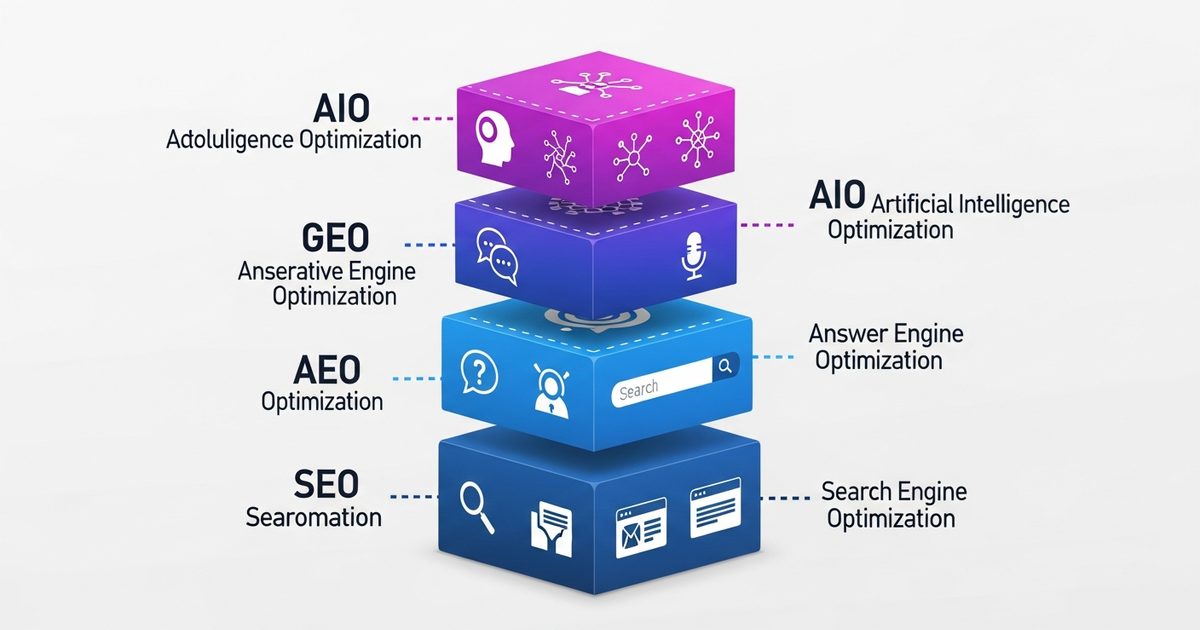
The most common mistake is treating these four as an either/or decision. You do not pick one and ignore the rest. They are sequential layers that stack on top of each other, and they reinforce each other far more than they compete.
A single well-executed piece of content can satisfy all four goals simultaneously:
- Strong keyword targeting and internal linking - serves the SEO layer
- Direct opening definition and question-format subheadings - serves the AEO layer
- Original data points, expert quotes, clear summaries, and structured comparison tables - serves the GEO layer
- The whole piece produced faster using AI research and drafting tools - that is AIO in practice
Think about a guide on "CRM pricing for small businesses." Done right, that single article can rank in Google's top results (SEO), appear as a featured snippet when someone searches that exact phrase (AEO), be cited by Perplexity when a user asks ChatGPT the same question (GEO), and be produced in half the time using AI-assisted research (AIO). The objectives are not pulling in different directions.
The teams winning right now are not the ones who chose their favorite acronym. They are the ones who built content comprehensive enough to perform in every environment at once.
How to Implement All Four in Your Content Strategy
Step 1 - Build your SEO foundation first
Before any AI-era strategy scales, your technical SEO needs to be solid. A slow site with crawl errors will not earn featured snippets or AI citations regardless of content quality. Fix Core Web Vitals, ensure clean indexing, build topical authority through a well-structured content cluster, and confirm AI crawlers (Googlebot, GPTBot, PerplexityBot) are not blocked in your robots.txt before moving to the layers above.
Step 2 - Structure every piece for direct answering
As you produce content, write with AEO in mind from the opening sentence. Your first paragraph should answer the primary question the page targets. Subheadings should mirror the actual questions your audience asks. Add FAQ schema to every pillar page and major blog post. This adds roughly 15 minutes to each article's production time and dramatically improves snippet eligibility.
Step 3 - Make your content citation-worthy
This is where GEO goes beyond AEO. Beyond winning a single snippet position, you need content that AI systems trust enough to cite across many different queries on related topics. That means original research and proprietary data where possible, clear author attribution with demonstrable credentials, and transparent citations when you reference external sources. Pull-quote-ready sentences, clean definitions, and structured data tables make your content far easier for LLMs to quote accurately.
Step 4 - Track where you are actually showing up
Most teams skip this step, and it costs them months of wasted effort. Traditional rank tracking tells you your Google positions. It tells you nothing about whether ChatGPT mentions your brand when someone asks about your category, or whether Perplexity cites your content when your target audience asks AI for a recommendation.
You need visibility tracking that covers AI platforms, not just SERPs. Tools like AI Rank Lab are built specifically for this gap - tracking your brand's presence and citation rate inside AI-generated responses across ChatGPT, Perplexity, Gemini, and Claude, so you can measure GEO and AEO performance with the same clarity you bring to traditional SEO ranking. Without this data, you are managing roughly 30 to 35% of the current search landscape completely blind.
Step 5 - Use AI tools to accelerate, not replace, strategy
AIO as a workflow means using AI to research faster, surface content gaps at scale, and produce higher volumes of well-structured drafts. The trap is producing generic AI content that lacks the original data, specific expertise, and genuine insights that GEO requires. Use AI for speed and structure; fill in the pieces only your team actually knows. That combination outperforms both pure-human-written generic content and pure-AI-generated content on every dimension.
Which Should You Prioritize Right Now?
The right starting point depends entirely on where your audience currently is in their journey from you:
- Zero organic presence: Start with SEO fundamentals. Nothing else scales until you have domain authority, crawlable pages, and a content base Google can index.
- Ranking on Google but missing snippets: Layer in AEO. Audit your top-performing pages and restructure them to target position zero for the questions they already rank near.
- Growing audience using ChatGPT or Perplexity for research: GEO becomes urgent. Build authoritative content assets and start monitoring your AI citation rate actively. If you do not know your GEO visibility today, that is the first thing to fix.
- Team bandwidth is the constraint: Invest in AIO as a workflow discipline. The leverage it gives you is what makes running SEO, AEO, and GEO simultaneously sustainable for a small team.
For most established brands in competitive verticals, the question is not whether to run all four in parallel - that is already table stakes. The question is how to measure all four so you can see what is working and what needs attention.
Common Mistakes Teams Make
Treating AI search like traditional keyword SEO: GEO is not keyword stuffing for AI. LLMs do not rank pages by exact-match keyword density. They identify trustworthy, well-structured, comprehensive sources. Over-optimizing for specific phrases hurts you here; building genuine topical authority helps you.
Burying the answer deep in content: For both AEO and GEO, your best, most direct answer needs to appear near the top of each page and each section. Long-winded introductions that circle the point for 400 words before getting to it are essentially invisible to snippet algorithms and AI parsers.
Ignoring schema markup: Schema is one of the clearest signals you can send to both Google and AI crawlers about what your content actually contains. FAQ schema, How-To schema, and Article schema each improve your eligibility for AEO placements and clarify how AI systems interpret your pages. It takes less than an hour to implement on a well-structured page and it pays off for years.
Not measuring AI visibility at all: This is the most costly mistake, and it is extremely common. Brands discovering in 2025 that they have no meaningful presence in ChatGPT or Perplexity are almost always brands that focused entirely on Google for the past several years and never started tracking AI platforms. If you are not measuring it, you are not managing it - and a competitor who is measuring it is slowly building the AI citation moat you will have to work much harder to close later.
The Bigger Picture
SEO, AEO, GEO, and AIO are not four separate strategies competing for your team's attention and budget. They are four lenses on the same goal: being visible and trustworthy wherever your audience looks for answers.
The shape of that landscape has changed. A meaningful portion of discovery now happens inside AI-generated responses rather than on traditional search result pages. Brands that adapt - by building content structured for both human readers and AI extraction, tracking their presence across every relevant platform, and using AI tools to produce that content at the pace competitive topics demand - will compound an advantage that is genuinely hard to close once established.
The acronyms are just shorthand for the different surfaces. Focus on the underlying goal - being the most useful, trustworthy, and visible source in your space - and you will naturally do all four well.
To see where your brand currently stands across AI search engines, the AI Rank Lab brand visibility tracker monitors your mention and citation rates across ChatGPT, Perplexity, Claude, and Gemini so you have actual data to act on.
Frequently Asked Questions
What is the difference between AEO and GEO?▾
Is SEO still relevant in 2025?▾
What does AIO stand for in marketing?▾
How do I optimize content for both Google and AI search engines?▾
What is generative engine optimization (GEO)?▾
How do I track my brand visibility in AI search engines?▾
Get a Free AI Ranking Consultation
Want to improve your brand's visibility in AI search engines like ChatGPT, Gemini, and Perplexity? Fill out the form and our experts will create a personalized strategy for you.

Written by
Devanshu
Chief Marketing Officer & AI Search Optimization Architect
Digital Marketing Strategist & Pioneer in SEO, Answer Engine Optimization (AEO), and Generative Engine Optimization (GEO).


