


Why You Cannot Just Check Once
The instinct, when you first hear about AI visibility, is to open ChatGPT, type a question about your category, and see if your brand comes up. It is a reasonable first move - but as a monitoring strategy it falls apart immediately. AI answers are volatile: the same prompt can produce different brands and different cited sources from one day to the next. A single manual check tells you almost nothing about your real visibility, and nothing at all about your trend.
Proper brand monitoring across AI engines is a repeatable workflow, not a one-time look. This guide walks through that workflow step by step - how to build a representative prompt set, run it across the major engines, read what comes back, and turn it into a routine you actually maintain.
Step 1: Define Your Query Universe
Start by mapping the questions your customers actually ask AI engines about your category. These fall into a few buckets:
Category queries: "best [your category] tools," "top [category] software for [audience]"
Comparison queries: "[competitor] alternatives," "[competitor A] vs [competitor B]"
Problem queries: the pain points your product solves, phrased as a user would ask them
Branded queries: "is [your brand] any good," "[your brand] reviews" - to see how engines describe you
The mistake here is testing one or two artificial keywords. Real people phrase the same need a dozen ways, so each topic should expand into many natural prompt variations. This expansion - sometimes called query fan-out - is what makes your monitoring representative instead of anecdotal. Aim for a set that genuinely reflects how your audience talks to AI, not how you would type a search query.
Step 2: Pick Your Platforms and Competitors
Decide which engines to monitor. For most brands the essential set is:
ChatGPT - the largest by usage; the default for recommendation-style queries
Perplexity - the most citation-driven, and the highest source of AI referral clicks
Google AI Overviews - because it sits on top of the search results your audience already sees
Claude and Gemini - add these if your audience skews toward their user bases
Then name 3 to 5 competitors to benchmark against. Visibility numbers in isolation are hard to interpret - knowing you appear in 40 percent of answers only becomes useful when you also know a rival appears in 75 percent. Competitor benchmarking turns raw data into a position you can act on.
Step 3: Run the Prompts and Capture Results
You have two ways to do this.
The manual method
Run each prompt in each engine yourself and log the results in a spreadsheet: did your brand appear, were you cited with a link, which competitors showed up. This is free and gives you a feel for the actual answers, but it does not scale. A serious prompt set across four engines is hundreds of queries, and you would need to repeat the whole thing regularly to catch trends. Manual checking is fine for a one-time audit, unworkable as an ongoing practice.
The automated method
Purpose-built tools run your prompt set across every engine on a schedule and record the results for you. The better ones use direct UI-based monitoring - querying the platforms the way a real user would see them rather than through a sanitized API - which produces results closer to what your customers actually get. Automated monitoring is what makes a daily or weekly cadence realistic instead of aspirational.
Step 4: Read the Right Metrics
Once results are coming in, focus on the metrics that actually inform decisions:
Mention rate - what share of relevant answers name your brand. Your awareness signal.
Citation rate - what share link to your site as a source. Your traffic signal, and usually the more important one.
Share of voice - your mention and citation rates relative to competitors on the same queries.
Coverage gaps - the specific prompts where competitors appear but you do not. This is your prioritized to-do list.
Per-platform breakdown - because strong ChatGPT visibility and weak Perplexity visibility are different problems with different fixes.
Treat all of it as directional rather than precise. The point is the trend and the gaps, not any single day's exact number.
Step 5: Set a Cadence You Will Actually Keep
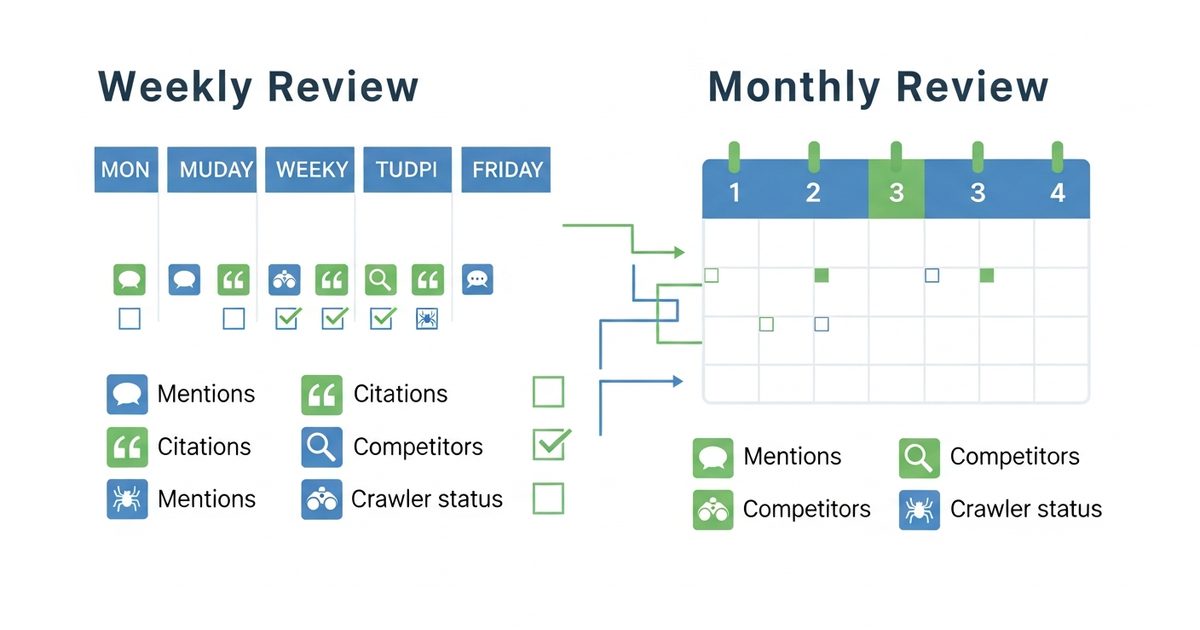
Monitoring only works if it is routine. A workable rhythm:
Weekly: glance at the dashboard for sharp moves - a sudden drop in citation rate or a competitor surging on a query you care about. Check AI referral traffic in GA4 for corroboration.
Monthly: review trends across all metrics, compare coverage against your priority queries, and re-run a sample of prompts manually to sanity-check the automated data.
After any site change: verify nothing you shipped broke AI crawler access - a robots.txt edit or CDN rule can quietly cut off the bots that feed your visibility.
Step 6: Turn Findings Into Action
Monitoring that does not change anything is just expensive reassurance. Each pattern points to a specific response:
Low mention rate everywhere: a brand-presence problem. You need more category association across the web - mentions, coverage, and authority that teach the models you belong in the conversation.
Mentioned but rarely cited: a content and structure problem. Improve answer formatting, add FAQ schema, and confirm AI crawlers can reach your pages.
Strong on one engine, weak on another: investigate that engine's specifics - Perplexity rewards freshness and crawlability heavily, for instance.
Competitor winning specific queries: study the pages being cited for those prompts and close the gap with better, more extractable content.
This is the step where measurement meets diagnosis - and where most standalone trackers stop short. Knowing your citation rate fell is only useful if you can find out why. AI Rank Lab connects brand visibility monitoring to AI bot tracking and AEO diagnostics, so a metric that moves comes with the likely cause attached - whether a crawler was blocked, schema is missing, or content needs work.
Putting It Together
Effective AI brand monitoring is not a clever one-off prompt - it is a defined query universe, run across the right engines, measured on the metrics that matter, reviewed on a cadence you keep, and connected to action. Build that loop and you will always know where you stand in AI search and what to do next. For the tools that automate this end to end, see our comparison of the best AI visibility tracker tools, and if you want the underlying concepts, start with our complete guide to AI visibility tracking and the difference between mentions and citations.
Frequently Asked Questions
How do I check if my brand appears in ChatGPT or Perplexity?▾
Can I monitor AI brand mentions manually?▾
How often should I monitor my AI search visibility?▾
Which AI platforms should I monitor for brand visibility?▾
What should I do if a competitor outranks me in AI answers?▾
Get a Free AI Ranking Consultation
Want to improve your brand's visibility in AI search engines like ChatGPT, Gemini, and Perplexity? Fill out the form and our experts will create a personalized strategy for you.

Written by
Devanshu
Chief Marketing Officer & AI Search Optimization Architect
Digital Marketing Strategist & Pioneer in SEO, Answer Engine Optimization (AEO), and Generative Engine Optimization (GEO).


