


The Question Traditional Analytics Cannot Answer
Open your analytics stack and you can answer almost any question about Google. Which keywords you rank for, how much organic traffic each page earns, which backlinks point where. What none of those tools can tell you is whether ChatGPT recommended your product yesterday, whether Perplexity cited your guide as a source this morning, or whether Google's AI Overview mentioned a competitor instead of you for a query you should own.
That blind spot is the entire reason AI visibility tracking exists. As more people ask AI engines for recommendations rather than scrolling a list of blue links, the question of whether those engines know and trust your brand has become as important as your Google ranking once was. This guide explains what AI visibility tracking actually measures, how the tools work under the hood, and how to read the numbers they produce.
What AI Visibility Tracking Measures
At its core, AI visibility tracking answers one question: when someone asks an AI engine about your category, does your brand show up? But "show up" breaks down into several distinct measurements, and understanding the difference between them is the key to using these tools well.
Brand mentions
The most basic metric is whether your brand name appears in an AI-generated answer at all. If someone asks Perplexity for "the best project management tools for remote teams" and your product is named in the response, that is a mention. Mentions measure awareness - the AI engine knows your brand exists and considers it relevant to the query.
Citations
A citation is stronger than a mention. It happens when the AI engine not only references your brand but links to your website as a source for its answer. Citations are the highest-value outcome because they drive referral traffic - the user can click through to your site directly from the AI response. As the team behind one popular review put it, mentions measure "brand visibility" while citations measure "actual content visibility," and the two should be tracked separately.
Share of voice
Visibility only means something in context. Share of voice measures what percentage of relevant AI answers mention your brand versus competitors. If you appear in 40 percent of answers for your category and your nearest rival appears in 70 percent, you have a share-of-voice gap that no amount of raw mention counting would reveal on its own.
AI Visibility Score
Most tools roll these signals into a single headline number, often a score out of 100, that reflects your overall presence in AI-generated answers. A score is convenient for tracking direction over time and reporting to stakeholders, but it is a summary - the underlying mention, citation, and share-of-voice data is where the actionable detail lives.
Sentiment and positioning
Newer tools also analyze how your brand is described. Being mentioned as the budget option is different from being mentioned as the category leader. Sentiment and positioning data tells you not just whether you appear, but how the AI engine frames you when it does.
How AI Visibility Tracking Tools Actually Work
Behind every visibility score is a fairly consistent four-step process, regardless of which tool you use.
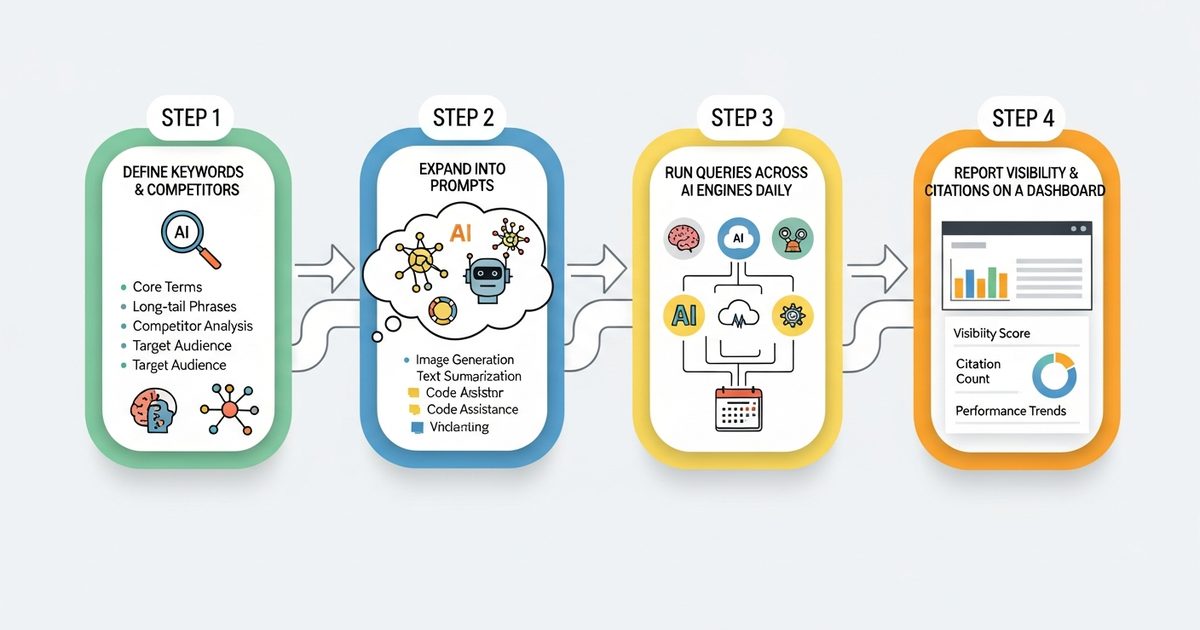
Step 1: You define topics, keywords, and competitors
You tell the tool what your brand is about - the categories you compete in, the keywords that matter, and the competitors you want to benchmark against. This defines the universe of queries the tool will monitor on your behalf.
Step 2: The tool expands topics into prompts
A single keyword is not how people talk to AI engines. So the tool expands each topic into many realistic prompt variations - what some platforms call query fan-out. The keyword "project management software" becomes dozens of natural prompts: "what's the best project management software for a small team," "project management tools that integrate with Slack," "affordable alternatives to Asana," and so on. This expansion is what makes the data representative of real user behavior rather than a single artificial query.
Step 3: It runs those prompts across AI engines
The tool sends each prompt to the AI engines it covers - typically ChatGPT, Perplexity, Claude, Gemini, and Google AI Overviews - and captures the responses. The better tools do this through direct UI-based monitoring, meaning they query the platforms the way a real user would see them rather than relying on a sanitized API. This matters because the answer a real user gets can differ from an API response.
Step 4: It reports mentions, citations, and trends
Finally, the tool parses every response for your brand and your competitors, records whether you were mentioned or cited, and rolls the results into dashboards showing your visibility score, share of voice, and how all of it is trending over time. Most platforms run this cycle daily and alert you when something shifts.
Why AI Visibility Is So Volatile
One thing that surprises teams new to AI visibility tracking is how much the numbers move. AI-generated answers are not stable the way a Google ranking is. Research from Semrush on AI Overviews found that zero keywords showed 100 percent URL consistency, and 96 percent saw the cited domains change over time. In other words, the source an AI engine cites today may not be the one it cites tomorrow, even for the identical query.
This is why a single visibility check is close to meaningless, and why continuous tracking matters. You are not looking for a fixed position - you are looking for a trend. Is your share of voice climbing or sliding over weeks? Are you being cited more consistently as you improve your content? The volatility is exactly why the data should be treated as directional rather than perfectly precise, and why one good week does not mean the work is done.
AEO, GEO, AI SEO - What's the Difference?
The vocabulary in this space is still settling, and the terms overlap heavily. Here is how they relate:
- AEO (Answer Engine Optimization): Optimizing your content so AI engines extract and surface it in their answers.
- GEO (Generative Engine Optimization): Optimizing specifically for generative AI systems like ChatGPT and Gemini. In practice, used almost interchangeably with AEO.
- AI SEO / LLM SEO: Broader umbrella terms for optimizing your presence across AI search engines and large language models.
The distinctions matter less than the underlying reality: all of these describe the work of getting AI engines to know, trust, and cite your brand. AI visibility tracking is how you measure whether that work is succeeding.
What AI Visibility Tracking Cannot Do On Its Own
A visibility tracker tells you what is happening - your mention rate, your share of voice, where competitors are beating you. What it does not always tell you is why, or what to do next. A low score can stem from very different root causes: AI crawlers being blocked from your site, content that lacks the structure AI engines need to extract answers, insufficient domain authority for competitive queries, or stale content that real-time engines like Perplexity deprioritize.
This is the gap between measurement and improvement. Tools that combine visibility tracking with diagnostics close it. AI Rank Lab, for example, pairs brand visibility tracking with AI bot monitoring - so you can see not just that your mention rate dropped, but that PerplexityBot stopped crawling a key section of your site last week, which explains why. Pairing the symptom with the cause is what turns a dashboard into an action plan.
Getting Started
If you are new to AI visibility tracking, the sensible first move is a free baseline check to see where you stand today. From there, the question is whether the data reveals a gap worth closing - and if it does, whether you need a focused tracking tool or one that also diagnoses the causes behind your numbers. For a side-by-side look at the options, see our comparison of the best AI visibility tracker tools.
The brands that treat AI visibility the way they once treated Google rankings - as something to measure continuously and improve deliberately - are the ones that will be recommended when your customers ask an AI engine what to buy. Tracking is where that work begins.
Frequently Asked Questions
What is AI visibility tracking?▾
What is the difference between a brand mention and a citation?▾
Why do AI visibility scores change so much?▾
What is the difference between AEO, GEO, and AI SEO?▾
Which AI platforms should a visibility tracker cover?▾
Get a Free AI Ranking Consultation
Want to improve your brand's visibility in AI search engines like ChatGPT, Gemini, and Perplexity? Fill out the form and our experts will create a personalized strategy for you.

Written by
Devanshu
Chief Marketing Officer & AI Search Optimization Architect
Digital Marketing Strategist & Pioneer in SEO, Answer Engine Optimization (AEO), and Generative Engine Optimization (GEO).


