


Choosing a white label SEO agency is not a shopping decision, it is a delegation decision. You are handing another company the work your client will judge you on, and in most cases your client will never learn that company exists. So the questions that matter are not which provider has the slickest site. They are: what does this partner charge me wholesale, will they talk to my client, do they do the work themselves, and what happens to my brand when a campaign underperforms.
Almost nothing published on this topic answers those questions with checkable facts, because the facts are inconvenient: most providers do not publish their rates. So on 16 September 2026 we read the public reseller, service and pricing pages of eight established providers and recorded, for each one, only what the vendor states in public. No testing, no delivery review, no claim about work quality. This is a disclosure audit, and the headline is simple. Of the eight, two publish an actual wholesale starting figure. The rest want a sales call first.
What a white label SEO agency actually sells you
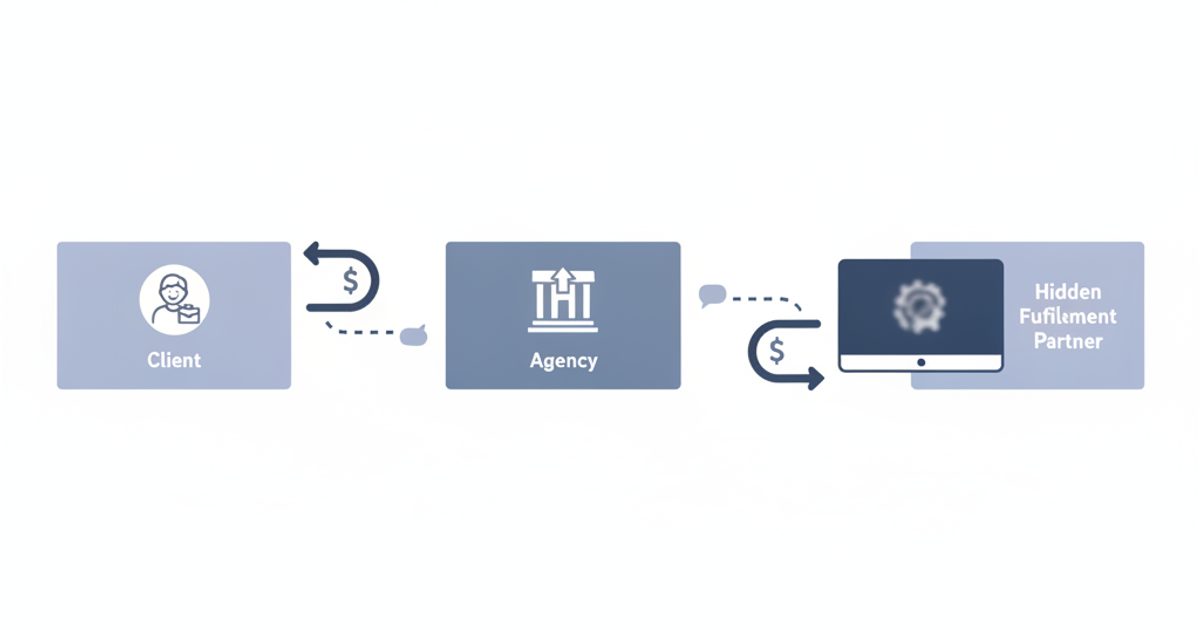
It sells fulfilment capacity plus invisibility. You keep the client, the contract, the invoice and the margin. The provider executes the audits, on-page work, content and link acquisition, and delivers it unbranded or branded as you, so the end client experiences one agency. An SEO reseller program is the commercial wrapper around that: wholesale rates, a partner dashboard, and sales collateral you can put your logo on.
Two things it is not. It is not a referral or affiliate arrangement, where the provider takes over the account and pays you a cut. And it is not the same product as white-label reporting software. Reporting tools put your logo on a dashboard; fulfilment partners do the actual optimisation work. We cover the reporting layer separately in our guide to white label SEO and GEO reports. If you already own delivery and only need branded dashboards, you need that page, not this one. If you need someone to do the work, read on.
Which providers publish wholesale pricing, and which require a sales call
Two of eight publish a starting rate you can plan a price list around. Everything below was read at source on 16 September 2026 and reflects what the vendor publishes, not what we were quoted.
| Provider | Rate published publicly? | Published figure (16 Sep 2026) | Stated minimum term |
|---|---|---|---|
| Agency Platform | Yes, full tier list | Local from $178/mo, National from $355/mo, link building from $119/mo | None stated, month to month |
| SEOReseller.com | Yes, entry figure only | Private label packages "start at $499", described as wholesale | None stated, no lengthy contracts |
| The HOTH | Retail card only, no reseller rate | Managed SEO retail $1,000 / $2,500 / $5,000 / $10,000 per month | Not stated on the reseller page |
| DashClicks | Platform fee only | Platform $199/mo; fulfilment "pay only for services you use", rates behind an account | "No contracts", "no minimums" |
| SharpNet | No figures, states "wholesale rates" | Not published | Free to join, no minimum commitments, month to month |
| Semify | No | Not published, "talk to our team" | Not published |
| That! Company | No, a pricing page with no prices | Not published, retainer model, "request pricing" | Not published |
| OuterBox | No | Not published, "get a free quote" | Not published |
The gap is worth naming plainly. Agency Platform lays out five national tiers from $355 to $2,219 a month with keyword counts attached, and flags that the figures shown are for its Gold membership so pricing varies by membership level. SEOReseller.com answers the price question in its own FAQ and states the prices are wholesale. That! Company publishes a page titled White Label Pricing on which every service ends with "request pricing" rather than a number.
A quote-only provider is not automatically worse. Custom scoping is legitimate when campaigns genuinely differ. But quote-only has a cost you should price in: you cannot build a retail rate card, or answer a prospect's "what would that cost" on the call, until your partner has quoted you. If you sell fast and cheap, published wholesale rates are worth real money to you. If you sell six-month enterprise engagements, they matter much less.
How much margin can you actually make reselling SEO?
Only two providers in this set publish enough for honest arithmetic, so here is the arithmetic on those, and no invented percentages for the rest.
Take Agency Platform's Starter national plan at $355 a month wholesale. Retail it at $750 and your gross margin is $395, or roughly 53 percent. Retail it at $1,000 and it is $645, or about 65 percent. Its Silver tier at $997 wholesale retailed at $2,000 gives $1,003, just over 50 percent. Take SEOReseller's $499 entry package, retail at $1,200, and you hold $701, about 58 percent. The HOTH's reseller page claims "most resellers see 40-60% margins" but publishes no wholesale rate to check that against, so treat it as a vendor claim rather than a benchmark.
Now the part the margin tables leave out. Gross margin is not profit. Out of that spread you pay for the person who runs the client call, the time spent translating the partner's deliverable into something your client understands, your own tooling, your sales cost of acquiring the account, and the months of a campaign that churns before it has repaid onboarding. A 55 percent gross margin on a $355 plan is $395 a month, which one difficult client meeting can consume. Resellers who make money on SEO usually do it on volume of similar accounts, or by selling a higher retail price than the wholesale tier implies because the strategy and relationship are genuinely theirs.
One pricing trap: if you mark up a wholesale plan whose rate is published on a public page, a curious client can find it. Agency Platform's tiers are indexed and readable by anyone. That is an argument for selling a scope you defined rather than reselling a named plan verbatim.
Who talks to your client, and can the provider contact them directly?
This is the axis that separates the providers most sharply, and nobody compares it. There are two opposite public positions in this set.
The invisible model: Agency Platform answers its own FAQ "Will my clients know I'm using an SEO reseller?" with "No. Deliverables are white-labeled and we don't contact your clients." The HOTH's reseller page takes the same line, stating that every report and deliverable is unbranded and that it handles fulfilment while you own the client relationship.
The participating model: That! Company states the opposite as its differentiator, writing "We handle the client interactions!" and describing a workflow in which it creates the initial analysis, meets the customer to deliver the report, and answers the customer's questions directly. OuterBox sits in between, offering optional call support and NDA coverage structured around the rules the agency sets.
Neither is wrong. A two-person agency with no SEO knowledge may genuinely want a strategist on the call who can answer a technical question properly, presented as part of the team. An established agency that sells on relationship will not want an outside voice anywhere near its client. What you must not do is sign without knowing which model you bought, because it determines whether your account manager needs to understand SEO or only needs to understand the client. Ask for it in writing, along with a non-solicitation clause. As SEO.co notes in its June 2026 reseller guide, a white label agreement will usually include a private label non-compete, meaning the provider cannot approach your clients without your permission. Usually is not a contract term. Get it in yours.
Will your client find out you are outsourcing the work?
They can, and the leaks are mundane. Unbranded PDFs are the easy part; providers compete on that. The leaks come from everywhere else: an email from a domain that is not yours, a calendar invite with the partner's meeting link, a Google Search Console or Google Business Profile user with an unfamiliar company address, a content draft whose document metadata carries the writer's agency, a tracking or reporting subdomain that resolves to the vendor, invoice line items in your own proposals copied from the partner's plan names, and published content that reuses author bios or boilerplate from the provider's other campaigns.
Ask a partner to walk you through every surface the end client touches and who owns the domain on each. Agency Platform, for example, publishes that its dashboard and notifications run on your own domain. That is the level of specificity to ask for. And decide your own disclosure position deliberately. Many agencies simply tell clients that specialist delivery is handled by a vetted partner team under their management, which is true, removes the risk of being caught, and rarely loses the deal.
In-house or subcontracted again?
Ask, because some providers volunteer it and some do not. SharpNet states plainly that it provides all work in-house and does not outsource to other companies. DashClicks lists an in-house team of full-time professionals as a program feature. OuterBox says 300-plus USA-based in-house experts deliver its programs. Semify describes US-based writers and an in-house link acquisition team. Of the eight pages we read, several others make no statement either way, which is not evidence of subcontracting but is a question you should put directly.
It matters for three reasons. Second-tier subcontracting adds a margin layer that comes out of delivery quality rather than the price. It makes accountability slower, because your escalation has to travel two companies. And it widens the pool of people who can see your client list. There is nothing shameful about a provider using specialist contractors for, say, digital PR; there is something wrong with a provider that will not tell you.
Contracts, minimums and what happens when the work is bad
Month-to-month is now the stated norm among the providers that say anything at all. DashClicks publishes "no contracts" and "no minimums", SharpNet says its partner program is free to join with no minimum commitments and month-to-month service, SEOReseller says it does not lock partners into lengthy contracts, and Agency Platform states no long-term commitments with a 15-day free trial. Semify, That! Company and OuterBox publish no terms.
Flexible terms protect you on the way out. They do nothing about the real risk, which is a campaign that goes quiet for four months while you keep invoicing. Before you sign, get answers to these, in writing:
- What is the stated turnaround from order to first deliverable, and what is the monthly delivery cadence after that? Most of these pages state no turnaround at all; Semify publicises a 92 percent SLA delivery figure without publishing the SLA.
- What is the remedy when a deliverable misses that cadence or fails review - rework, credit, refund, or nothing?
- Who is my named escalation contact, and what is the response window?
- Can I see the raw work log, not just the client-facing summary?
- If I leave, do I keep the content, the accounts and the reports?
Then run a paid pilot on one account you can afford to have go badly, ideally your own site, before you put a client's brand behind it. One campaign for one month tells you more than any reseller page.
White label link building and Google's position on paid links
Most providers in this set sell link products, and this is where a reseller carries risk they did not create and cannot see. Google's spam policies, last updated 28 August 2026, list "buying or selling links for ranking purposes" as link spam, and include exchanging money for links or for posts that contain links, exchanging goods or services for links, and advertorials or native advertising where payment is received for articles containing links that pass ranking credit.
That is a plain statement about a product category several white-label providers sell by the unit. Some position against the worst of it - Semify states no PBNs and no spam, OuterBox frames placements around publisher fit and disavow recommendations - but a placement your partner paid for is still a placement your partner paid for, and your client's domain absorbs the consequence, not the vendor's. If you resell links, at minimum understand what is being bought on your behalf, ask whether payment changes hands for placements, and price the risk into what you promise. Do not repeat a vendor's safety claim to a client as if you had verified it.
The same caution applies to the AEO and GEO add-ons now attached to these programs. Agency Platform sells AEO and GEO layers alongside SEO, The HOTH sells AI visibility services. The underlying work can be legitimate, but Google's guide to generative AI features, last updated 10 July 2026, says there is no special markup or machine-readable AI file that makes a page eligible, and that structured data is not required for generative AI search. Anything sold as a proprietary shortcut into AI answers deserves the same scrutiny as a link package.
Is white label SEO worth it against hiring in-house?
It depends on how many accounts you can keep fed. Semify's own case for outsourcing puts an experienced in-house SEO hire at $50,000 to $80,000 a year before benefits, three to six months to hire and onboard, and $500 to $2,000 a month in tool subscriptions. Those are a vendor's figures and they are argued in the vendor's favour, but the shape is right: a salaried hire is a fixed cost, and a wholesale plan is a variable one.
The arithmetic that follows is your own. At two or three SEO clients, an in-house hire is idle and expensive, and a reseller program is the obvious answer. Somewhere past ten or fifteen similar accounts, the wholesale spend approaches a salary and you are paying a margin to someone else for work you now understand well enough to direct. The honest answer for most small agencies is that white label SEO is worth it as a way to start selling search without a hiring risk, and worth reconsidering the moment delivery becomes the biggest line in your cost base. The intermediate move many agencies miss is hiring one strategist in-house to direct the work and keeping a fulfilment partner for execution.
How to check a white label SEO partner before you sign
Work through this in order. It takes an afternoon and it is the only part of this article that is not about someone else's marketing pages.
- Get the full wholesale rate card in writing, including add-ons, setup fees and what a mid-campaign scope change costs.
- Establish the client-contact rule explicitly: never, only with permission, or as your team under your brand.
- Get a non-solicitation clause covering your clients during and after the engagement.
- Ask who performs each service and whether any part is subcontracted further.
- Request two unedited sample deliverables - a technical audit and a content piece - not a case study.
- Audit every client-facing surface for branding leaks, including email domains, dashboards and file metadata.
- Pin down turnaround, reporting cadence and the remedy when either slips.
- Ask exactly what is bought when a link product is delivered, and whether money changes hands for placements.
- Run a paid pilot on one account, preferably your own, for a full month.
- Confirm what you keep if you leave: content, account access, historical reports.
A partner that answers all ten in writing is probably a good partner. A partner that will not answer the second, fourth or eighth is telling you something useful, and you should listen to it before your client does.
Frequently Asked Questions
What is a white label SEO agency and how is it different from an SEO reseller program?▾
How much margin can I actually make reselling SEO?▾
Will my client find out I am outsourcing the SEO work?▾
Who talks to my client, me or the white label provider?▾
What happens if the white label SEO provider delivers bad work?▾
Is white label SEO worth it compared to hiring an in-house SEO?▾
Which white label SEO providers publish wholesale pricing and which require a sales call?▾
Is there a minimum monthly commitment or long term contract with white label SEO providers?▾
Does the provider do the work in-house or subcontract it again?▾
Are white label link building packages safe under Google's spam policies?▾
What is the difference between white label SEO fulfilment and white label SEO reporting?▾
How do I check a white label SEO partner before signing?▾
Get a Free AI Ranking Consultation
Want to improve your brand's visibility in AI search engines like ChatGPT, Gemini, and Perplexity? Fill out the form and our experts will create a personalized strategy for you.

Written by
Devanshu
Chief Marketing Officer & AI Search Optimization Architect
Digital Marketing Strategist & Pioneer in SEO, Answer Engine Optimization (AEO), and Generative Engine Optimization (GEO).


