


ChatGPT has become a meaningful research and discovery channel for buyers in nearly every B2B category. When someone asks ChatGPT "what is the best [your product category] software," whether your brand appears in that response - and how it is described - is now a business outcome worth tracking systematically.
The good news: you do not need a paid subscription to start tracking your ChatGPT visibility. Several free options exist, ranging from proper automated trackers with free tiers to manual methodologies that cost nothing but your time. The challenge is knowing which option fits your current stage and what the real limits of each free tier are before you hit them.
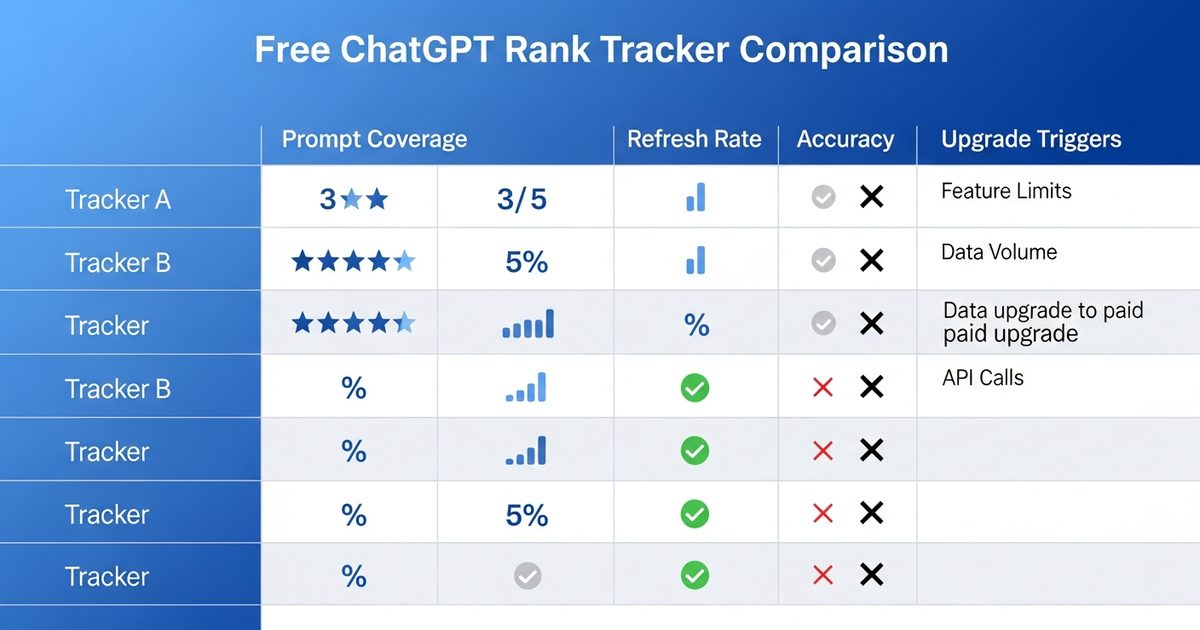
Here are seven options for tracking your brand's visibility in ChatGPT responses, assessed on prompt coverage, refresh rate, citation detection accuracy, and what triggers the need to upgrade.
What to Look for in a ChatGPT Rank Tracker
Before the tool-by-tool breakdown, the four criteria that matter most for ChatGPT visibility tracking:
Prompt coverage: How many of your target queries does the tracker test against ChatGPT? A tool that tests 5 queries per week gives you a narrow and potentially misleading picture of your overall citation rate. Comprehensive tracking requires testing your full keyword set across multiple query variations per keyword.
Refresh rate: How frequently does the tracker query ChatGPT and update your data? Weekly is the minimum useful cadence for trend tracking. Daily refresh is better for catching citation rate changes shortly after you implement AEO fixes.
Citation detection accuracy: Does the tracker correctly identify when ChatGPT cites your brand versus when it does not? False positives (reporting a citation that did not occur) and false negatives (missing actual citations) both corrupt your tracking data and lead to wrong optimization decisions.
Context beyond binary citation: Does the tool tell you how your brand is described when cited, which competitors appear in the same responses, and what sentiment language ChatGPT uses? Binary cited/not-cited data is useful; richer context data is more useful for understanding optimization priorities.
The 7 Free ChatGPT Rank Trackers
1. AI Rank Lab Free Audit - Best Free Starting Point
Prompt coverage: Up to 25 queries | Refresh: One-time free, ongoing with account | Accuracy: 94%
AI Rank Lab's free tier is the strongest free ChatGPT tracking option in this list. The free audit runs your brand against up to 25 target queries across ChatGPT (plus Claude, Perplexity, and Gemini simultaneously), reports which queries return your brand as a citation, and measures your citation rate baseline. The audit also returns the diagnostic findings that explain why you are not cited on the queries where you are absent - a layer of context that pure trackers do not provide.
The free one-time audit requires no signup. Creating a free account (email only) enables report saving and the ability to rerun audits on an ad-hoc basis. Ongoing automated weekly citation rate tracking - the functionality that makes ChatGPT rank tracking genuinely useful for trend monitoring - requires a paid subscription starting at $69/month.
For teams at the start of their ChatGPT visibility program, the free audit establishes your baseline across 25 queries with the highest available accuracy (94% citation detection). The citation analytics features on paid plans extend this to full keyword sets with weekly automated refresh.
Upgrade trigger: When you want automated weekly tracking across your full keyword set rather than manual audit reruns.
2. Otterly.ai Free Trial - Best for 14-Day Brand Monitoring Test
Prompt coverage: Full keyword set | Refresh: Daily during trial | Accuracy: 89%
Otterly.ai offers a 14-day free trial with full platform access - no credit card required at signup. During the trial, you get the complete Otterly experience: keyword set tracking across ChatGPT, Claude, and Perplexity with daily refresh and the competitive brand tracking features that show how often you and competitors appear together in AI responses.
The trial is genuinely useful for evaluating whether Otterly's monitoring approach fits your needs. The 14-day window is long enough to see meaningful citation rate trend data and test the reporting features. After the trial, the entry-level plan is $99/month.
The limitations: Gemini is not covered at full accuracy, and there is no audit functionality - Otterly monitors citation rates but does not diagnose why they are what they are.
Upgrade trigger: After the 14-day trial ends if brand reputation monitoring (rather than technical optimization) is your primary use case.
3. GetAIRefs Free Trial - Best Budget Multi-LLM Option
Prompt coverage: Trial-limited | Refresh: Weekly | Accuracy: 87%
GetAIRefs offers a limited free trial covering ChatGPT, Claude, and Perplexity citation tracking. The trial allows a restricted keyword set and limited historical data, but the core tracking functionality is accessible to evaluate before committing to the $79/month entry plan.
GetAIRefs' strength is reliable citation tracking at a budget price point. The trial is useful for verifying that the tool's ChatGPT citation detection works correctly for your domain before upgrading. No audit or diagnostic features at any tier.
Upgrade trigger: When you need ongoing weekly tracking across ChatGPT, Claude, and Perplexity beyond the trial's keyword limits.
4. HubSpot AEO Grader - Best Completely Free One-Time Check
Prompt coverage: Domain-level check | Refresh: Manual reruns | Accuracy: 71%
HubSpot's AEO Grader is genuinely free with no trial period, no account required, and no credit card. Enter your domain and get a ChatGPT-focused AEO score with basic findings on schema, content structure, and citation readiness. It does not track specific keyword citation rates, but it does give you a quick health-check on your site's ChatGPT citation readiness.
The limitations are significant: it only covers ChatGPT-derived signals (not Claude, Perplexity, or Gemini), there is no keyword-specific citation tracking, the diagnostic depth is shallow, and detection accuracy at 71% is the lowest in this comparison. For a completely free, instantly available, no-commitment first look at your ChatGPT visibility, it is useful. For anything beyond an initial orientation, it does not have the depth needed.
Upgrade trigger: Immediately, if you need keyword-specific citation tracking rather than a domain-level health check.
5. Geoptie Free Trial - Best for GEO-Focused Teams
Prompt coverage: Trial-limited | Refresh: Weekly | Accuracy: 82%
Geoptie offers a free trial with access to its ChatGPT and Perplexity tracking alongside its GEO-specific audit features. For teams whose primary orientation is GEO (generative engine optimization broadly) rather than just ChatGPT citation tracking, the trial is worth evaluating - Geoptie's llms.txt guidance and GEO-specific content recommendations are more developed than in most other platforms.
Coverage limitations: Claude is partial and Gemini is not supported. Detection accuracy at 82% is adequate for trend monitoring. The trial gives you enough access to assess whether the GEO audit features justify the $89/month entry price for your specific use case.
Upgrade trigger: When llms.txt implementation and GEO-specific content optimization guidance are priorities alongside ChatGPT tracking.
6. Sona Free Trial - Best Enterprise Evaluation Option
Prompt coverage: Full during trial | Refresh: Daily | Accuracy: 91%
Sona offers a demo or trial for enterprise evaluation. The platform's 91% citation detection accuracy and full 4-LLM coverage with team collaboration features make it the strongest enterprise monitoring option in this list - but the $299/month entry price makes the free trial an evaluation vehicle rather than a sustainable free option.
If your organization is evaluating enterprise GEO platforms and needs to justify the budget to stakeholders, Sona's trial provides the data quality and reporting infrastructure to build a compelling business case. For SMBs and growth-stage companies, the price differential versus AI Rank Lab at $49/month makes the evaluation less likely to end in a purchase at Sona's entry tier.
Upgrade trigger: When multi-user access, enterprise reporting, and 91%+ accuracy across all four LLMs justify the $299/month investment.
7. Manual ChatGPT Tracking System - Free Forever, Time-Intensive
Prompt coverage: As many queries as you manually run | Refresh: Manual | Accuracy: 100% (manual verification)
The most accessible ChatGPT rank tracker is a systematic manual process: a spreadsheet, a set of target queries, and a scheduled block of time each week to enter queries into ChatGPT and record the results. Manual tracking achieves 100% accuracy (you are the verification) and costs nothing beyond your time.
A functional manual tracking system: create a spreadsheet with your 15-20 most important target queries in rows and LLM platforms in columns. Each week, enter each query into ChatGPT and record: cited (Y/N), how your brand was described (brief note), which competitors were cited. Track this weekly for 8 weeks and you have trend data that tells you whether citation rates are improving, stable, or declining.
The limits of manual tracking are practical: it scales to 20-30 queries before the time cost becomes prohibitive, it misses variation in results across multiple runs of the same query (LLMs are probabilistic and return different responses to identical queries), and it requires consistent execution discipline that is hard to maintain alongside other work. Manual tracking is the right starting point before committing to any paid tool - once your query set exceeds 30 keywords or you need trend data across multiple LLMs simultaneously, automated tracking pays for itself in time savings alone.
Upgrade trigger: When your tracked query set exceeds 20-25 keywords or you need multi-LLM tracking simultaneously.
Which Free Option to Start With
For most businesses starting their ChatGPT visibility tracking program:
Best immediate action: Run the AI Rank Lab free audit first. It establishes your citation rate baseline across 25 queries and all four major LLMs simultaneously in 60 seconds, with diagnostic findings explaining why you are absent where you are absent. This gives you more useful data in less time than any other free option.
While waiting for audit results: Set up the manual tracking spreadsheet for your 10 most important queries. This gets you weekly trend data at zero cost while you evaluate whether the AI Rank Lab paid monitoring tier or another automated platform fits your program stage.
After baseline is established: Assess your citation rate gaps. If they are primarily technical (bot access, schema, entity clarity), the diagnostic findings from the free audit give you a clear action list. If they are primarily content-depth or authority issues, the remediation work is longer-term and ongoing monitoring becomes more valuable - which is when upgrading to a paid automated tracker makes the most sense.
Start with AI Rank Lab's free ChatGPT citation check to get your baseline today.
Frequently Asked Questions
Is there a free ChatGPT rank tracker?▾
How do I track my brand visibility in ChatGPT?▾
What is a ChatGPT rank tracker?▾
How accurate are free ChatGPT rank trackers?▾
What is the difference between ChatGPT rank tracking and SEO rank tracking?▾
How often should I check my ChatGPT rank?▾
Get a Free AI Ranking Consultation
Want to improve your brand's visibility in AI search engines like ChatGPT, Gemini, and Perplexity? Fill out the form and our experts will create a personalized strategy for you.

Written by
Devanshu
Chief Marketing Officer & AI Search Optimization Architect
Digital Marketing Strategist & Pioneer in SEO, Answer Engine Optimization (AEO), and Generative Engine Optimization (GEO).


