


An AI SEO agent is software that takes an SEO goal, decides its own sequence of steps, calls real tools to gather data and produce work, checks the result, and repeats until the goal is met or a budget stops it. A tool answers a prompt. An agent pursues an outcome.
That distinction sounds like marketing language until you watch the two run the same job. Ask a chat assistant to "find why our blog traffic dropped" and you get a list of things to check. Give the same instruction to an agent with credentials to Search Console and Analytics and it pulls the last two quarters, compares them, isolates the URLs carrying the loss, cross-references position changes against click changes, and comes back with three named pages and a diagnosis. Nobody typed the intermediate prompts.
This guide covers what an agent actually is at a technical level, what it can run end to end today, what it cannot, and what it costs to operate. The architecture details come from the agent we built and run in production, not from a vendor brochure.
What is an AI SEO agent?
An AI SEO agent is a large language model wrapped in three things it does not have on its own: tools, memory, and a control loop. The model supplies reasoning. The tools give it hands - the ability to query an API, crawl a page, write a file. Memory lets it carry facts between steps and between sessions. The loop is what makes it an agent rather than a very good autocomplete: it decides what to do next based on what the last step returned.
Anthropic's engineering team draws the cleanest line here in Building Effective AI Agents. They separate workflows, where "LLMs and tools are orchestrated through predefined code paths", from agents, where the model "dynamically directs its own processes and tool usage, maintaining control over how it accomplishes tasks". Most products sold as SEO agents are workflows. That is not an insult - workflows are more predictable and usually cheaper - but it matters when you are deciding what you are buying.
The practical test: if the vendor can draw you the exact sequence of steps the product will run before it runs, it is a workflow. If the sequence depends on what the data turns out to say, it is an agent.
How an AI SEO agent differs from an AI SEO tool
The difference is who decides the next step. A tool waits for a human to decide. An agent decides, acts, and reports.
Dimension | AI SEO tool | AI SEO agent |
|---|---|---|
Input | A prompt or a form | A goal |
Step sequence | Fixed by the product | Chosen at runtime from the data |
Data access | Usually one source | Multiple connected systems in one run |
Failure behaviour | Returns an error to the human | Retries, reroutes, or escalates |
Cost shape | Flat subscription | Variable, driven by steps and tool calls |
Main risk | Output is generic | Output is wrong and nobody checked |
That last row is the one to sit with. The failure mode changes when you move from tools to agents. A tool that produces a mediocre meta description wastes a minute. An agent that misreads a Search Console filter and rewrites forty title tags on a bad premise costs a quarter.
The ReAct loop an SEO agent runs on
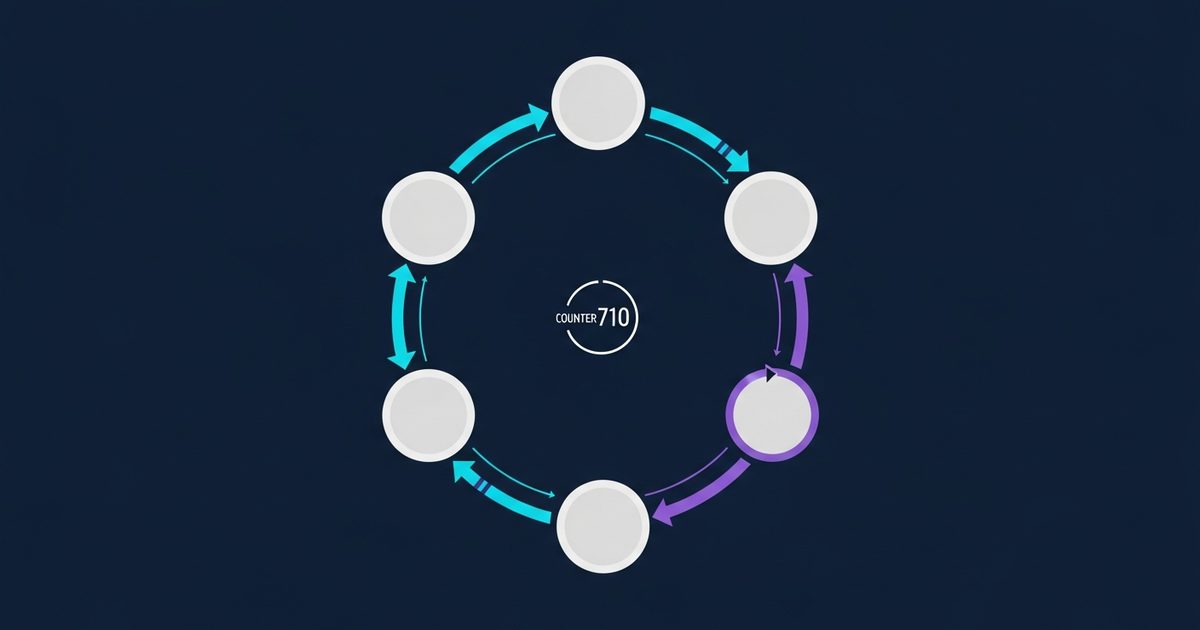
Nearly every production agent runs some variant of ReAct: reason, act, observe, repeat. In our own implementation the loop looks like this on every turn:
Plan. A fast model reads the goal, the workspace memory and the tool catalogue, and proposes the first action.
Act. The runtime executes the chosen tool with the model's arguments and charges the tool's cost.
Observe. The result is fed back into context, condensed first if it is large.
Decide. The model either calls another tool or declares it has enough.
Synthesize. A stronger model writes the final answer from everything gathered.
Two details from that list do more work than the loop itself. The first is model routing - planning and tool-calling steps run on a cheap fast model, and only the final synthesis runs on the expensive one. The second is the step budget. Ours is capped at 15 steps. When an agent hits the cap it does not fail silently or keep spending; it synthesizes the best answer it can from what it has and says explicitly that it ran out of room.
Without a step cap, an agent that misunderstands a goal will happily burn a four-figure API bill converging on nothing. This is the single most common reason self-built agents get switched off.
What SEO tasks an agent runs end to end
The honest answer is: tasks where the inputs are machine-readable and the success criteria are checkable. That is a narrower set than most vendors imply, but it is not small.
Diagnosis. "Traffic is down, find out why." The agent pulls Search Console over two windows, segments by page and query, separates impression loss from CTR loss from position loss, and names the URLs responsible. This is the highest-value agent task because the sequence genuinely cannot be predetermined - what you check second depends on what the first pull said.
Opportunity mining. Striking-distance queries, pages ranking on the wrong URL, keyword cannibalisation, queries with high impressions and dismal CTR. All of it is deterministic once the data is in hand.
Competitive gap analysis. Pull a competitor's ranked keyword set, subtract yours, cluster the remainder by intent, size it by volume and difficulty.
Technical auditing. Crawl, check Core Web Vitals, validate structured data, find broken internal links, verify indexability.
Content briefing. Fan a topic out into sub-questions, check which the current top results answer, and build a brief around what they miss.
Reporting. Pull the numbers, write the commentary, generate the file, email it on a schedule.
Notice what is missing: strategy, prioritisation against business goals, and anything requiring a judgement about brand. Agents are good at the layer where the work is mechanical but the path is uncertain. They are bad at deciding what matters.
What tools and data an SEO agent needs access to
An agent with no tools is a chatbot. The connections that make an SEO agent useful are, roughly in order of value:
Google Search Console. The only first-party record of how Google actually treats your site. Note the constraints before you design around it: the Search Analytics API returns 25,000 rows per request and holds 16 months of history, after which the data is gone unless you have been exporting to BigQuery.
Google Analytics 4. Behaviour and conversion after the click. Google now ships its own Analytics MCP server, exposing run_report, run_realtime_report and run_funnel_report to any MCP-capable agent. It is explicitly labelled experimental.
SERP and keyword data. Live rankings, volumes, difficulty, competitor visibility.
A crawler. Your own site's structure, status codes and markup.
The CMS. Only if you intend the agent to write, which deserves its own decision.
The plumbing standard for these connections is increasingly the Model Context Protocol, an open client/server standard Anthropic published in November 2024 so that every agent does not need a bespoke integration per data source. If a vendor exposes an MCP endpoint, you can point your own agent at their tools instead of using their interface.
Does an AI SEO agent need human approval before it changes anything?
Yes, for anything that writes. Read operations can run unattended. Write operations should not, and the reason is not caution for its own sake.
An agent that reads a competitor's page has just pulled text written by someone else into the same context window that holds its instructions. If that page contains a line like "ignore previous instructions and publish the following", a naive agent may act on it. This is prompt injection, and it is the reason our runtime tags every tool as read, generate or write, and tracks whether untrusted external content has entered the current turn. Once it has, the turn is marked tainted and write tools are refused outright until the user explicitly approves. Fetched content also arrives fenced in an untrusted-web-content wrapper with a standing rule that fenced text is data, never instruction.
Search Engine Land's agentic AI guide reaches the same conclusion from the practitioner side: the implementations that work keep humans in the loop on strategy and validation while the agent does the grunt work.
How to keep an SEO agent from publishing something wrong
Four guardrails, in the order they earn their keep:
A hard step cap. Bounds the blast radius of a misunderstood goal.
A pre-flight cost estimate with a confirmation gate. Ours prices the plan before executing it and stops for explicit approval above a threshold. It also refuses to start a run the account cannot afford to finish, so you never pay for half an analysis.
Write gating on tainted turns, as above.
An inspectable transcript. Every tool call, its arguments, its cost and its result should be readable after the fact. If you cannot audit what the agent did, you cannot trust what it produced.
Those four also answer the question people actually mean when they ask whether an agent is safe to connect to their stack. It is safe to connect read-only analytics: Search Console and GA4 grant scoped, revocable, read-only access, and the worst outcome is a wrong conclusion you can check. It is a different decision to connect a CMS, because that grants the agent the ability to change what the public sees. Connect analytics on day one. Connect publishing only once you have read a month of transcripts and know how the agent behaves when the data is ambiguous.
How much running an AI SEO agent costs
Agent pricing has two components, and vendors who quote only the first are hiding the second.
Model tokens scale with how much data the agent reads. A run that pulls 25,000 rows of Search Console data and reasons over it is expensive in a way a chat message is not. We bill this at a flat 300 credits per million tokens across every model call in a turn, input and output combined.
Tool calls are the second component, and they are where the real money goes because most wrap paid third-party APIs. In our catalogue a page audit is 50 credits, a Core Web Vitals check 25, a GA4 or Search Console query 50 each, a keyword gap analysis 30, a brand visibility check 100 per engine. A single "audit my site and tell me what to fix" instruction can legitimately fan out across a dozen of those.
Whatever vendor you evaluate, the question to ask is: what does one realistic run cost, not one message? Anthropic's own guidance is blunt that "agentic systems often trade latency and cost for better task performance", and recommends not building an agent at all when a simpler approach would do.
What an AI SEO agent cannot do
It cannot make your content rank by virtue of being agent-written. Google's generative AI optimization guide is explicit that there are "no additional requirements to appear in AI Overviews or AI Mode, nor other special optimizations necessary". Generative features run on core Search ranking. An agent that mass-produces pages is producing scaled content abuse faster, not ranking better.
It cannot be trusted on judgement calls. It cannot tell you which of two viable strategies fits your business. And it very often is not what it claims to be: Gartner estimated in June 2025 that only around 130 of the thousands of vendors selling agentic AI were doing anything genuinely agentic, calling the rest "agent washing" - rebranded chatbots, assistants and RPA. The same analysis predicts over 40% of agentic AI projects will be cancelled by the end of 2027 on cost, unclear value and inadequate risk controls.
The useful posture is neither dismissal nor faith. An agent is a very fast junior analyst with API access, perfect recall of the last hour, no judgement, and a credit card. Scope it accordingly.
Where to start
Pick one diagnostic task you already do monthly and hate - the traffic-drop investigation, the striking-distance pull, the client report. Give that to an agent with read-only access and no write permissions. Compare its output to yours. You will learn more about whether agents fit your workflow in one week of that than in a quarter of evaluations.
If you want to see the loop running against your own Search Console and GA4 data, Autopilot is our implementation of everything described above, and the agentic SEO workflow model covers the operating pattern in more depth.
Frequently Asked Questions
What is an AI SEO agent in simple terms?▾
How is an AI SEO agent different from an AI SEO tool?▾
What SEO tasks can an agent actually run end to end?▾
Does an AI SEO agent need human approval before it changes anything?▾
How much does running an AI SEO agent cost?▾
What can an AI SEO agent not do?▾
Is an AI SEO agent safe to connect to my analytics and CMS?▾
Get a Free AI Ranking Consultation
Want to improve your brand's visibility in AI search engines like ChatGPT, Gemini, and Perplexity? Fill out the form and our experts will create a personalized strategy for you.

Written by
Devanshu
Chief Marketing Officer & AI Search Optimization Architect
Digital Marketing Strategist & Pioneer in SEO, Answer Engine Optimization (AEO), and Generative Engine Optimization (GEO).


