


Agentic SEO is an operating model where a system observes your search data, decides what to investigate next, acts through connected tools, and reviews the result - repeating that loop until a goal is met. It replaces the static checklist with a process whose next step is chosen from evidence rather than fixed in advance.
The reason this matters is not that checklists are bad. It is that checklists encode a fixed order of operations for a problem whose correct order changes with the data. "Check indexation, then check Core Web Vitals, then check content depth" is a reasonable default and the wrong sequence roughly half the time. A system that reads the Search Console data first and then decides what to check second is doing something a checklist structurally cannot.
This is the pillar for how we think about the model: the loop, the guardrails, what to hand over first, and why a large share of these projects fail.
What is agentic SEO?
Agentic SEO is search work executed by systems that hold a goal, choose their own actions, and use tools to carry them out. Three properties have to be present before the label means anything:
- Goal-directed input. The instruction is an outcome ("find why organic conversions fell in June"), not a task ("run a rank report").
- Runtime step selection. The sequence of actions is determined during the run, from what earlier steps returned.
- Tool execution. The system actually reaches into Search Console, analytics, a crawler or a SERP API. Without tools it is a writing assistant with opinions.
Anthropic's engineering write-up Building Effective AI Agents is the cleanest reference for the boundary. It separates workflows, where "LLMs and tools are orchestrated through predefined code paths", from agents, where the model "dynamically directs its own processes and tool usage". Most software sold under the agentic banner is the former. Anthropic also makes a point the category badly needs: start simple, and only add agentic complexity when a simpler approach demonstrably underperforms, because "agentic systems often trade latency and cost for better task performance".
How an agentic SEO workflow actually works
The loop has four beats. Every serious implementation is a variation on them.
1. Observe
The system pulls state: Search Console performance over two comparable windows, GA4 behaviour, current rankings, a crawl of the affected section. Critically, it pulls more than it will use, because it does not yet know what is relevant.
2. Decide
A model reads what came back and selects the next action from a tool catalogue. This is the step that distinguishes the model from automation. Given a 30% click decline with flat impressions, it should choose a CTR and SERP-feature investigation. Given a 30% impression decline with flat position, it should choose an indexation and demand investigation. Same symptom, different second step.
3. Act
It executes the chosen tool and pays the cost of that call. Results are condensed before re-entering context, because raw API responses will otherwise exhaust the context window in three steps.
4. Review
It evaluates whether the goal is met. If not, it loops. If it has run out of budget, it should stop and say what it learned rather than continue burning money or, worse, invent a conclusion.
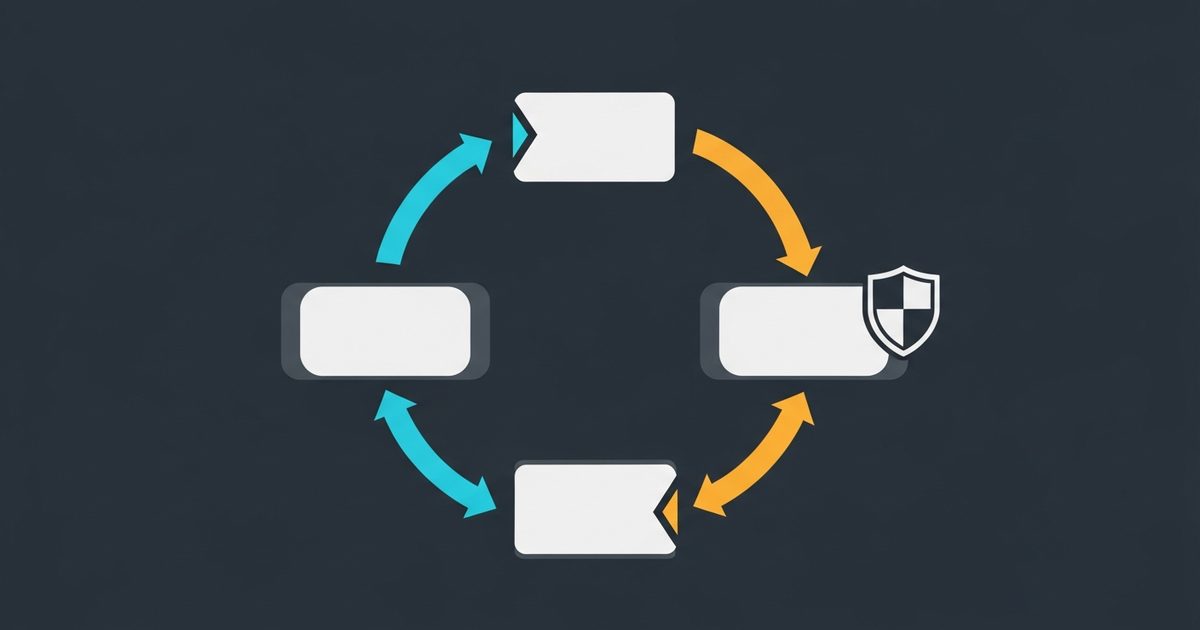
In our own runtime the loop is capped at 15 steps, planning and tool selection run on a fast cheap model while only the final synthesis runs on the expensive one, and a plan is priced before it executes. That last mechanism matters more than it sounds: the run is estimated, and if the estimate exceeds a threshold the system stops and asks for confirmation before spending anything. If the account cannot cover the estimate, the turn ends immediately rather than half-completing an analysis you paid for.
Agentic SEO versus SEO automation
These get conflated constantly, and the distinction is not academic - it changes what you should expect when something goes wrong.
| SEO automation | Agentic SEO | |
|---|---|---|
| Sequence | Written by a human in advance | Chosen at runtime by the model |
| Handles novelty | No - unhandled cases break | Yes - reroutes around them |
| Reproducibility | Identical every run | Varies between runs |
| Debugging | Read the script | Read the transcript |
| Cost per run | Fixed and predictable | Variable, driven by steps taken |
| Best for | Known, repeated procedures | Open-ended investigation |
Reproducibility is the trade nobody warns you about. A scheduled crawl produces the same report shape every Monday. An agent given the same instruction twice may take a different route and surface a different emphasis. That is a feature for diagnosis and a liability for client reporting, which is why the mature pattern is to use deterministic automation for recurring reports and agentic runs for investigation.
Which SEO tasks to hand to an agent first
Order them by two variables: how mechanical the work is, and how checkable the output is. High on both means hand it over now.
- Traffic-drop diagnosis. The best first candidate. Genuinely open-ended, entirely evidence-based, and you can verify the conclusion yourself in ten minutes.
- Striking-distance and cannibalisation mining. Mechanical, high volume, tedious for humans, trivially checkable.
- Competitive keyword gap analysis. Pull, subtract, cluster, size. The judgement is in what you do with it, not in producing it.
- Technical audit triage. Not the crawl itself, which is deterministic, but the ranking of what the crawl found by likely impact.
- Content brief construction. Fan the topic into sub-questions, check which the incumbent results answer, build the brief around the gaps.
What to hand over last, or never: anything that publishes without review, anything that decides priority against business goals, and anything where being confidently wrong is expensive. Search Engine Land's agentic AI and SEO guide lands in the same place - the implementations that survive keep humans on strategy and validation while the agent absorbs the grunt work.
What guardrails an agentic SEO system needs
Guardrails are not a compliance chore here. They are the difference between a system you can leave running and one you have to supervise, which is the whole value proposition.
- A hard step budget. Bounds what a misunderstood goal can cost. On hitting the cap the system should synthesize from what it has and say it ran out of room, never silently truncate.
- Pre-flight cost estimation. Price the plan before running it, and gate anything above a threshold behind explicit approval.
- Tool permission tagging. Classify every tool as read, generate or write. Reads can run unattended. Writes cannot.
- Untrusted-content quarantine. When an agent fetches a competitor page, that page's text lands in the same context window as your instructions. If it contains injected commands, a naive agent may follow them. Our runtime fences all fetched content in an untrusted wrapper, marks the turn tainted, and refuses write tools for the rest of that turn unless a human explicitly approves.
- A readable transcript. Every tool call, argument, cost and result, inspectable afterwards. An agentic system you cannot audit is an agentic system you cannot trust.
How agentic SEO relates to Google query fan-out
There is a neat symmetry people miss. Google's generative AI optimization guide explains that AI Mode expands one prompt into many related sub-queries and retrieves against all of them - query fan-out - which is why depth of topic coverage now outperforms keyword targeting. An agent fans out the same way on the analysis side, decomposing "why did traffic drop" into a set of sub-investigations.
But be careful with the conclusion. The same Google guidance is explicit that there are "no additional requirements to appear in AI Overviews or AI Mode, nor other special optimizations necessary". Using an agent to produce content does not make that content eligible for anything it would not otherwise be eligible for. Using an agent to spin a page per keyword variation is scaled content abuse executed at speed. The agent helps you find what to write about and check whether you covered it. It does not confer eligibility.
Does agentic SEO replace SEO professionals?
It replaces a category of task, not a role. The tasks it absorbs are the ones that involve pulling data from four systems and reconciling them - which happens to be where a lot of junior time currently goes. What it does not absorb is deciding which of three defensible strategies fits a business with a particular sales cycle and a particular tolerance for risk.
The realistic near-term shape is one experienced practitioner supervising work that previously needed three, with the practitioner's time moving from data assembly to judgement and validation. Gartner's forecast points the same direction, predicting 15% of day-to-day work decisions will be made autonomously through agentic AI by 2028, up from effectively none in 2024. Fifteen percent is a substantial shift and it is not a replacement.
How to measure whether agentic SEO is working
Measure the output, not the activity. Three questions:
- Would you have reached the same conclusion? Run the agent on an investigation you have already done manually. Compare. This is the only honest accuracy test.
- What did it cost per useful conclusion? Not cost per run. Runs that produce nothing actionable still cost money, and their share is the number that tells you whether the scoping is right.
- Did search performance actually move? In Search Console, using Google's own generative AI performance reports for AI-surface traffic. Ignore any third-party tool claiming to read Google's internal AI ranking systems - no external tool has that access.
What an agentic SEO run costs
Two components, and the second is the one that surprises teams.
Model tokens scale with how much data enters context. This is why the observe stage is a cost decision, not just a data decision: pulling 25,000 rows of Search Console data and reasoning over them is meaningfully more expensive than pulling 500. We bill tokens at a flat 300 credits per million across every model call in a turn, input and output combined, which is why our runtime condenses large tool results before they re-enter context rather than passing them through raw.
Tool calls are usually the larger share, because most wrap paid third-party APIs. Our published per-call costs give a sense of the shape: a page audit is 50 credits, a Core Web Vitals check 25, a Search Console or GA4 query 50 each, a keyword gap analysis 30, a competitor discovery call 15, a live SERP lookup 5 per keyword, and a brand visibility check 100 per engine queried. A single instruction like "audit this section and tell me what to fix first" can legitimately fan out across ten or more of those calls.
Three consequences follow, and they apply whichever vendor you use:
- Evaluate cost per run, not cost per message. A per-seat price with unlimited chat tells you nothing about what a real multi-tool investigation costs.
- A broad goal is an expensive goal. "Improve our SEO" fans out across every tool in the catalogue. "Find which blog URLs lost clicks in June and why" does not.
- Unbounded runs are the failure mode. Without a step cap and a pre-flight estimate, a misunderstood goal converges on nothing at full price. This is the mechanism behind most of the cancellations in the next section.
Why agentic AI projects fail
Because most of them are not agentic and the rest are unscoped. Gartner predicted in June 2025 that over 40% of agentic AI projects will be cancelled by the end of 2027, citing escalating costs, unclear business value and inadequate risk controls. In the same analysis it estimated that only around 130 of the thousands of vendors marketing agentic AI were genuinely agentic, describing the rest as "agent washing" - rebranded assistants, chatbots and robotic process automation.
The failure pattern in SEO specifically is consistent. A team gives an agent an unbounded goal, no step cap and write access, gets an expensive and slightly wrong output, and concludes the technology does not work. What did not work was the scoping. Start with one read-only diagnostic task, bound it, compare its output to your own for a month, and expand from there.
Where to start this week
Take the investigation you dread most - the one that means opening Search Console, GA4 and a rank tracker in three tabs and reconciling them by hand. Hand exactly that to an agent with read-only access, a step cap and a cost ceiling. Do it four times. If the conclusions match yours, widen the scope. If they do not, you have learned something cheap and important.
The companion piece on what an AI SEO agent is covers the architecture in more depth, and Autopilot runs the loop described here against your own connected data.
Frequently Asked Questions
What is agentic SEO?▾
How does an agentic SEO workflow actually work?▾
What is the difference between agentic SEO and SEO automation?▾
Which SEO tasks should you hand to an agent first?▾
What guardrails does an agentic SEO system need?▾
Does agentic SEO replace SEO professionals?▾
Why do agentic AI projects fail?▾
How do you measure whether agentic SEO is working?▾
Get a Free AI Ranking Consultation
Want to improve your brand's visibility in AI search engines like ChatGPT, Gemini, and Perplexity? Fill out the form and our experts will create a personalized strategy for you.

Written by
Devanshu
Chief Marketing Officer & AI Search Optimization Architect
Digital Marketing Strategist & Pioneer in SEO, Answer Engine Optimization (AEO), and Generative Engine Optimization (GEO).


