


Your brand's visibility in ChatGPT is now a meaningful business metric. When a potential buyer asks ChatGPT to recommend solutions in your category, whether your brand appears in that response - and how it is described - has a direct effect on first-touch awareness and, downstream, on conversion rates.
The challenge is that ChatGPT is not a search engine with a rank position you can check in a dashboard. It is a probabilistic system that generates different responses to the same query in different sessions. Checking your ChatGPT brand visibility requires a different approach than traditional keyword rank tracking.
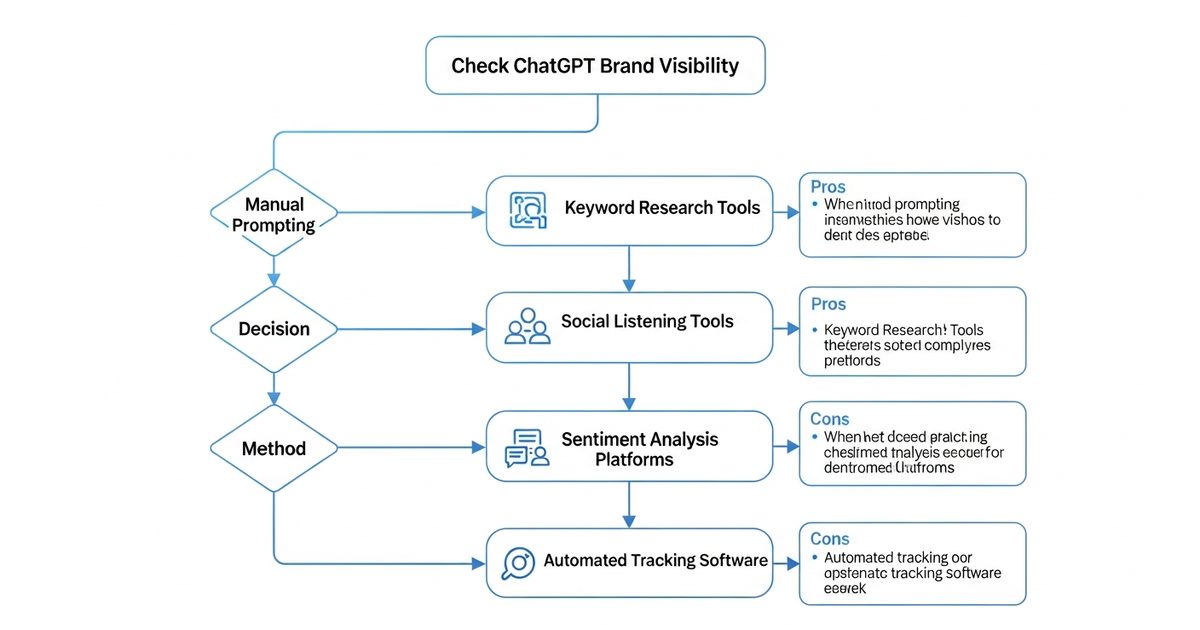
Here are five methods for checking your brand's visibility in ChatGPT responses, from the simplest free option to the most comprehensive automated approach - with the specific situations where each one makes sense.
Method 1: Direct Manual Prompting
Cost: Free | Time: 15-30 minutes | Best for: Initial spot check, verifying specific queries
The most accessible method is the most obvious one: open ChatGPT, enter your target queries, and observe whether your brand appears in the responses. This requires no tools, no accounts, and no budget. It is also the most reliable method for verifying any specific query - you are reading the actual response, not an automated interpretation of it.
How to run an effective manual check
Start with three types of queries that between them cover the most important citation scenarios:
Direct brand queries: Enter your brand name directly ("Tell me about [Brand Name]") and note whether ChatGPT recognizes your brand, describes it accurately, and characterizes it correctly. Brand query citation should be above 80% for an established brand - if ChatGPT does not recognize your brand or describes it inaccurately, you have an entity clarity issue to address.
Category queries: Enter queries your target buyers ask when evaluating your category ("What is the best [your product category] for [use case]?"). Note whether your brand appears in the recommendation list and where relative to competitors. This tests your topical authority and AEO signal strength.
Problem queries: Enter queries phrased as problems your product solves ("How do I [problem you solve]?"). Note whether your brand or your competitors appear as suggested solutions. Problem query citation often outperforms category query citation for brands with strong technical content.
The probabilistic limitation: ChatGPT returns different responses to identical queries across sessions. A single run of a query tells you whether you appeared in that specific response, not your citation rate for that query. To get a meaningful read on a specific query, run it 5-10 times in fresh chat sessions and note the percentage of sessions where your brand appeared. Across 10 runs, 4 appearances = 40% citation rate for that query.
When to use it: Initial brand visibility check before setting up any tool. Verifying whether a specific AEO fix improved citation rates for a target query. Spot-checking your competitors' positioning. Not suitable for systematic monitoring across more than 10-15 queries.
Method 2: Structured Manual Tracking Spreadsheet
Cost: Free | Time: 1-2 hours per week | Best for: Regular tracking of up to 20 queries without a tool subscription
A structured spreadsheet system converts manual prompting from a one-off check into a repeatable tracking methodology. It requires more time than automated tools but costs nothing and provides genuine trend data over time.
Setting up the tracking system
Create a spreadsheet with these columns: Query, Date, Run 1 (cited Y/N), Run 2, Run 3, Citation Rate (average of 3-5 runs), How Brand Described, Competitors Cited, Notes. For each query, run it 3-5 times in separate chat sessions and record each result. Calculate a citation rate per query per week from the average of your runs.
Track 10-20 of your most important queries. Run the spreadsheet weekly - it takes 45-90 minutes for 15 queries at 3 runs each. After 4-6 weeks you have citation rate trend data that shows whether your AEO optimization work is having a measurable effect.
The reality check: Maintaining this system consistently requires discipline. The most common failure mode is starting strong and then skipping weeks when other priorities compete. Build a calendar reminder and a dedicated 90-minute block for it, or accept that automated tracking will be more reliable for sustained use.
When to use it: Teams not ready to commit to a paid tool who want real trend data. Useful for 2-3 months of baseline building before deciding whether paid automation is justified by the results.
Method 3: ChatGPT API Spot-Check Script
Cost: Low (API usage fees, typically under $5/month for spot checking) | Time: Setup 1-2 hours | Best for: Technical teams wanting automated spot checks without a SaaS subscription
If you have a technical team member comfortable with Python or JavaScript, a simple script using the OpenAI API can automate the manual prompting process. The script submits each target query to ChatGPT via the API, parses the response for brand mentions, and writes results to a spreadsheet or database. This gives you the automation benefits - consistent execution, no time commitment per run - at a fraction of the cost of a dedicated SaaS tool.
A basic implementation: a Python script that reads your query list from a CSV, submits each query to gpt-4o via the API 3-5 times, checks each response for your brand name and key competitors using string matching, and writes results with timestamps to a Google Sheet.
The limitations compared to dedicated AEO tools: string matching misses indirect mentions and paraphrased citations that a proper NLP-based detection system catches. You also need to build and maintain the script yourself, handle API rate limits, and build any reporting you want. For teams with the technical capability and a preference for custom infrastructure, this is a cost-effective middle ground. For teams without that capability, a dedicated tool is faster and more reliable.
When to use it: Engineering or data teams that prefer custom tooling over SaaS subscriptions. Useful when you want automated tracking for a specific set of queries with custom logic that off-the-shelf tools do not support.
Method 4: AI Rank Lab Automated Citation Tracking
Cost: Free audit, $69/month ongoing | Time: Setup 10 minutes | Best for: Systematic multi-LLM tracking across full keyword sets
AI Rank Lab's citation analytics automates ChatGPT visibility tracking across your full keyword set with weekly refresh. The platform queries ChatGPT (and Claude, Perplexity, and Gemini simultaneously) using your target keyword list, detects citations using NLP-based brand recognition rather than simple string matching, and presents citation rates with historical trend lines in a unified dashboard.
The key features that differentiate automated tracking from the manual methods above:
Cross-session averaging: The platform runs multiple query instances per keyword to account for ChatGPT's probabilistic nature, giving you a statistically meaningful citation rate rather than a single-session result.
Competitor citation tracking: For each query, the platform identifies which competitors appear in the same responses where your brand is absent - surfacing specific competitive gaps rather than just an overall citation rate.
Brand description monitoring: The platform captures how ChatGPT describes your brand when you are cited, allowing you to track whether your messaging is accurately represented and whether it is improving over time.
Integrated AEO audit: The AEO audit tool connects directly to your citation tracking data - when a citation rate drops, the audit findings explain which technical or content signals are most likely responsible. This diagnostic loop is not available in monitoring-only tools.
The free audit gives you a one-time check across up to 25 queries with full diagnostic findings. Ongoing automated weekly tracking requires the $49/month paid plan.
When to use it: When your keyword set exceeds 20-25 queries, when you need multi-LLM tracking simultaneously, or when you want the diagnostic loop connecting citation rate data to specific optimization findings.
Method 5: Broader AI Monitoring Platforms
Cost: $99-300/month | Time: Setup 30-60 minutes | Best for: Agencies and enterprises focused on brand reputation across AI platforms
Platforms like Otterly.ai and Sona provide ChatGPT brand visibility tracking as part of a broader AI brand monitoring suite. They track not just citation rates but brand sentiment in AI responses, share-of-voice versus competitors across AI platforms, and alert you to significant changes in how your brand is described.
The difference from Method 4 is focus: AI monitoring platforms are built around brand reputation and competitive intelligence rather than technical AEO optimization. They are most valuable for brand teams that need to track how ChatGPT describes their brand across a wide range of queries - including unsolicited brand mentions where someone asks ChatGPT about your brand without a specific recommendation context.
These platforms do not include AEO audit functionality, so they tell you what is happening (citation rates, brand descriptions, competitor comparisons) without diagnosing why or providing specific technical fixes. For teams that have the SEO or AEO expertise to interpret the data and drive optimization independently, this is workable. For teams that need both measurement and a roadmap for improvement, a platform with an integrated audit engine is more complete.
When to use it: Agencies managing AI brand reputation for clients. Enterprises with established SEO teams that need brand monitoring data rather than optimization guidance. Teams whose primary metric is share-of-voice rather than citation rate for specific technical queries.
Which Method to Use When
Use direct manual prompting (Method 1) for any initial spot check, verifying a specific query after implementing a fix, or competitive research on a handful of queries. It takes 15 minutes and gives you real data immediately.
Use the structured spreadsheet (Method 2) when you want regular trend data across 10-20 queries but are not ready to commit to a paid tool. Plan for 60-90 minutes per week and 4-6 weeks before the trend data becomes meaningful.
Use the API script (Method 3) if you have technical resources and a preference for custom infrastructure over SaaS subscriptions. Budget 2-3 hours of setup and ongoing script maintenance.
Use AI Rank Lab automated tracking (Method 4) when your keyword set exceeds 20 queries, when you need multi-LLM tracking simultaneously, or when you want the diagnostic connection between citation rate data and specific actionable fixes. Start with the free audit before deciding on the paid plan.
Use broader AI monitoring platforms (Method 5) when brand reputation monitoring and share-of-voice analytics across AI platforms are the primary requirement, and when your team can drive optimization work independently of the monitoring data.
For most teams building their ChatGPT visibility program: start with Method 1 today (15 minutes, free), set up the Method 2 spreadsheet this week, and run the AI Rank Lab free audit to establish a proper baseline. Then assess whether the diagnostic findings from the audit justify the $49/month paid monitoring tier for ongoing automated tracking.
Run your free ChatGPT brand visibility check here to see where you currently stand across all four major LLMs.
Frequently Asked Questions
How do I check if my brand appears in ChatGPT?▾
Why does my brand appear in ChatGPT sometimes but not others?▾
What is a ChatGPT visibility tracker?▾
How long does it take for ChatGPT to recognize my brand?▾
Can I track my brand visibility in Claude and Gemini too?▾
What is a good ChatGPT brand visibility score?▾
Get a Free AI Ranking Consultation
Want to improve your brand's visibility in AI search engines like ChatGPT, Gemini, and Perplexity? Fill out the form and our experts will create a personalized strategy for you.

Written by
Devanshu
Chief Marketing Officer & AI Search Optimization Architect
Digital Marketing Strategist & Pioneer in SEO, Answer Engine Optimization (AEO), and Generative Engine Optimization (GEO).


