


Perplexity has grown faster than any other AI search engine in 2025-2026. With over 100 million monthly active users as of early 2026 and a user base that skews heavily toward high-intent researchers, professionals, and buyers, showing up in Perplexity answers is increasingly a meaningful business metric - not just a vanity data point.
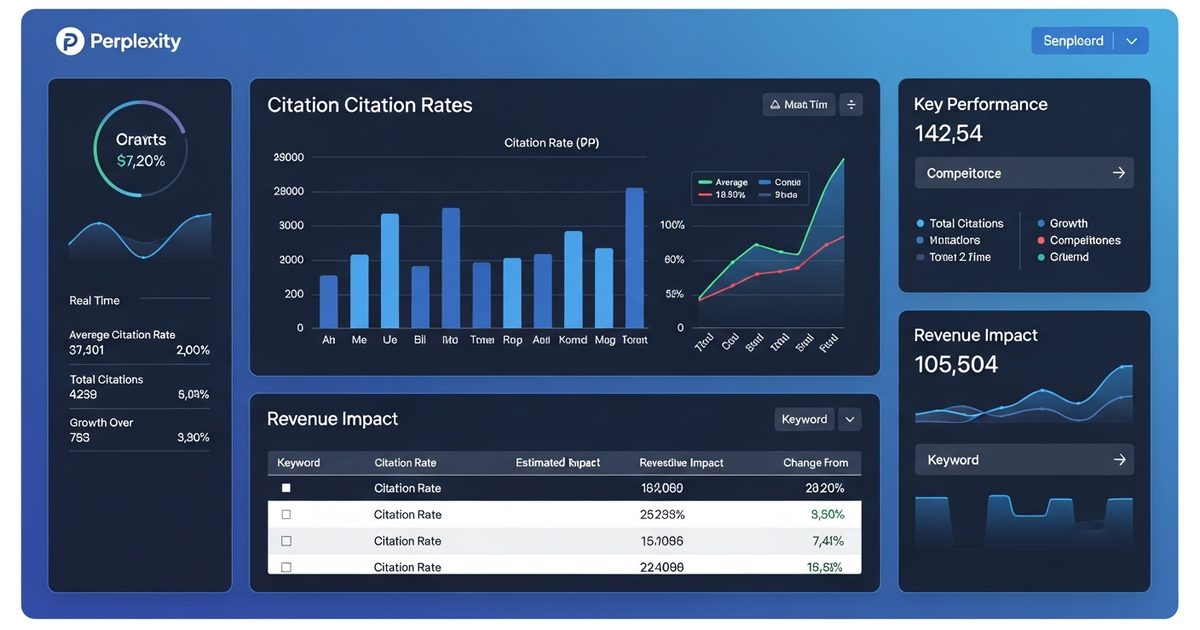
A Perplexity ranking report shows you how often your brand, product, or website is cited when Perplexity generates answers to queries in your category. It tells you which queries you appear in, which competitors appear instead of you, and whether your visibility is trending up or down over time.
This guide covers what a good Perplexity ranking report includes, where to get one, and - most importantly - how to use the data to actually drive revenue rather than just reporting numbers to stakeholders.
Why Perplexity Specifically Matters in 2026
The AI search landscape has multiple major players, but Perplexity has characteristics that make it particularly important for brands focused on high-value audience segments:
High-intent user base: Perplexity users skew toward researchers, professionals, and purchase-ready buyers. These are not casual browsers - they are actively seeking specific information or comparing options before making decisions.
Source citation by default: Perplexity cites its sources inline and prominently. When your brand is cited in a Perplexity answer, the citation is visible and clickable - creating a direct traffic pathway that other AI engines handle differently.
Niche professional authority: In B2B, financial, medical, legal, and technology categories, Perplexity has become the preferred AI research tool for professionals. Being cited by Perplexity in these categories carries meaningful credibility signals.
Rapid growth trajectory: Perplexity's user base grew approximately 300% in 2024 and continued strong growth through 2025. The audience size justifies dedicated tracking even for brands that are still primarily Google-focused.
What a Good Perplexity Ranking Report Includes
Not all Perplexity ranking reports are equally useful. Here is what a report needs to include to be actionable rather than just informational:
1. Overall Citation Rate with Trend
The core metric: what percentage of tracked queries result in a Perplexity citation that includes your brand, domain, or content? This should be shown as a percentage with a trend line going back to baseline. A report that shows only the current month's citation rate without historical context does not let you assess whether things are improving or deteriorating.
2. Query-Level Breakdown
Which specific queries are you cited in, and which are you absent from? This is where the actionable data lives. A query where you are never cited despite ranking well on Google often indicates a specific technical or content gap that can be fixed. A query where you are cited inconsistently (sometimes yes, sometimes no) indicates a borderline authority signal that targeted optimization can push in the right direction.
3. Competitor Citation Comparison
For each tracked query, which competitors are being cited alongside or instead of you? This competitive context is essential for prioritization. If a direct competitor is cited in 80% of a high-value query and you are cited in 15%, that is a gap worth addressing urgently. If no competitors are being cited either, the category is underserved by AI content and there is an opportunity to establish first-mover authority.
4. Citation Snippet Context
What does Perplexity actually say when it cites you? The best reports show the text context around citations - whether Perplexity is citing you favorably, neutrally, or as a comparison point. Being cited as "Brand X, which costs more than alternatives" is technically a citation but a different signal than being cited as "the leading platform for X."
5. Trend Period and Query Freshness
Perplexity's citation behavior changes as new content is published, as Perplexity's training and retrieval systems update, and as your own content changes. A good report runs queries on a consistent weekly or bi-weekly schedule to capture trends accurately rather than snapshots.
Where to Get a Perplexity Ranking Report
Option 1: AI Rank Lab (Recommended)
AI Rank Lab provides automated Perplexity citation rate tracking as part of its full AEO monitoring platform. You define your keyword set, and the platform runs those queries in Perplexity on a regular schedule, tracks citation rates, benchmarks competitors, and produces reports showing all the elements above.
The advantage of using AI Rank Lab is that Perplexity tracking comes alongside ChatGPT, Gemini, and Claude tracking in the same dashboard. Most brands that care about Perplexity visibility also care about the other major AI engines - tracking them separately would require multiple tools and manual report aggregation. AI Rank Lab solves this in a single platform.
The technical AEO audit layer is also relevant for Perplexity specifically: when your Perplexity citation rate is low for a given query, the audit identifies likely causes - which saves significant diagnostic time compared to manually testing hypotheses.
Pricing: From $49/month for individual sites with full Perplexity tracking included.
Option 2: Otterly AI
Otterly AI provides Perplexity citation monitoring as part of its AI search tracking suite. The reports are clean and easy to share with clients or stakeholders. Like most monitoring-only platforms, it shows you the data without providing guidance on how to improve the numbers.
Pricing: From $99/month.
Option 3: Manual Tracking (Free, Low Quality)
You can run manual citation checks by entering your target queries directly into Perplexity and noting whether your brand appears. This is free but not scalable - it cannot be done at query volumes that provide statistical significance, cannot track trends over time, and cannot be automated. Manual checks are useful for spot-checking but not for running a systematic Perplexity visibility program.
How to Use Perplexity Ranking Data to Drive Revenue
Citation rate data is only valuable to the degree that you act on it. Here is the framework for converting Perplexity ranking report data into actual revenue impact:
Step 1: Identify Your High-Value Query Set
Not all queries are equal. Before optimizing broadly, identify the 10-15 queries where being cited by Perplexity would have the highest business impact. These are typically: queries that high-intent buyers use when comparing options, queries related to your highest-margin products or services, and queries where a direct competitor is significantly outperforming you in Perplexity citations.
This prioritization is critical because AEO/GEO optimization takes time and resources. Spending that effort on queries that drive revenue is significantly more valuable than spreading effort evenly across your entire keyword set.
Step 2: Diagnose Why You Are Not Being Cited
For each high-value query where your citation rate is below 30%, diagnose the specific barriers. The most common reasons for low Perplexity citation rates are:
Thin content coverage: Your page on this topic is too short or too surface-level for Perplexity to recognize it as authoritative. Perplexity tends to cite comprehensive, structured content over brief summaries.
Missing structured data: FAQ schema, Article schema, and Organization schema help AI engines understand and retrieve your content accurately. Missing schema is one of the fastest fixes for citation rate improvement.
Weak backlink authority on the topic: Perplexity weighs topical authority signals. If your backlink profile does not include links from authoritative sources in your category, your citation eligibility is limited.
Crawl or indexation issues: If Perplexity's crawler cannot access your content reliably, it cannot cite it. Check your robots.txt file specifically for blocks against PerplexityBot.
Entity ambiguity: If Perplexity cannot clearly identify what your brand or product is, who it is for, and what it does, it defaults to citing more clearly defined competitors. Entity clarity - established through consistent structured data and clear on-page context - is a fundamental citation prerequisite.
Step 3: Fix the Highest-Impact Gaps First
Based on your diagnosis, prioritize fixes by estimated citation rate impact and implementation difficulty. Schema markup fixes are typically fast to implement and show results within 4-6 weeks. Content expansion and restructuring takes longer but has broader impact. Backlink authority building is a longer-term program (3-6 months) but addresses the root cause of authority-driven citation gaps.
Step 4: Track Changes Against Your Baseline
After implementing each fix, track the citation rate for the affected queries over the following 4-8 weeks. Perplexity's citation behavior does not change instantly - allow sufficient time for retrieval system updates to reflect your content changes. A citation rate improvement of 5-10 percentage points per query is a meaningful result from a targeted fix; improvements of 20+ percentage points indicate you have addressed a significant barrier.
Step 5: Connect Citation Rate to Business Metrics
The final step - and the one most teams skip - is connecting citation rate improvements to downstream business metrics. Track whether increases in Perplexity citation rates for high-value queries correlate with: website traffic from Perplexity referrals, branded search volume (people who saw your brand cited and searched for it), and conversion rate on landing pages for cited products or categories.
This connection transforms Perplexity ranking from an interesting data point into a revenue-linked metric that justifies ongoing investment in AEO/GEO optimization.
Benchmarks: What Is a Good Perplexity Citation Rate?
Perplexity citation rates vary significantly by category, query type, and competitive intensity. Based on AI Rank Lab's aggregate data across thousands of tracked queries:
Informational queries (general education): Average citation rates of 15-35% for brands with moderate content authority. Top performers reach 60-80%.
Comparative queries ("best X for Y"): Average citation rates of 10-25%. These queries are highly competitive as multiple brands are relevant - being cited in any percentage is meaningful.
Brand queries (direct brand mentions): Citation rates of 70-95% for established brands with adequate online presence. Low citation rates on brand queries indicate fundamental entity recognition issues.
Transactional queries ("how to buy X"): Average citation rates of 8-20%. These high-value queries are hardest to rank in because Perplexity generates synthesized advice rather than citing a single source.
Use these ranges to calibrate whether your Perplexity citation rates indicate an opportunity, a problem, or expected performance given your competitive position and content investment level.
Getting Your First Perplexity Ranking Report
The fastest way to understand your current Perplexity visibility is to run a baseline citation check before investing in any optimization work. Define your 15-20 most important queries, run them in Perplexity manually, and note which ones produce a citation. This 30-minute exercise will tell you whether Perplexity visibility is a priority problem or a maintenance optimization.
For ongoing tracking and the query volume needed to identify trends, a dedicated platform is necessary. AI Rank Lab's Perplexity tracking provides automated citation rate monitoring, competitive benchmarking, and technical audit diagnostics - the complete toolkit for building and improving your Perplexity search presence in 2026.
Frequently Asked Questions
What is a Perplexity ranking report?▾
How do I check my Perplexity citation rate?▾
How long does it take to improve Perplexity citation rates?▾
Why is Perplexity important for SEO in 2026?▾
What is a good Perplexity citation rate benchmark?▾
Get a Free AI Ranking Consultation
Want to improve your brand's visibility in AI search engines like ChatGPT, Gemini, and Perplexity? Fill out the form and our experts will create a personalized strategy for you.

Written by
Devanshu
Chief Marketing Officer & AI Search Optimization Architect
Digital Marketing Strategist & Pioneer in SEO, Answer Engine Optimization (AEO), and Generative Engine Optimization (GEO).


