


An AI content gap analysis finds where answer engines talk about your competitors instead of you: the prompts where competitors are named and you are not, the cited pages that mention them and skip you, and the sub-questions their cited pages answer that none of your pages do. A classic content gap analysis compares Google keyword rankings. The AI version keeps that layer, adds those three, and confirms each gap across repeated runs, because a gap you see in one answer is often just noise.
This guide gives you one workflow for all four gap types (keyword, prompt, source and content), the sheet columns to record at each step, a scoring model to rank the list, a worked example, the action each gap type calls for, and how often to rerun the whole thing. It builds on the published workflows from Ahrefs, Semrush, Peec AI, Similarweb and others, and adds variance data from 972 repeated prompt runs tracked in AI Rank Lab. Tool features and definitions checked October 24, 2026.
Key takeaways
- There are four gaps, not one. Keyword gap (Google rankings), prompt gap (competitors named, you are not), source gap (cited pages that help competitors and not you) and content gap (sub-questions you never answer). Each needs a different fix.
- Confirm a gap before you act on it. Across 972 repeated runs of 42 prompt-engine pairs tracked in AI Rank Lab (February to October 2026), 42.9% of pairs flipped between mentioning and not mentioning the brand at least once. Run each prompt at least 5 times per engine before you call a gap.
- One run shows only part of the source list. In the same data, the median pair cited 2.7 times as many distinct domains across all its runs as in an average single run, and only a median 3.4% of cited domains appeared in every run.
- Google rankings still feed AI answers. AirOps found 55.8% of pages ChatGPT cited ranked in Google's top 20 for the prompt or one of its fan-out queries, so the keyword gap stays in the workflow.
- Score every gap, then give it one action: a new page, an update, a listing or reviews, editorial outreach, community work, or park it.
- Rerun the full analysis quarterly, re-check top-priority prompts monthly, and judge a fix over weeks of repeated runs, never one.
What is a content gap analysis?
A content gap analysis is the process of finding the topics and questions your audience cares about that competitors cover and you do not, and turning that list into decisions: what to create, what to update, and what to ignore. Ahrefs defines it as "the process of finding topics your competitors have covered but you haven't", and most guides still run it on keyword rankings.
In the keyword version, you enter your domain and a few competitors into a tool and read the overlap. Semrush Keyword Gap compares up to five domains and labels keywords as Missing (every competitor ranks, you do not), Weak (you rank below all competitors), Untapped (at least one competitor ranks, you do not) and so on. That still matters. But it only describes Google's ranked list, and buyers now also ask ChatGPT, Gemini, Claude, Perplexity and Google's AI features, which answer in prose, name a handful of brands and cite a handful of pages.
How is an AI content gap analysis different from a keyword gap analysis?
An AI content gap analysis measures prompts instead of keywords, mentions and citations instead of positions, and rates instead of single results. Three differences change the method:
- The unit is a prompt, and prompts fan out. Google says AI Overviews and AI Mode may use "query fan-out", "issuing multiple related searches across subtopics and data sources". In the AirOps study of 15,000 prompts (March 2026), ChatGPT generated two or more fan-out queries for 89.6% of searches, and 95% of those fan-out queries had zero monthly search volume. A keyword tool cannot see most of the questions that decide what gets cited. (More on the mechanism in our query fan-out explainer.)
- The output is a mention or a citation, not a rank. An answer can name your brand without linking you, or link your page without naming you as a recommendation. You record both.
- The result is a distribution. The same prompt gives different brands and sources from run to run, so a gap is a rate (competitor named in 4 of 5 runs, you in 0 of 5), not a yes or no.
What are the four content gap types in AI search?
The four gap types are the keyword gap, the prompt gap, the source gap and the content gap. They answer different questions, need different evidence and lead to different work, which is why lumping them into one "gap list" produces a backlog nobody can act on.
| Gap type | Question it answers | Evidence you need | Where the data comes from | Typical fix |
|---|---|---|---|---|
| Keyword gap | Which Google queries do competitors rank for that we do not? | Rankings for you and 3-5 competitors | Ahrefs, Semrush, Search Console | New page or expanded page |
| Prompt gap (mention gap) | Which prompts name competitors but not us? | Mention rate per prompt and engine over repeated runs | Prompt tracking tool or manual runs | Comparison, alternatives or use-case pages, plus off-site mentions |
| Source gap (citation gap) | Which cited pages help competitors and not us? | Cited URLs per run, grouped by domain and owner | The sources listed in each answer | Listings, reviews, outreach, PR, community work, or a stronger own page |
| Content gap (answer gap) | Which sub-questions do cited pages answer that our pages do not? | Sub-question list from cited pages vs your pages | Reading the cited pages | New section, new page or restructure |
What is a prompt gap, or brand mention gap?
A prompt gap is a prompt where AI answers name one or more competitors and do not name you. Peec AI calls it a brand mention gap and defines it the same way in its February 2026 beginner's guide; Semrush's AI Visibility Toolkit labels the same list "Topic Opportunities: Prompts where your competitors are visible, but your brand is not." Two softer versions belong on the same sheet: a position gap (you are named, but after the competitors) and a sentiment gap (you are named neutrally or negatively while competitors are framed positively), which Similarweb's March 2026 guide treats as its own gap type.
What is a source gap or citation gap?
A source gap is a page AI engines cite for your prompts that helps a competitor and not you. In this guide it has two kinds, because the fixes differ:
- Third-party source gaps: review platforms, publisher roundups, forums, videos and directories that are cited and mention competitors but not you. Semrush calls these Source Opportunities, "sources frequently cited in AI answers that mention your competitors but not your brand". The fix is off-site.
- Competitor-owned source gaps: the competitor's own page is the cited source. The fix is on-site: a more complete, more specific page of your own.
Be careful with vendor terms here. Peec AI uses "source gap" for something else: your own URLs that engines retrieve but rarely cite, as described in its January 2026 source gap guide. That is closer to what this guide calls a content gap. For the bigger picture of which kinds of sites answer engines cite, see what sources LLMs cite.
What is a content gap in AI answers?
A content gap, at the AI level, is a sub-question that the cited pages answer and your pages do not, or answer too thinly to be used. It is the gap that explains why a relevant page of yours still loses: being found is not the same as being used. In the AirOps data, only 15% of the 548,534 pages ChatGPT retrieved were cited in the final answer. Semrush's June 2026 content gap guide offers useful lenses for this layer: topic gaps (not covered), intent gaps (covered for the wrong need), quality gaps (thin or outdated) and originality gaps (repeats what competing pages say).
Same gap, different names: a vendor glossary
No two tools use the same words, which makes it easy to compare unlike things. This is how the terms map to the four types above, based on each vendor's own documentation checked October 24, 2026.
| Vendor term | Vendor | What it measures | Maps to |
|---|---|---|---|
| Topic Opportunities / Missing Prompts | Semrush AI Visibility Toolkit | Prompts where competitors are visible or mentioned and you are absent | Prompt gap |
| Source Opportunities | Semrush AI Visibility Toolkit | Frequently cited sources that mention competitors but not you | Third-party source gap |
| Brand mention gap | Peec AI | Prompts where competitors are named and you are not, then the sources behind them | Prompt gap, then source gap |
| Source gap | Peec AI | Your URLs that are retrieved but rarely cited | Content gap (on your own pages) |
| Topic, prompt-level, sentiment and citation gaps | Similarweb | Category absence, absence on specific prompts, weaker framing, cited third parties that skip you | Prompt gap (three kinds) and source gap |
| Citation gap analysis | Profound (agent in Optimizely Opal) | Your citations vs competitors' for a topic, with recommended blog topics | Source gap and content gap |
| Content gap / Keyword Gap | Ahrefs / Semrush | Keywords competitors rank for and you do not | Keyword gap |
How do you do an AI content gap analysis, step by step?
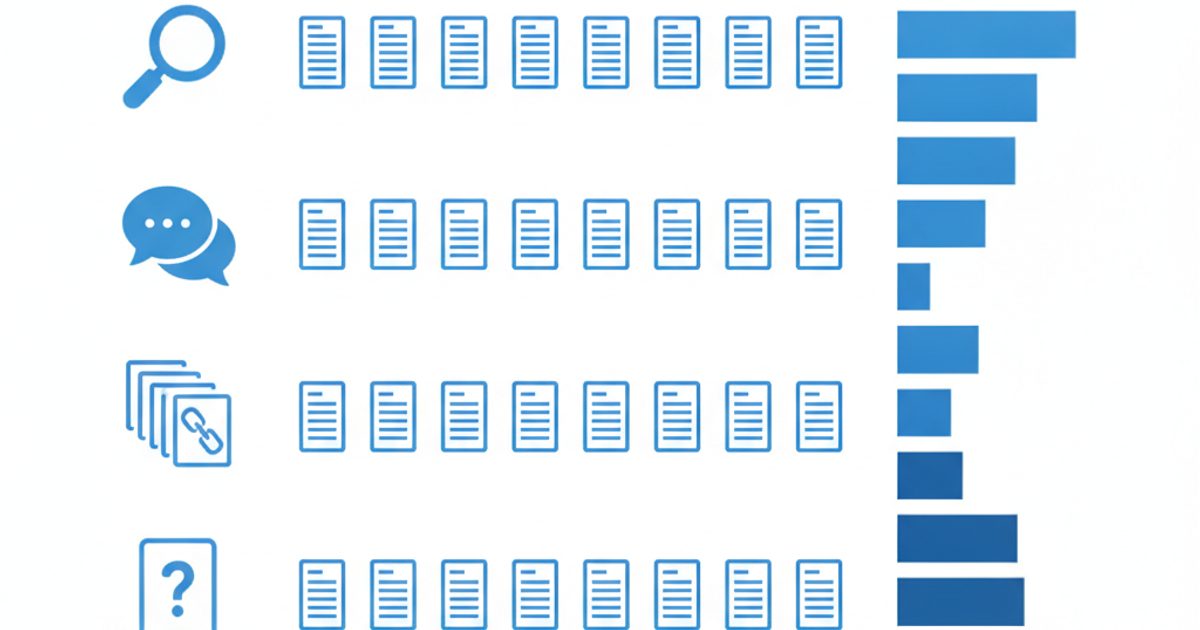
You do it in nine steps: set the scope, build a prompt set, run each prompt several times per engine, pull the prompt, source and content gaps out of those runs, add the keyword gap, score everything, then ship and re-measure. The table shows what goes in and what comes out of each step, so you can build the spreadsheet as you go.
| Step | Input | Output (sheet tab and columns) |
|---|---|---|
| 1. Set the scope | Products, markets, a handful of broad category prompts | Scope: 3-5 competitors that actually appear in AI answers, topics, engines |
| 2. Build the prompt set | Sales and support questions, search data, reviews | Prompts: prompt, topic, intent, funnel stage |
| 3. Run each prompt repeatedly | Prompt set | Runs: date, engine, you mentioned (Y/N), position, competitors named, cited URLs |
| 4. Find prompt gaps | Runs | Prompt gaps: prompt, engine, your mention rate, each competitor's mention rate, label |
| 5. Find source gaps | Cited URLs from Runs | Sources: URL, domain, owner type, mentions you (Y/N), competitors mentioned, share of runs cited, engines |
| 6. Find content gaps | Top cited pages for each gap prompt | Sub-questions: sub-question, cited pages answering it, your page, status |
| 7. Add keyword gaps | Keyword gap export or Search Console | Keywords: keyword, volume, competitors in top 10, your position, topic |
| 8. Score and assign actions | All gap tabs | Backlog: gap, type, score, action, owner, date |
| 9. Ship and re-measure | Backlog | Results: baseline vs after mention and citation rates |
- Set the scope. Run 5-10 broad category prompts first and write down every brand and site that shows up. Your AI competitors are the ones answer engines name, which often includes marketplaces, publishers and tools your sales team never mentions. Keep 3-5. Pick the engines your buyers use. If engines never retrieve your pages at all, fix crawlability and indexing first; our AI search audit template covers that.
- Build the prompt set. Write 20-50 prompts per product line the way buyers ask them, and tag each by topic and intent (informational, commercial, transactional), as both Peec and Semrush recommend. Choosing the prompts is its own discipline; our prompt research guide covers sourcing and sizing.
- Run each prompt repeatedly. Run every prompt at least 5 times per engine, spread over at least three days, before you label anything. Record the fields in the Runs tab for every run. The next section shows why one run misleads. To automate this step, AI Rank Lab's brand visibility tracking runs the prompts you choose on ChatGPT, Claude, Gemini, Perplexity, Google AI Overviews and AI Mode and stores every run with mention, position, sentiment, competitors named and cited URLs. It runs when you trigger it, so put the reruns in your calendar.
- Find prompt gaps. For each prompt and engine, divide the runs that mention you by total runs, and do the same for each competitor. Label each prompt-engine row: persistent gap (a competitor named in 70% or more of runs, you in under 30%), intermittent (30-69%) or one-off (under 30%). Add position and sentiment gaps in separate columns. For the share math across a whole prompt set, see AI share of voice. AI Rank Lab's competitor view shows which competitors appear for each tracked prompt and their share.
- Find source gaps. Pull every cited URL from the runs, group by domain, and tag the owner: your site, a competitor, a review platform or marketplace, a publisher, a community or video site, a reference site, or a directory. Open each frequently cited page and note whether it mentions you and which competitors it mentions. Keep the share of runs it was cited in and how many engines cited it: a source several engines use and that names several competitors is worth more. Peec's gap score works on the same idea, multiplying the number of competitors a source mentions by how often AI uses it. AI Rank Lab's citation analytics lists the domains and URLs cited for your prompts and competitor citation share, which gives you this tab without copying links by hand.
- Find content gaps. For each persistent prompt gap, open the 3-5 most-cited pages and list the sub-questions they answer, from their headings, tables and FAQs. Put your best matching page next to them and mark each sub-question as answered well, answered thinly or missing. Note format too: Peec found the pages ChatGPT cited most in its example were listicles, while long single-product reviews with few headings were retrieved but rarely cited. In AI Rank Lab, the Action Plan does this step for a chosen prompt: it gathers the URLs cited in your stored runs, reads those pages, extracts what they cover and returns content briefs.
- Add keyword gaps. Run a classic keyword gap in Ahrefs (Competitive Analysis, "Show keyword opportunities") or Semrush Keyword Gap (Missing and Untapped tabs). Ahrefs suggests, for very large reports, keeping keywords where at least two competitors rank in the top 10, with volume of 20 or more and Keyword Difficulty of 30 or less. Free option: Search Console queries where you get impressions but rank low. AI Rank Lab's Autopilot also has a keyword gap skill that compares your ranking keywords with a competitor's top 20. Keep only keywords inside the topics of your prompt set so everything stays one strategy. This layer still matters because Google's AI features ground answers in its search index and, in the AirOps data, most pages ChatGPT cited ranked in Google's top 20 for at least one related query.
- Score and assign actions. Score every row with the model below and give it exactly one action and one owner.
- Ship and re-measure. Record the baseline rates before you change anything, ship, then rerun the same prompts on the same engines over the following weeks and compare rates, not single answers.
How many runs before you call it a gap?
Run each prompt at least 5 times per engine across at least three days before you call a prompt or source gap, and treat only gaps seen in 70% or more of runs as persistent. A single run cannot tell a real gap from normal variation. Our own data shows how much answers move with nobody changing anything.
Method: successful runs stored in AI Rank Lab between February 13 and October 22, 2026, limited to prompt-engine pairs with at least 5 successful runs (42 pairs, 972 runs, 14 tracked domains). "Mention flipped" means the brand was mentioned in some runs and not in others. Jaccard is the overlap of cited domains between consecutive runs (1 = identical, 0 = no overlap).
| Engine | Prompt-engine pairs | Runs | Pairs where the brand mention flipped | Median cited-domain overlap between consecutive runs |
|---|---|---|---|---|
| ChatGPT | 11 | 240 | 54.5% | 0.54 |
| Claude | 11 | 227 | 45.5% | 0.53 |
| Gemini | 13 | 275 | 23.1% | 0.26 |
| Perplexity | 6 | 224 | 66.7% | 0.59 |
| All engines | 42 | 972 | 42.9% | 0.41 |
What this means for gap analysis:
- Prompt gaps need repeats most on Perplexity and ChatGPT, where brand mentions flipped in over half of pairs. A competitor named in one Perplexity answer and not the next is the normal state, not a finding.
- Source gaps need repeats most on Gemini, where consecutive runs shared only about a quarter of their cited domains. A source list from one Gemini run is a sample, not the list.
- One run shows roughly a third of the sources. The median pair cited 2.7 times as many distinct domains across its runs as in one average run, and only a median 3.4% of cited domains appeared in every run. Weight sources by the share of runs they appear in.
- Some prompts never move. 19 pairs always mentioned the brand and 5 never did. Those are stable wins and stable gaps, and a stable gap is the most trustworthy row on the sheet.
The samples per engine are small (6-13 pairs), so read these as direction, not benchmarks. Independent research points the same way: in "Don't Measure Once" (University of St. Gallen, April 2026), day-to-day overlap of cited sources averaged 0.34 to 0.42, a single run was "essentially uninformative" for estimating brand visibility, and the authors recommend at least 7 runs per prompt per day for monitoring. Five runs across several days is a pragmatic floor for discovering gaps; measuring whether a fix worked deserves the stricter standard, with unchanged control prompts and a fixed test window.
Can you do an AI content gap analysis for free?
Yes. Every step can be done by hand with the free tiers of the answer engines, Google Search Console and a spreadsheet. The limit is volume: the repeated runs that make the result trustworthy are exactly the part people skip when working manually.
| Task | Manual method (free) | Tool method |
|---|---|---|
| Run prompts | Paste each prompt into ChatGPT, Gemini, Perplexity and Claude with web search on, in a temporary or fresh session so account memory does not color the answer; copy answer and links into the Runs tab | One prompt list runs across engines; every run stored with parsed fields |
| Volume per cycle | 25 prompts x 4 engines x 5 runs = 500 copy-paste runs | Same 500 runs, paid in credits or subscription instead of hours |
| Google AI Overviews and AI Mode | Search in Google and note the cited links; results vary by location and account | Location-set checks for each query |
| Mention detection | Read every answer; watch for name variants | Parsed automatically; brand aliases still need setting up |
| Source grouping | Pivot table on domain; open pages to check mentions | Domain and URL reports with competitor mentions |
| Keyword gap | Search Console queries with impressions and low positions, plus manual SERP checks | Ahrefs, Semrush or a keyword gap tool |
| Best for | A first look at under about 20 prompts | Recurring analysis, many prompts, agencies running several clients |
Which tools do AI content gap analysis?
Disclosure: AI Rank Lab is our product. We list it first because this is our site, and we've kept the same criteria for every tool below. Criteria: which of the four gap types the tool covers from its own data, which engines it checks, and what it does after finding a gap. Features checked October 24, 2026 against each vendor's public documentation.
- AI Rank Lab. Runs the prompts you choose on ChatGPT, Claude, Gemini, Perplexity, Google AI Overviews and AI Mode and stores every run, so prompt gaps and source gaps come from repeated runs rather than a snapshot. The competitor view and citation analytics give the prompt and source gap lists; the Action Plan reads the pages cited for a prompt and turns them into briefs; the content writer drafts and publishes the page; after you publish, the citation tracker re-checks opted-in prompts weekly. Keyword gaps come through the Autopilot skill. Limits: runs happen when you trigger them, not on an automatic schedule, so you plan the repeats.
- Semrush AI Visibility Toolkit. Topic Opportunities (prompt gaps) and Source Opportunities (third-party source gaps) are built-in filters, with data from Google AI Overviews, AI Mode, Gemini and ChatGPT refreshed daily on a rolling basis, per Semrush's documentation. The better choice if your team already runs Semrush Keyword Gap, because the keyword layer sits in the same account.
- Peec AI. Published the clearest public workflows for both mention gaps and source gaps, with prompt tagging and a gap score for third-party sources. A good choice for teams that want a tool built around source-level analysis.
- Profound. Its Citation Gap Analysis agent, available on Optimizely's agent platform, takes a topic and returns share of voice, platform distribution, citation gaps and prioritized blog topics across Perplexity, ChatGPT and Google AI. The better choice for enterprise teams already on Optimizely.
- Otterly.AI. Its citations report filters cited URLs by domain category and by whether your brand is mentioned, and its help documentation routes the results by team: brand pages to content, news and blogs to PR, forums and social to the social team. Useful when several teams split the work.
- Ahrefs. The Competitive Analysis content gap report, with a free Sheets template, is a strong option for the classic keyword layer. Ahrefs Brand Radar covers AI mentions separately.
How do you prioritize content gaps? A scoring model
Score each gap on four factors that make it worth closing, multiply them, and divide by the effort to close it: Priority = Value x Evidence x Reach x Pressure / Effort. Multiplying means a gap has to be strong on every factor to rise to the top, and dividing by effort pushes cheap, well-evidenced fixes up.
| Factor | 1 | 2 | 3 |
|---|---|---|---|
| Value (intent of the prompt or keyword) | Informational, early research | Consideration: comparisons, how-to-choose | Decision: best-for, alternatives, pricing, vendor shortlists |
| Evidence (how sure you are the gap is real) | One-off: under 30% of runs, or 1 competitor ranks | Intermittent: 30-69% of runs, or 2 competitors rank | Persistent: 70%+ of runs, or 3+ competitors rank |
| Reach | 1 engine, or under 100 searches a month | 2 engines, or 100-1,000 searches | 3+ engines, or over 1,000 searches |
| Pressure (competitors present in the answer or source) | 1 competitor | 2 competitors | 3+ competitors |
| Effort (divisor) | Update a page, claim a listing | New page | Earned coverage: editorial outreach, PR |
Scores run from about 0.3 to 81. Start with these bands: 24 or more, this sprint; 8 to 23, next cycle; under 8, park and recheck. These thresholds are our suggested starting point, not a validated benchmark; move them once you see which fixes actually shift your rates. Other published models weigh things differently: LLMrefs averages four equally weighted 0-100 criteria (volume, difficulty, funnel fit and AI visibility potential), and Peec's gap score ranks sources only. What this model adds is evidence from repeated runs and the cost of the fix.
Worked example: one gap sheet, six gaps
This is an illustrative composite, not a client and not real measurements. A B2B project management software brand tracks 25 prompts on ChatGPT, Perplexity and Gemini, 5 runs each per engine (375 runs), against three competitors. Here are six rows from its sheet after steps 4 to 7.
| Gap | Type | Evidence | V | E | R | P | Effort | Score | Action |
|---|---|---|---|---|---|---|---|---|---|
| Review platform category page for agency project tools | Source gap (third-party) | Cited in 9 of 15 runs on 3 engines; lists 3 competitors; brand has no profile | 3 | 2 | 3 | 3 | 1 | 54 | Claim and complete the profile; ask real customers for reviews |
| "best project management software for agencies" | Prompt gap | Competitors named in 12 of 15 runs; brand in 0 of 15 | 3 | 3 | 3 | 3 | 2 | 40.5 | New agency use-case page with a comparison table and pricing |
| "kanban vs scrum board" | Keyword gap | 3 competitors in the top 10; brand not ranking; over 1,000 searches a month | 1 | 3 | 3 | 3 | 2 | 13.5 | New explainer page linked from the product page |
| Publisher roundup of agency tools | Source gap (third-party) | Cited in 6 of 15 runs on 2 engines; lists 3 competitors | 3 | 2 | 2 | 3 | 3 | 12 | Pitch the editor with something new: data, a missing use case |
| "How do agencies bill clients from a project tool?" | Content gap | Answered by 2 of 4 cited pages; brand's feature page skips it | 2 | 2 | 2 | 1 | 1 | 8 | Add a section with a direct answer and steps to the existing page |
| "free project management tool for students" | Prompt gap | One competitor named in 1 of 5 runs on one engine | 1 | 1 | 1 | 1 | 2 | 0.5 | Park; outside the target customer |
Three things the example shows. First, the top score is not the biggest gap but the cheapest well-evidenced one: claiming a listing on a page that engines cite repeatedly. Second, the last row would have looked identical to the second in a single run (competitor named, brand absent); only the repeats separate a real gap from noise. Third, the keyword gap ranks in the middle, which is the right place for it: worth doing, but not ahead of decision-stage prompts.
How do you turn each gap into an action?
Every gap gets one action matched to where the missing signal lives: on your site, on a third-party page you can influence directly, or on a page you can only earn. Google's guidance applies to all of it: its guide to generative AI features asks for "valuable, non-commodity content" and notes that "it can be helpful to have a unique viewpoint that stands out". So one strong page per real intent, never a page per prompt variant.
| Finding | Action | Owner | Measure afterwards |
|---|---|---|---|
| Prompt gap, no page of yours fits the intent | New page: comparison, alternatives, use case or pricing | Content | Mention rate per engine over repeated runs |
| Prompt gap, you have a relevant page that is not cited | Update: direct answer first, tables, missing sub-questions, current facts | Content | Citation rate of that URL |
| Source gap: review platform, marketplace or directory | Claim and complete the listing; request reviews from real customers | Marketing | Listed or not; is the page still cited |
| Source gap: editorial roundup or news article | Outreach with new information, data or a use case the piece lacks; PR. Label any paid placement as sponsored | PR | Inclusion; mention rate on prompts citing it |
| Source gap: forum, community or video | Participate as an identified employee; answer the actual question; publish a video if videos are cited | Social or community | Mentions in the cited threads |
| Source gap: competitor-owned page | Publish a more complete, more specific page; do not copy theirs | Content | Which URL engines cite for the prompt |
| Content gap | Add a section; a new page only if the sub-question is a distinct intent; merge overlapping pages | Content | Citation rate; sub-question coverage |
| Keyword gap | Classic SEO page with internal links from related pages | SEO | Rankings and Search Console clicks |
| One-off or off-target gap | Park; recheck next cycle | - | - |
Our first-party data shows what a source gap list tends to look like in practice. Across 1,711 successful runs stored in AI Rank Lab (14 tracked domains, about 56% of runs from software and marketing-tool brands, February to October 2026), the most-cited third-party domains included conductor.com (cited in 181 runs), seranking.com (153), tryprofound.com (148) and g2.com (140). That is a mix of vendor blogs and a review marketplace, and the two need different actions from the table above: a better page of your own to compete with vendor content, and a complete listing with real reviews for the marketplace.
How often should you rerun a content gap analysis?
Rerun the full analysis every quarter, re-check your top-priority prompts every month, and measure each fix over at least two to four weeks of repeated runs. Source mixes change fast: in Semrush's three-month study of more than 230,000 prompts (published November 2025), Reddit went from appearing in close to 60% of ChatGPT responses in early August 2025 to around 10% by mid-September. A gap list older than a quarter may describe sources engines no longer use.
- Quarterly: the full nine steps, including a fresh competitor check in step 1. Also rerun after a major engine or model change in your category.
- Monthly: repeated runs of the prompts scored 24 or more, to see whether those gaps are closing. Similarweb's author describes the same rhythm: monthly prompt-level review, quarterly topic-level audit.
- After each fix: compare rates from the baseline period with rates over the following weeks. In the St. Gallen study, the standard error of a brand's detection rate fell below 0.10 at about 10 days and below 0.05 at about 24 days of daily repeated runs, which is why a week is usually too short to judge.
- For Google's AI features: also check Search Console's Generative AI performance report, Google's own data on how your pages perform in AI Overviews and AI Mode.
In AI Rank Lab, prompt runs happen when you choose to run them, and every run is stored for comparison. The one automatic re-check is the Action Plan's citation tracker, which re-runs opted-in prompts weekly after you publish to see whether the new page starts being cited.
Common mistakes in AI content gap analysis
- Using the sales competitor list. The brands and sites answer engines name are your AI competitors, and they are often not the ones on your battlecard.
- Calling gaps from one run. In our data, 42.9% of prompt-engine pairs flipped mention status at least once with no change made.
- Mixing mentions and citations. A prompt gap is about being named; a source gap is about being linked or being on the pages that are linked. Track both columns.
- Dropping the keyword layer. Pages that rank in Google feed AI Overviews, AI Mode and, in the AirOps data, many ChatGPT citations.
- Writing a page per prompt. Many prompts share one intent. One complete page beats ten thin variants, and Google treats mass-produced near-duplicates as scaled content abuse.
- Not recording a baseline. Without before-rates from the same prompts and engines, you cannot tell a fix from drift.
Method and limitations
Vendor features and definitions come from each vendor's public documentation, checked October 24, 2026; features change, so confirm in the product before you buy. AI Rank Lab figures are aggregated and anonymized from runs stored in the product: 972 runs across 42 prompt-engine pairs with at least 5 runs each for the stability numbers, and 1,711 successful runs across 14 tracked domains for the cited-domain counts, February to October 2026. The runs lean toward software and marketing-tool brands (about 56%), so the specific domains will differ in your category; the variance pattern is the transferable part. The worked example is illustrative. The scoring thresholds are a suggested starting point, not a tested benchmark.
If you want the prompt runs, competitor and citation reports and the Action Plan briefs in one place instead of a spreadsheet, you can try AI Rank Lab: signup includes 100 free credits, no credit card needed.
Get a free AI ranking consultation
Want your brand to show up when ChatGPT, Gemini and Perplexity answer questions in your market? Tell us about your site and our team will send a personalized strategy.


