

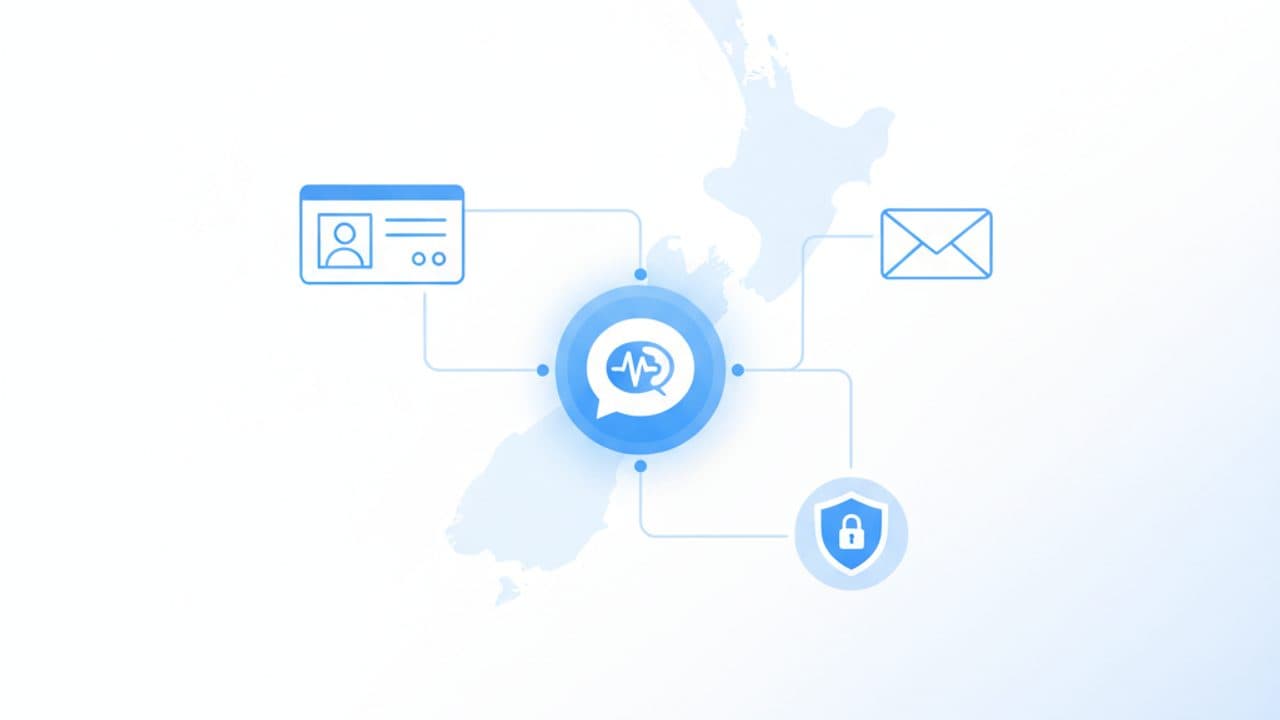
Yes - the Privacy Act 2020 applies to every AI tool a New Zealand marketing team uses, from ChatGPT drafts to CRM scoring and website chatbots, because the Act is technology-neutral and New Zealand has no separate AI statute. The rules that matter most for marketers right now are the 13 information privacy principles (IPPs), the new IPP 3A notice duty for personal information you get from someone other than the person (in force since 1 May 2026), the Privacy Commissioner's generative AI expectations, the Biometric Processing Privacy Code for facial and voice AI, and the Unsolicited Electronic Messages Act for any AI-written email or text.
This guide translates those rules into marketing workflows: what you can paste into an AI tool, which IPP each workflow touches, what to ask an AI vendor, how AI-written campaigns stay inside the spam law, and how New Zealand differs from Australia's December 2026 automated decision-making rule. Every date below was checked against privacy.org.nz, legislation.govt.nz, justice.govt.nz and dia.govt.nz on 2 November 2026. It is general information for marketers, not legal advice.
Key takeaways
- The Privacy Act 2020 covers AI use in New Zealand with no carve-out. The Office of the Privacy Commissioner (OPC) says the IPPs apply whether you build AI tools, buy them, or staff use them informally.
- IPP 3A came into force on 1 May 2026. If you get personal information from a list provider, partner, enrichment tool or agency, you must take reasonable steps to tell people, unless an exception applies.
- The OPC's default position: don't put personal information into a generative AI tool unless the provider has explicitly confirmed it won't retain or disclose it.
- An offshore AI provider that only stores or processes data for you is not an IPP 12 overseas disclosure - but one that uses your inputs for its own purposes, such as training, may be.
- The Biometric Processing Privacy Code has applied to new processing since 3 November 2025, and the grace period for existing systems ended on 3 August 2026. Emotion prediction and attention tracking are heavily restricted.
- AI-written emails and texts are still commercial electronic messages: you need consent, a clear sender identity and an unsubscribe that is actioned within five working days.
Does the Privacy Act 2020 apply to AI marketing tools?
Yes. The OPC's position is that the Privacy Act applies to everyone using AI tools in New Zealand, and its September 2023 guidance on AI and the IPPs says the principles apply "whether you're building your own AI tools, using AI tools to support decision making, or have team members who are informally using AI in their work", and also where overseas organisations provide AI tools for use in New Zealand. The Act is technology-neutral: it regulates what you do with personal information, not which software does it.
Personal information means information about an identifiable individual. In marketing that includes names and email addresses, but also CRM notes, purchase histories, call recordings, chat transcripts, loyalty data, photos and voice clips. The moment any of that goes into a prompt, a fine-tuning file, an AI-powered CRM or a chatbot log, the IPPs apply to that step.
Does New Zealand have an AI law like the EU AI Act?
No. New Zealand has taken what Bell Gully calls a "light touch" approach to AI regulation: there is no AI-specific statute, so the Privacy Act 2020, its codes of practice and existing consumer and marketing laws do the work. That makes the Privacy Commissioner's guidance the closest thing to an AI rulebook a New Zealand marketer has.
Which privacy principles matter when marketers use AI?
All 13 IPPs (plus the new IPP 3A) can apply, but they bite at different points in an AI workflow. The OPC groups them as collection (IPPs 1-4), use and protection (IPPs 5-10) and sharing (IPPs 11-13). The table maps each one to the marketing situation where it most often matters and the practical action that follows.
| IPP | What it requires | Where it bites in AI marketing | Action |
|---|---|---|---|
| 1 - Purpose | Collect only what you need for a lawful purpose | Collecting extra data "in case the AI can use it later" | Write down the purpose before connecting a data source to an AI tool |
| 2 - Source | Collect from the person where possible | AI prospecting and enrichment tools that pull data from elsewhere | Prefer first-party data; record why indirect collection was needed |
| 3 - Tell people (direct) | Say what you collect, why and who gets it | Chatbots and forms whose data feeds AI tools | Update privacy notices and chatbot openers to mention AI use |
| 3A - Tell people (indirect) | Notify when you collect from a third party (from 1 May 2026) | Bought lists, partner data, agency-supplied lists, enrichment | Build a notification step into list onboarding (see below) |
| 4 - Manner | Collection must be lawful, fair and not unreasonably intrusive | Scraping social profiles to train or prompt a model | Avoid scraping private or login-gated content |
| 5 - Security | Reasonable safeguards against loss and misuse | Prompts and chat logs stored by the AI provider | Use business tiers, access controls and retention settings |
| 6 - Access | People can ask for their information | AI-generated profiles, scores and summaries about a customer | Know where AI outputs about a person are stored so you can find them |
| 7 - Correction | People can ask you to correct it | Wrong inferences an AI wrote into a CRM record | Make AI-generated fields editable and traceable |
| 8 - Accuracy | Check accuracy before you use or disclose | Hallucinated facts in AI-written personalisation | Human review of anything that states a fact about a person |
| 9 - Retention | Keep it no longer than needed | Old exports sitting in AI workspaces and uploaded files | Set deletion schedules for AI workspaces |
| 10 - Use limits | Use only for the purpose collected, or a directly related one | Reusing customer-service transcripts to train a sales model | Check the original purpose before reusing data for AI |
| 11 - Disclosure | Disclose only on a permitted ground | An AI vendor that uses your inputs for its own purposes | Choose tools whose terms stop training on your inputs |
| 12 - Overseas disclosure | Extra conditions for sending data offshore | Offshore AI providers that use data for their own purposes | Check the IPP 12 grounds or keep the provider as your agent only |
| 13 - Unique identifiers | Limits on assigning and using unique IDs | Re-using another agency's ID (such as an IRD number) as a customer key in an AI system | Use your own identifiers and keep them out of prompts |
Can you paste customer data into ChatGPT or other AI tools in NZ?
Only with care, and the OPC's starting point is "don't". Its generative AI expectations say personal or confidential information should not be entered into a generative AI tool unless the provider has explicitly confirmed that it will not retain or disclose it. The AI guidance uses a landlord writing letters to tenants as its example: the landlord is an agency under the Act, so they "should avoid putting personal information into AI tools", and should first check whether the provider stores inputs and whether it uses them to train its systems.
For marketers, that translates into a simple rule: generic work is fine, identifiable work needs a decision. The table below sorts common AI marketing tasks by how much personal information they usually involve.
| AI marketing task | Personal information involved? | Main rules engaged | Lower-risk way to do it |
|---|---|---|---|
| Drafting blog posts, ad copy, landing pages | Usually none | None, if no personal details are entered | Keep prompts generic; never paste customer quotes with names |
| Summarising reviews or survey comments | Often (names, details in free text) | IPPs 5, 10, 11, 12 | Strip names and contact details before upload |
| Segmenting a CRM list with an AI tool | Yes | IPPs 1, 5, 8, 10, 12 | Use a tool under a contract that stops training; run a PIA |
| Website chatbot that answers customers | Yes (whatever visitors type) | IPPs 3, 5, 6, 8, 9 | Tell visitors it is AI, set log retention, test accuracy |
| AI prospecting or data-enrichment tools | Yes, collected indirectly | IPPs 2, 3A, 4, 8; UEMA | Notify under IPP 3A; never email without consent |
| AI-personalised email or SMS campaigns | Yes | IPPs 8, 10; UEMA | Human review of personal facts; consent records |
| Call recording transcription and sentiment | Yes, and voice can be biometric | IPPs 3, 5, 10; possibly the biometrics code | Tell callers; avoid emotion inference |
| In-store or screen-based camera analytics | Yes, biometric | Biometric Processing Privacy Code | Proportionality assessment before you start |
One mechanism to understand: when you put information into a tool, the question is whether the provider is acting only as your agent (storing and processing for you) or using the information for its own purposes. The OPC guidance notes that providers "may not ring-fence information you provide from other information they hold", which is why it suggests preferring tools that run offline or "AI tools where the contractual terms stop the provider from using input data for training".
What is IPP 3A and when did it start?
IPP 3A is a new notice duty for indirect collection, and it has been in force since 1 May 2026. It was added to section 22 of the Privacy Act by the Privacy Amendment Act 2025, which received Royal Assent on 23 September 2025. The Ministry of Justice confirms the 1 May 2026 date and notes the change is intended to help New Zealand keep its EU adequacy status. The Act's transitional provision means IPP 3A does not apply to personal information collected before 1 May 2026.
Under the OPC's IPP 3A guidance, when you collect personal information from a source other than the individual, you must take reasonable steps to make the person aware of:
- the fact that the information has been collected;
- the purpose of the collection;
- the intended recipients;
- your name and address as the agency collecting and holding it;
- any law that authorises or requires the collection; and
- their rights to access and correct the information.
Timing: notice is due "as soon as reasonably practicable after the information has been collected", unless the person has already been told. If you delay, you should be able to justify the delay and record your reasoning. MinterEllisonRuddWatts' summary of the final OPC guidance adds two points marketers often miss: inconvenience or cost alone does not exempt you, and if you regularly share with particular recipients you should name them or describe them as specifically as possible, so a vague "our partners" is unlikely to be enough.
Does IPP 3A apply to bought lead lists, enrichment tools and partner data?
Yes, all of these are indirect collection, which is exactly what IPP 3A targets. The OPC's own guidance includes marketing examples worth knowing:
- Partner contact lists: a business that received a list from a partner agency for a campaign several weeks away deferred its notice until the campaign started, and the OPC treated that as a reasonable timeframe.
- Loyalty data: using loyalty card data to build shopping profiles for targeted advertising does not fall within the "would not prejudice the individual" exception.
- Referrals: a business whose form names the partner it refers clients to, and links to that partner's privacy policy, lets the partner rely on the person already being aware.
- Social media: the publicly available exception may apply to public social media pages, but not to private accounts you can only see as a friend or follower.
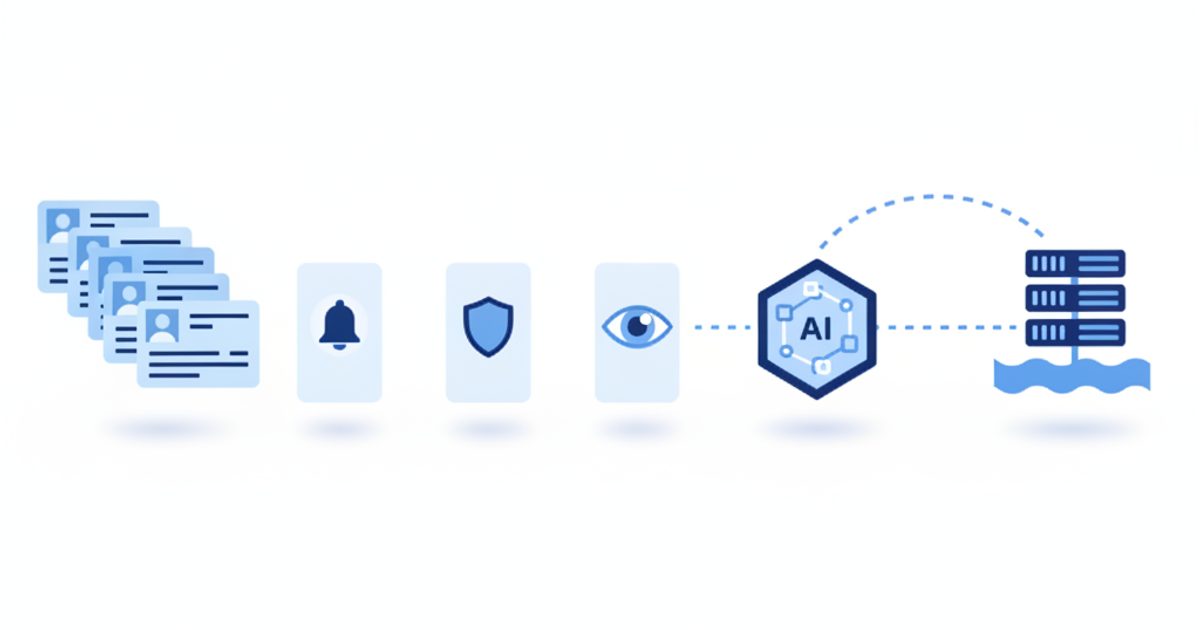
AI makes indirect collection easier than ever: enrichment tools append job titles and phone numbers, prospecting agents compile contact lists, and social listening tools collect posts at scale. Each of these brings personal information in from a third party, so each needs an IPP 3A decision.
How to build IPP 3A into an AI-assisted list workflow
- Map every indirect source. List each tool, partner, agency and data provider that sends you personal information, including AI enrichment and prospecting tools.
- Check what the source already told people. If you rely on the "already aware" exception, keep evidence, such as a copy of the source's privacy notice naming you or your category.
- Decide on an exception or a notice for each source. Record which exception applies and why, or choose the notice channel (first email, onboarding message, SMS).
- Write the notice. Cover the six matters above in plain language, naming recipients specifically.
- Put it in contracts. Ask list providers and partners to give the notice at their first contact, as Bell Gully and others suggest, while remembering the duty stays yours.
- Remember the spam law is separate. An IPP 3A notice is not consent to send marketing email - that needs UEMA consent (covered below).
What does the Privacy Commissioner expect from businesses using generative AI?
The Commissioner published eight expectations for agencies considering generative AI on 15 June 2023, and the page is still live as at 2 November 2026, noting it is "subject to change". Several 2023 law-firm summaries list seven; the current OPC page lists eight, including engagement with Māori as a separate expectation. Here they are, with what each means for a marketing team:
- Senior leadership approval based on a full consideration of risks and mitigations. In practice: an AI tool register signed off by someone accountable, not tools adopted ad hoc by individual marketers.
- Review whether the tool is necessary and proportionate, or whether an alternative approach would do. Drafting a headline does not need customer data; a segmentation project might.
- Conduct a privacy impact assessment (and/or algorithmic impact assessment) before use, including feedback from affected communities and a review of the provider's published privacy information.
- Be transparent with customers about how, when and why the tool is used, in plain language, before collecting their information - with particular care for children.
- Engage with Māori about potential impacts on their communities and taonga, ideally developing risk procedures with tangata whenua.
- Develop procedures for accuracy and access, so you can check outputs before use and handle access and correction requests.
- Have a human review outputs before acting on them.
- Don't enter personal or confidential information unless the provider has explicitly confirmed it won't retain or disclose it; consider stripping re-identifying details first.
The later AI guidance adds a caution on the human-review point: for higher-risk automated decisions, "simply having a 'human in the loop' may not be enough" because of automation blindness, so reviewers need the time, authority and resourcing to actually overrule the tool. For marketing, the higher-risk decisions are things like AI-driven eligibility for offers, credit-linked promotions, or excluding people from pricing - not choosing a subject line.
Is using an overseas AI provider an IPP 12 disclosure?
Not if the provider only stores or processes the information for you. The OPC AI guidance says plainly: "Using offshore technology providers to store or process your data is not treated as a disclosure under IPP12, so long as they are not using that information for their own purposes." Whether IPP 12 applies "may depend on the details of AI tool being used", so you need to check whether information you share is used for purposes beyond yours - training being the obvious one.
If the provider does use your inputs for its own purposes, IPP 12 allows disclosure to a foreign person or entity only on specific grounds, including:
- the person authorises it after being expressly told the recipient may not offer comparable protection;
- the recipient carries on business in New Zealand and you reasonably believe it is subject to the Privacy Act;
- you reasonably believe the recipient is subject to privacy laws with comparable safeguards, or to a prescribed binding scheme or prescribed country's laws; or
- you otherwise reasonably believe the recipient must protect the information comparably, for example under an agreement such as the OPC's model contract clauses.
Either way, the OPC is clear that "you remain responsible for protecting that information" when a third-party system handles it.
Data residency and vendor questions to ask before you sign
Most AI tools New Zealand marketers use are hosted offshore, so data residency is a question for the contract, not an assumption. Ask every AI vendor these questions in writing and keep the answers with your PIA:
- Do you use our prompts, uploads or outputs to train or improve your models? Can that be switched off by contract, not just by a setting?
- Where are our prompts, files and logs stored and processed? Can we choose a region?
- How long do you retain prompts and outputs, and can we set a shorter period or delete on request?
- Do you act only on our instructions, or do you use the data for any purpose of your own?
- Which sub-processors handle our data, and in which countries?
- Which staff can access our data, and under what controls?
- How and when will you tell us about a security incident affecting our data?
- Can we export everything you hold about a specific person, so we can answer an access request?
- Do any features perform face, voice or other biometric analysis?
- What happens to our data when the contract ends?
Does the Biometric Processing Privacy Code apply to facial or voice AI?
Yes, if your marketing uses technology to verify, identify or categorise people from their face, voice or other physical or behavioural features. The Biometric Processing Privacy Code 2025 was issued on 21 July 2025 and, as verified on privacy.org.nz on 2 November 2026:
- has applied to new biometric processing since 3 November 2025;
- gave agencies already using biometrics a nine-month transition, which ended on 3 August 2026, so it now applies to all processing;
- was changed by Amendment No 1 (March 2026) to reflect IPP 3A, with the consolidated version in force from 1 May 2026.
For biometric information, the Code's 13 rules replace the 13 IPPs. According to the OPC's summary, the key new obligations are an effectiveness and proportionality assessment, safeguards to reduce privacy risk, transparency about when and why a biometric system is in use, and "safe limits": highly intrusive uses such as emotion prediction, attention tracking or inferring sensitive information like ethnicity or sex are only permitted in limited situations, such as aiding people with disabilities, keeping people safe, or research.
Marketing uses that clearly need a Code assessment include in-store cameras that estimate shoppers' age, gender or mood, digital screens that track whether people look at an ad, and voice recognition that identifies returning callers. Using a fully synthetic AI voice or face that is not based on a real person involves no one's biometric information. Cloning a real staff member's voice for ads is less clear-cut: it may fall outside the Code's verify, identify or categorise scope, but the recordings are still that person's personal information under the Act, so get their informed agreement and take advice.
Do AI-written marketing emails have to follow the Unsolicited Electronic Messages Act?
Yes. The Unsolicited Electronic Messages Act 2007 (UEMA) regulates commercial electronic messages regardless of whether a person, a template or an AI model wrote them, and regardless of whether a person or an automated agent pressed send. The Department of Internal Affairs (DIA) enforces it, and its guidance for businesses says it covers email, fax, instant messaging and text messages, but not phone calls or website pop-ups. A single message can be spam; it does not need to be sent in bulk.
| UEMA requirement | What it means | AI-specific trap |
|---|---|---|
| Consent | Express, inferred or deemed. The sender carries the onus of proving consent. DIA does not consider that consent can reasonably be inferred from a single transaction. | An AI prospecting tool finds an email address; that is not consent. A colleague's referral made without the person's knowledge is not consent either. |
| Deemed consent | Only where an address is conspicuously published in a business or official capacity, with no "no spam" statement, and the message relates to that role. | AI tools that scrape addresses from websites ignore the "relevant to their role" condition. |
| Sender identity | Clearly and accurately identify the sender and how the recipient can contact them. | AI-generated personas or sender names that hide the business behind them. |
| Unsubscribe | A functional, free unsubscribe in every message, honoured within five working days, starting the day after the request. | Unsubscribes that don't sync to the AI or automation tool sending the next sequence. |
| No address harvesting | You cannot use software to collect addresses for messages people have not agreed to receive. | Many AI "find any email" tools work exactly this way. |
| Penalties | DIA says failure to comply could mean a fine of up to NZ$500,000. | An AI agent can send many non-compliant messages before anyone notices. |
Two more points from DIA's FAQ and commercial messaging page: verbal consent is valid but you should record it, and adding a hyperlink to your company's site in the signature of an otherwise non-commercial email can make it a commercial message. Transactional messages, such as quotes requested by the person, order confirmations and warranty or safety information, are not commercial electronic messages and do not need the consent, identity and unsubscribe elements.
How is New Zealand different from Australia's 10 December 2026 rule?
New Zealand has no equivalent of Australia's automated decision-making transparency rule. Across the Tasman, the Privacy and Other Legislation Amendment Act 2024 added requirements (APP 1.7-1.9) that apply from 10 December 2026: privacy policies must explain where personal information is used in automated decisions that could significantly affect individuals. Bell Gully's May 2026 guide flags that rule as an overseas development New Zealand businesses should watch. We cover what it means for Australian marketers in Australia's Privacy Act ADM rules for marketers.
| Issue | New Zealand (as at 2 November 2026) | Australia |
|---|---|---|
| Main law | Privacy Act 2020, 13 IPPs plus IPP 3A | Privacy Act 1988, 13 Australian Privacy Principles |
| Newest marketing-relevant change | IPP 3A indirect collection notice, in force 1 May 2026 | ADM transparency in privacy policies (APP 1.7-1.9), from 10 December 2026 |
| Automated decision disclosure | No specific duty; the Commissioner is asking for "stronger protections" | Required in the privacy policy for decisions that could significantly affect individuals |
| AI-specific regulator guidance | OPC generative AI expectations (2023) and AI and the IPPs guidance (2023) | OAIC guidance (see our Australian article) |
| Biometrics | Dedicated Biometric Processing Privacy Code 2025 | Handled as sensitive information under the APPs |
| Anti-spam law | Unsolicited Electronic Messages Act 2007 (DIA) | Spam Act 2003 (ACMA) |
If you market on both sides of the Tasman, the practical answer is to design for the stricter rule on each point: IPP 3A-style notices for indirect data, and an Australian-style ADM paragraph in your privacy policy if any AI tool makes decisions that significantly affect customers.
What happens if you get AI privacy wrong in New Zealand?
Today the main consequences are complaints, investigations and reputational damage rather than large fines under the Privacy Act. People can complain to the OPC, which can investigate and issue compliance notices, and complaints can proceed to the Human Rights Review Tribunal. If an AI-related incident is a privacy breach that has caused or might cause serious harm - for example, a chatbot log or an uploaded customer file being exposed - you must notify the OPC and affected people "as soon as practicable"; the OPC suggests aiming for 72 hours.
That may change. On the Act's fifth anniversary (1 December 2025), the Commissioner called for reforms including "significant fines, and real consequences", a right to erasure, and stronger protections for automated decision-making, saying "people should know why an automated decision is taken against them". The same statement reports that three quarters of people in the OPC's March 2025 privacy survey supported audit powers and fines. As at 2 November 2026 these are proposals, not law. Under the UEMA, the financial risk is already real: up to NZ$500,000.
AI marketing privacy checklist for New Zealand teams
Use this as a working checklist for each AI tool or workflow. It reflects the sources above as at 2 November 2026.
| # | Check | Rule it supports |
|---|---|---|
| 1 | Keep a register of every AI tool marketing uses, with an accountable approver | OPC expectation 1 |
| 2 | Record the purpose of each data flow into an AI tool | IPPs 1 and 10 |
| 3 | Run a privacy impact assessment for any tool that touches personal information | OPC expectation 3 |
| 4 | Ban pasting identifiable customer data into consumer AI tools; strip names first | OPC expectation 8, IPP 5 |
| 5 | Get written vendor answers on training, retention, location and sub-processors | IPPs 5, 11, 12 |
| 6 | Update the privacy notice and chatbot opener to say how AI is used | IPP 3, OPC expectation 4 |
| 7 | Map indirect data sources and decide on an IPP 3A notice or exception for each | IPP 3A |
| 8 | Name recipients specifically in notices, not "our partners" | IPP 3A guidance |
| 9 | Human review of any AI output that states a fact about a person | IPP 8, OPC expectation 7 |
| 10 | Make AI-generated CRM fields findable and editable for access and correction requests | IPPs 6 and 7 |
| 11 | Set retention and deletion rules for AI workspaces, uploads and chat logs | IPP 9 |
| 12 | Assess any face, voice or emotion analysis against the biometrics code before use | Biometric Processing Privacy Code |
| 13 | Hold consent records for every address an AI-assisted campaign emails or texts | UEMA consent |
| 14 | Sync unsubscribes across every sending tool within five working days | UEMA unsubscribe |
| 15 | Add AI incidents (exposed logs, wrong recipients) to your breach response plan | Privacy Act breach notification |
| 16 | Consider impacts on Māori communities and data for customer-facing AI | OPC expectation 5 |
Privacy is one part of running AI-era marketing well in New Zealand. For the visibility side - how New Zealanders now find businesses through Google AI Overviews and chat assistants - see our guide to AI search in New Zealand and our NZ SEO guide. If AI answers already say something inaccurate about your business, our guide to fixing wrong AI answers about your brand covers the correction workflow.
Not legal advice. This article is general information for marketers, written from the primary sources linked above and checked on 2 November 2026. It is not legal advice and does not cover every exception or sector code (for example, the Health Information Privacy Code). Laws and OPC guidance change; for decisions about your own data, talk to a New Zealand privacy lawyer or contact the Office of the Privacy Commissioner.
If you track how AI engines describe your brand, AI Rank Lab (our product) runs the generic questions customers ask - no customer data needed in a prompt.
Get a free AI ranking consultation
Want your brand to show up when ChatGPT, Gemini and Perplexity answer questions in your market? Tell us about your site and our team will send a personalized strategy.


