

The AI visibility loop
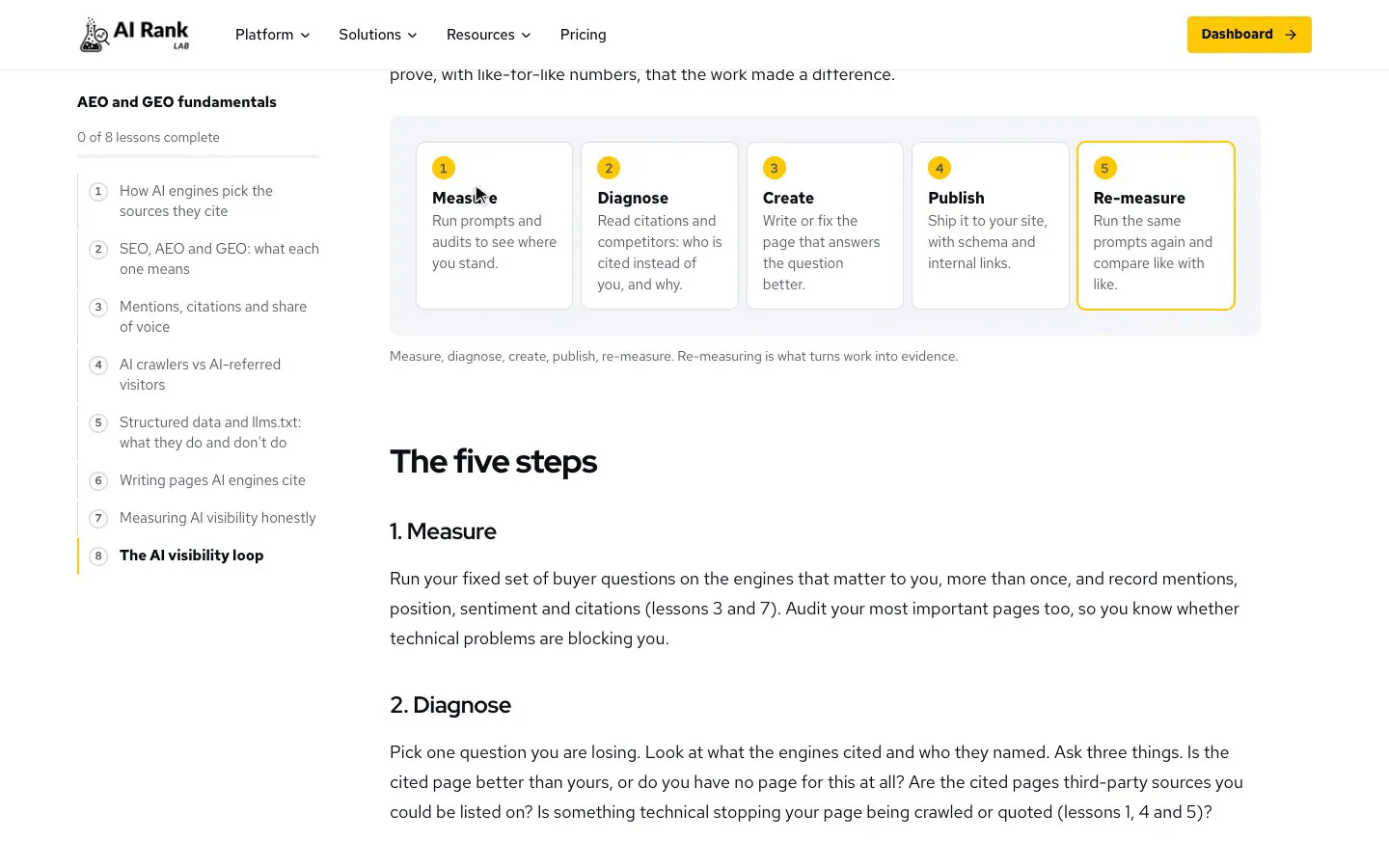
Measure, diagnose, create, publish, re-measure: the workflow the rest of the Academy teaches.
Listen to this lesson · 2:58
In shortThe AI visibility loop is a five-step routine: measure where AI engines mention and cite you, diagnose who they cite instead and why, create or fix the page that answers the question better, publish it so it can be crawled, then re-measure the same questions on the same engines. Each pass teaches you something about one question. Repeating it, question by question, is how visibility grows.
Why a loop and not a checklist
AI search doesn't have a finish line. Engines change their models, competitors publish, and answers vary from run to run. A one-off audit tells you where you stood on one day. A loop gives you a way to keep improving and to prove, with like-for-like numbers, that the work made a difference.
- MeasureRun prompts and audits to see where you stand.
- DiagnoseRead citations and competitors: who is cited instead of you, and why.
- CreateWrite or fix the page that answers the question better.
- PublishShip it to your site, with schema and internal links.
- Re-measureRun the same prompts again and compare like with like.
The five steps
1. Measure
Run your fixed set of buyer questions on the engines that matter to you, more than once, and record mentions, position, sentiment and citations (lessons 3 and 7). Audit your most important pages too, so you know whether technical problems are blocking you.
2. Diagnose
Pick one question you are losing. Look at what the engines cited and who they named. Ask three things. Is the cited page better than yours, or do you have no page for this at all? Are the cited pages third-party sources you could be listed on? Is something technical stopping your page being crawled or quoted (lessons 1, 4 and 5)?
3. Create
Write or rewrite the page that answers the question better than what is cited now: answer first, specific facts with sources, a clear entity and something original (lesson 6). If the gap is a third-party list, the work may be outreach rather than writing.
4. Publish
Publish it where crawlers can reach it, with accurate structured data and internal links from related pages. Make sure it's indexable and not blocked for the search crawlers. Then give it time: engines have to crawl and index it before they can retrieve it.
5. Re-measure
Run the same question on the same engines again, several times, and compare with your baseline. Same question, same engines, same competitor list. If you are mentioned or cited more often across runs, keep going. If not, go back to step 2 with what you learned.
A bookkeeping firm asks "best bookkeeping service for small restaurants" on three engines, three times each. It is named in 1 of 9 answers. The cited pages are two comparison articles and a competitor's guide to restaurant bookkeeping with a pricing table. The firm has no page on restaurants. It writes one, with real prices, a checklist and a client example, publishes it, asks one comparison site to update its listing, and re-runs the same nine answers a few weeks later.
Where each step lives in AI Rank Lab
| Step | Tool | Sidebar path | Lesson |
|---|---|---|---|
| Measure | Prompt research, Visibility overview, AEO and GEO checker | AI search → Brand visibility; AI search → AEO and GEO checker | Run prompts across AI engines |
| Diagnose | Citations, Competitors, Action plan | AI search → Brand visibility | Find who gets cited |
| Create | AI content writer | Content → Write → AI content writer | Write your first article |
| Publish | WordPress and webhooks | Content → Publish → WordPress and webhooks | Connect WordPress |
| Re-measure | Prompt research, Progress reports | AI search → Monitoring and reports → Progress reports | Build a comparison |
Action plan joins diagnose and create: it reads the pages cited for a prompt you're losing and turns them into topic briefs that the AI content writer can draft from. After you publish and save the URL, you can switch on weekly citation tracking for that prompt. That is the only automatic re-check in the product; every other prompt runs when you run it.
A realistic rhythm
- Weekly: check the prompts you're tracking after recent changes, review the weekly citation checks, and pick the next question to work on. See A 30-minute weekly routine.
- Monthly: re-run the full question set, compare with last month like for like and report. See The monthly client report.
- Per page: one question, one page, one loop. Small, focused passes are easier to learn from than a site-wide rewrite.
Changing the question set between measurements, so before and after can't be compared. Re-measuring too soon, before the new page has been crawled and indexed. And judging the result on a single run. Each one makes good work look like failure, or the reverse.
Check yourself
0 of 3 answered.
Progress is saved in this browser.
Transcript
Put the lesson to work
Paste your site and get a free SEO, AEO and GEO audit with the fixes, then come back to the next lesson.